Adventures in Storytelling 4

Entry 4, Carpe editorem, occide…continued.   

In my last entry I outlined four points that needed addressing in P1. I left off in the middle of my second round of editing and highlighted that I use my own tools to help identify my strengths and weaknesses. I made a list and focused on the nuts and bolts, things like -ly words and passive voice.

I want highlight one of the other two issues identified: lore/worldbuilding mistakes and inconsistencies; and, there are some things I simply don’t like.

I’m going to start with the first—lore/worldbuilding—because it’s easier to answer.

There is no end to the discourse regarding “worldbuilding.” There are endless books and articles on the topic, various charts and step-by-step guides on how to “build unique and imaginative places.” And that’s great, sometimes people need a guide.

Once you’ve come to understand the need for worldbuilding and mastered the concepts, your next step is to debate endlessly about when and where to use it, what qualifies as worldbuilding, and when its really just an infodump?

I’m not going to bore you with a lengthy discourse. I believe thoroughly that if you are writing, you are worldbuilding. Every sentence is an opportunity to build and deepen the unique flavor and culture of a world. It should be done in every kind of story, regardless if the setting is New York City or some far-flung elfland.

The danger with worldbuilding lies in the fact that sometimes it is an infodump.

In P1, I found that I didn’t really have a problem with infodumping. I killed that problem in one of my first drafts, working and reworking paragraphs and conversations to move information in a smoother way. I classified lore and worldbuilding information into two categories: absolutely necessary, and trivia.

Lore that is absolutely necessary is lore that is needed in order for the plot and the character’s actions to make sense. It is necessary to suspend a reader’s belief. For example, P1’s co-protagonist, R, has a background before meeting protagonist E. R’s background includes connections to an organization with an extensive history. That history must be told for R’s actions to make sense. Without that lore, R’s movements and thoughts become schizophrenic—unmoored from the reality of the story.

Lore classified as trivia is the nice little accoutrements that make a story unique, pretty, realistic. It’s the way someone styles hair or takes their tea. It’s how the road shunts to the left or how the flowers were blooming late in the mild spring. Fine details, those little things whose inclusion adds color but absence results in no serious loss to the central action of the story.

The issue was just how much lore I had.

If you recall from Adventures in Storytelling 1, I started P1 because a sense of overwhelming vastness that plagued my first abortive attempts at putting Project Paisley on paper. I knew I had something; I just wasn’t sure where to go with it. P1 was started to help me congeal—so to speak—my world.

In that, I would say I was successful. I believe the world I’ve created is colorful and realistic. Is it perfect? Of course not! But I think I have a world that is interesting and engaging. It’s made up of several counties, each with their own unique cultures.

That said, I didn’t start out that way. While writing, I spent a lot of time thinking about P1’s setting.

The main setting of P1 is an island-bound city, at the risk of oversharing, when thinking about this city I had two real cities in mind—London and Paris. I wanted to capture the things I liked about both cities. I thought deeply about how the ocean effects a city, it’s culture, government, etc. What considerations does an island-bound nation have to make regarding security? How does the sea change their food culture? What kind of jobs would their poor city-folk work? What of the prosperous?

In the end, I found myself asking, what would Paris be like if was actually on the coast of Normandy? What about London without the Thames?

My first draft was missing many of the key elements that I feel make this setting (as it’s written now) interesting. While I muddled through various technical problems, I found myself filling in the blank corners. Ordinary English idioms were rewritten to better relay the culture of a seafaring people, food became fish heavy, the peasantry became laborers and fishermen. I began to add these little details.

And that was just a single city. The religion of this world was terribly atrophied. I used a placeholder name for the main deity until a better name struck me in the middle of a slow work day. That bit of inspiration was just pure luck, the rest I had to force myself to sit down and think about.

When I began writing P1, I already had a small booklet that I jotted ideas in. It was in no way comprehensive, but it was helpful and allowed me to keep track of my thoughts.  

I’d written several notes about the religion of a particular civilization that acts as the “national antagonist” if that makes sense. This nation is in a strained relationship with the other nations. They’re less an actual threat and more a looming, invisible darkness that hangs over the characters like a Sword of Damocles.

With them, I had to ask myself, how weird am I willing to be? How strange and foreign do I go? I wanted to create a religion that would repulse all modern sensibilities. Something in the way of a mystery cult with elements of ancient fertility cults. I confided in some friends and the answer I got back is the same advice I would give to any writer. Be weird. Write what you want. Weird is where the fun is.

There is only one way to solve lore and worldbuilding inconsistencies. If its trivial, you can drop it. If it’s necessary, you alter it. Its perfectly possible for you to like the mistake more than the original idea. I’ve changed things to better match up with the mistake I made.

But, the more you have, the higher the chance for error. As I read through my second or third draft, I realized that my timeline was, well, fucked. I couldn’t keep my pacing tight. Things were moving either too quickly to be believable, or too slowly. Fixing this is easier said than done. I haven’t completely fixed it.

Before my most recent draft I sat down and did two things.

First, I worked out a primitive timeline. I went event by event and found that a perceptive reader would quickly take note of the awkwardness of the pacing. Conflict was happening so frequently that despite my clear delineation of day and night, it didn’t feel like there was enough time between problem and resolution.

Now, of course, piling catastrophe on catastrophe is part of being a writer. The action happens in between conflict and resolution. Because my story has a high element of political chaos, it was necessary for the conflicts to coalesce, or the solution to become a problem later in the plot. But I couldn’t make the pacing feel natural. I had to sit down and write it out, event by event, piece by piece, until I understood exactly what I was looking at.

I remain uncomfortable with my current timeline; I am working on fixing the pacing.

The second thing I did was go through each chapter and take out everything I could find that was lore related. I placed it all in a master document. This list has become an augmentation to my original booklet. I refer to it as needed. Now, anything inconsistent or repeated is glaringly obvious. By listing each piece of lore/worldbuilding with the chapter it was found in, I am now able to refer and correct.

You’ll note that these aren’t really solutions. They’re more like guides. The tasks I’ve made for myself are monumental and they cannot be solved in a few short sessions. As I write this entry, I’m actively in the middle of these corrections. I’m not foolish enough to think that I can work a perfect draft. Eventually, I will have to give in and let the story escape.

It’s hard to pinpoint a lesson when you’re actively attempting to fix something. The only thing I could offer my past self is this:

Writing is work, but a good story deserves your attention. Even if you can only work small pieces at a time, keep chipping away. Every correction, every setback, every mistake makes you a better writer.

Above: a view from the Paris Catacombs. Consecrated in 1786, the Catacombs are the final resting place of countless Parisian dead. May the souls of the faithfully departed, through the mercy of God, rest in peace.

Writer’s Review: The Secrets to Creating Character Arcs

Before I began writing these reviews, I had a simple criterion for selecting a how-to-write book: I judged the cover.

The cliché “never judge a book by its cover” is more like an aspiration, sort of like “reach for the stars.” No one is actually going to reach up and grab a star and no one is ever going to not judge a book by its cover.

I admit, it’s not a great method. But, when it comes to reading into a topic where you’re not really sure where to start, it’s a utilitarian method. I mean, how else are you supposed to select a book? Considering the books in this genre are designed for mass-appeal you just have to dive in.

Today’s book is one of those I selected based on the cover. I just like it, its simple and striking.         

The Secrets to Creating Character Arcs: A Fiction Writer’s Guide to Masterful Character Creation (Growing Authors out of Writers) by John S. Warner

I can’t tell you anything about John S. Warner. He has a Facebook and a Goodreads page, but it appears that everything he writes is how-to-write books. I have no problem with this, readers are the best at telling writers what they want to read.

The Secrets to Creating Character Arcs: A Fiction Writer’s Guide to Masterful Character Creation (Growing Authors out of Writers) is made up of ten chapters with an introduction and concluding remarks. It’s a little less than 200 pages, making it a quick and easy read.

Warner starts the book with a quick explanation of what he calls The Holy Trinity: Plot, Structure, and Characters. A good story, he writes, is made of this union. I can agree here, but this isn’t really ground breaking. It took a few more chapters for me to finally feel like I was getting something worthwhile from this book.  

Warner’s next step is to discuss the Trinity in further detail. He starts with plot. He provides some advice.

  • Your plot should provide a smooth flow to the story
  • The focus of your plot should be on the leading characters of your story
  • Your plot should have a clear insight into your protagonist’s psyche
  • The plot should start with a bang
  • Your plot should grab the emotions of your readers, but let go in the end

Again, nothing here that I wouldn’t call intuitive to the practicing writer.

However, once he begins breaking down what he means by plot points, I feel like we’re finally getting into some nitty-gritty. It was about here that I began to enjoy it. You see, this book falls into a category I would classify as a “beginner’s basics” or an “expert’s vindicator.”

What Warner begins to discuss now are the seven plot points.

  • Inciting incident
    • First point
      • First pinch
    • Midpoint
      • Final pinch
    • Second point
  • Resolution

He fleshes out each bullet point and then describes how the arrangement of these points is structure.

I then began to contrast what Warner was writing with my own personal techniques. I saw how they differed and how they overlapped. I realized that I didn’t need to read this book, but I wanted to. Warner’s book was simple enough that it was making me think about my own theories.

Warner calls it plotting—writing down the desired events of your story—I call it wish-listing. When it comes to ordering these points, we both call it structuring. These are just a few examples of our overlapping.

Warner dedicates a good chunk of the book to some quick outlines of various, popular structures like Save the Cat’s Beat Sheet and the Fichtean Curve. This a helpful for someone who is not familiar with these structural modes or for someone who wants a refresher.

Once Warner finishes up his explanations of the first aspects of the trinity, he moves on to the real red meat of the book: characters and characterization.

He begins with the bones of a character—what he calls the three pillars of characterization. They are Physical Characterization, the distinct physical details of your character like a scar, scabby knees, or left-handedness. Psychological characterization, those psychological details that help you build a character’s personality, their fears, biases, secrets. Lastly, social circumstances, your character’s place in a society, their school, profession, etc.

I appreciate that Warner writes on archetypes, but stays away from the traditional Jungian archetypes. He keeps it minimal, focusing on Protagonists, antagonists, mentors, sidekicks, and skeptics.

Warner finishes the book with several chapters on crafting characters. He provides questions, some basic tips, and outlines to help you write. There isn’t really anything here to write home about.

Final Thoughts

As much as I enjoyed Warner’s Creating Character Arcs, I can’t say that there is much here for experienced writers. There were many sections that I found helpful for formulating my own ideas on writing, but I can see how that wouldn’t be useful for every writer.

Certainly, if you’re a beginner looking for a more structured way to craft characters, Warner’s book might be a good starting point.

Skippable, but useful for certain purposes.   

Don’t forget to check out the crowdfunding pages for Anvil Issue 2, where my short story, Afflicted: Nourritures les Ver, will be published! For more info, click here.

Hail, Iron Age!

I’ll be featured in the 2nd issue of Anvil: Iron Age Magazine. Updates are to come, but I expect publication in Fall 2023.

For now, I would direct you to their 1st issue. It’s been fully funded, but you can still use the Indiegogo page to purchase the 1st issue or reach out to campaign directly. Publication for issues one is expected in July 2023.

Anvil promises to be an aggregator of indie IPs, especially drawing from the tradition of pulp fiction and comics. If this is the kind of writing you’re interested in, check out their website for more info.

I haven’t written much about my love of pulp, but when it comes to short stories, I draw much of my inspiration from the greats: Robert Howard, H.P Lovecraft, C.L Moore.

For this latest piece, I tapped into my inner C. L. Moore and wrote a female fantasy hero. But unlike Moore’s Jirel, I lean into the gross-out horror of 18th Century medicine. I want to see Amélia Mitre become a modern pulp hero worthy of my heroes.

Some exciting things are happening for me this year and I’m proud to share it with you. Further details are to come.

Update 07/24/2023: You can preorder Anvil: Iron Age Magazine Issue 2 here.

And, if you don’t already know, my short story, Egg, can be read in Cirsova 14, Spring 2023.

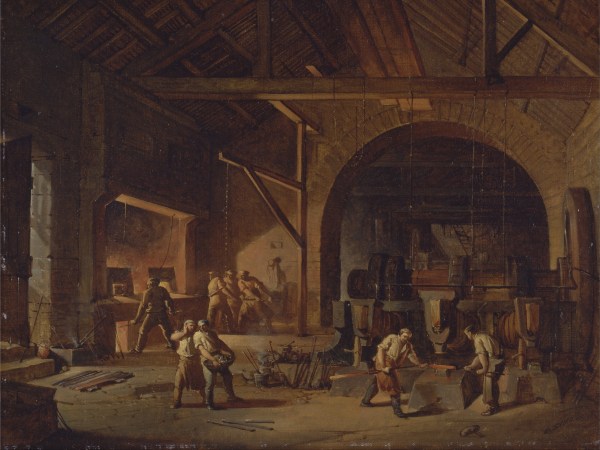
Above: Interior of an Ironworks. Godfrey Sykes (1825 – 1866) British Painter. Oil on Canvas. Housed at the Yale Center for British Art.

Adventures in Storytelling 3

Entry 3, Carpe editorem, occide. 

As I stated in the last entry, I learned it was okay to trust my instincts. But when it came to editing, I didn’t really know where to start. I read a couple books on editing, some more useful than others, and sort of just decided to start from the beginning. {read Storytelling 2, here}

I wrote Project Paisley’s P1 into three parts. As a finished draft, P1 was massive, as in, this-is-never-getting-published massive. It was a problem I was aware of while writing it. The seed had grown into a wild forest and was in need of serious cultivation if I was going to make anything of it.

While writing P1 I made heavy use of a tactic I call pre-editing (some call it backtracking). Pre-editing is when I go back to former chapters/sections in order to reread them. Sometimes this is done in order to refresh my memory, double check lore, or simply because I can’t do anything else. Often, if I see a mistake or I decided to rewrite something, I fix it. There are people who believe this is terrible for your writing, but I find helpful. Sometimes, I’ve gone back and read something really good and it’s inspired me or reminded me that I’m not utterly useless as a writer.

While working on part three I had some difficulty getting to my end. I took some time at the local library to print out the first part of P1. I learned from one of the aforementioned editing books that seeing your work in print instead of on a screen can help you distance yourself from it. I also learned that changing the font from your standard use font (like Times New Roman) to something less familiar (like Bahnschrift) provides further alienation.        

This technique, which I call alienation, works for me and I still use it. Placing distance between yourself and your work is like taking a break in a very torrid relationship. It can be incredibly difficult. You’ve spent hours, days, months, years with a particular project. Cutting yourself off from the creative process that held you in thrall for so long is like clipping off pieces of your own soul.

But you must cool that fire before you can really edit. Pre-editing, for all the use I got out of it, wasn’t helping me edit. It was creating a longer and more unwieldy draft. I spent so much time with part one that I had difficulty pulling away from it in order to finish part three. I ended up adding an entirely new section to part two, while I believe this worked out for the best, when I finally got around to finishing part three, I was dealing with a draft so large I knew that no company would publish it as a first novel.

Still, I persevered. I sent the draft to a printer in order to have the monstrosity printed and mailed to me. Note: don’t ever do this. It is cheaper to buy your own ink and paper, print from home in batches and store in a three-ring binder.

In 2019, I started a new fulltime job. Circumstances required me to shelve P1 for months.

Then, Covid happened, and I dusted P1 off. 2020 was a hard year for most of us, but opportunity lies in even the worst elements of chaos and hardship. Never pass up an opportunity to exercise your passion.  

Distance granted me clarity. But not crystal-clear clarity. More like, cold light of day, icy shower clarity.

That’s a little harsh, but you catch my meaning. There were things about my writing that shocked me. The overuse of -ly words, the abundance of had and so, the rambling sentences, the ones that ended randomly unfinished.

And that was just the technical stuff. There were lore errors, inconsistent naming, naming conventions I suddenly found that I hated…

But, as I went further and further into my first draft edit, I came to realize something. For all my mistakes, I enjoyed reading it. Sure, it was messy and unfinished, I had a hundred little things that needed fixing, plot threads that needed tying up (or cutting entirely), but it was good. Or, at least, it was good to me. It hit me as something I would like to read.             

Writing is an organic endeavor. Where you start shouldn’t be where you finish. This became abundantly clear when I took P1 off the shelf and began my first few rounds of editing. My ending was better than my beginning.

My skills as a writer improved dramatically from the first sentence to the last sentence. Both still needed work but the last sentence was in a much better state than the first.

I came away from my first draft feeling better than I expected. I wrote an end-of-edit letter to myself and stuck it in my binder to act as a rubric for my next move. In it, I outlined several things I needed to work on:

  1. My voice is passive, I need to own my words.
  2. If you see had or so, delete immediately/rewrite the sentence.
  3. Various lore and worldbuilding mistakes and inconsistencies.
  4. There are somethings here that I simply don’t like.  

By itemizing the issues in P1, I felt more confident and put it back on the shelf for another month.

I needed a break, editing is hard work, in many ways harder than writing. Editing engages our creative drive, but it also demands our reason. There were times where I found myself arguing over if I should delete a certain word or rework a sentence. More than once I crossed out a word only to mark it with a simple “ok” only to cross that out.   I started the next month, rested and ready. I used my end-of-edit letter to focus my second pass on the nuts and bolts of my writing. My voice was there, but it was buried under mountains of passive verbs and extraneous adverbs. Not to mention that I used the words had and so like crutches.

99% of the time, had and so are unnecessary and they take away from the active action of the characters turning them into passive meat puppets and robbing your voice of it’s confidence. “She had become tired” should be “she was tired.” “So she changed her plans” needs to be “she changed her plans.”

This paragraph: “She ran quickly, speeding down the hall and roughly turning the corner. She threw herself into the next room. Slammed the door and waited silently for the danger to pass.”

Became: “She ran. Her pace picked up speed, slowing as she rounded the corner. There! She spotted the first open door and threw herself into the room. She pressed against the door. Waited. Sweat slipped down her temple. She heard steps—stilled.”     

You’ll note that the second paragraph became longer and the sentence length became more varied. By removing the crutch of adverbs, I was forced to think more about the scene. How do you add tension without an -ly guiding the reader?

Variation is the spice of writing. Vary your sentence length. Vary your grammatical structure. Vary your verbs, nouns, etc. There is no reason sentences in fiction can’t be one word. Or twelve. I also vary my punctuation and my diction.

Note: I don’t want to make it seem as if this all happened between my first and second draft. Writing doesn’t work that way. One day I simply began to notice these changes in my writing. That being said, I’ve gone through four drafts of P1 and I’m currently rewriting most of it. I’ll address the last two issues in the next entry.    

These are my tools, pre-editing, alienation, end-of-edit letter, and variation. They go by different names, some people don’t like them, some don’t find them useful. And that’s okay. Writing is not carpentry. We craft our own tools and use them as we intend them; if it doesn’t work, we toss it out even if it works for someone else.   

Own the tools of your craft. Use them to help you identify your crutches and build the confidence to yank them out.  

A Simple Meal of Bread and Cheese

Some time ago, an old friend and I had a discussion set off by a fan fiction she was reading. She sent me a screen shot of something she thought was funny, or horrendous, I can’t remember. What I do remember was seeing the phrase “they stopped near midday and ate a simple meal of bread and cheese.” Immediately, without much context, I knew it was either an alternate history or a fantasy alternative universe (AU) because I’ve seen this deliciously terrible phrase in nearly every fantasy I’ve ever read.

A simple meal of bread and cheese evokes a strange, nostalgic feeling. It has the quality of a really good but utterly normal Christmas dinner. Or better yet, Holiday leftovers. When it’s the middle of the night and you make a cheese sandwich with a dinner roll and some slightly dried cheddar that was left on the appetizer tray.   

The phrase itself is unassuming but I can glean some information from it. If your meal is simple, its probably because you come from a high-class background because for a peasant this is just a meal. Simple connotate rustic. Rustic is a polite word for coarse, country, rural, roughing-it. And while its utilitarian enough to evoke these vagaries, the quaint charm leaves me unsatisfied. Like there was a missed opportunity for a slight taste of a wider world.

I find myself asking the writer, what kind of cheese? What kind of bread? Are there nuts in the cheese? What kind of grain is the bread made from? Would it go well with apples?

As Chesterton so elegantly put, the poets have been silent on the subject of cheese and we ought to rectify that.

Personally, I’d rather smear a soft green cheese over a slab of oat-laden bread than place a slice of Kraft on a piece of Wonder Bread. But my tastes aside, a simple meal of bread and cheese is prime real-estate for worldbuilding, whether that world is modern, archaic, or fairytale.

“…hot soup, cold meats, a blackberry tart, new loaves, slabs of butter, and half a ripe cheese: good plain food, as good as the Shire could show…”

The Fellowship of the Ring

While the meal Frodo and his friend have at the Prancing Pony is more than just bread and cheese, the words to describe this simple meal of bread and cheese is marked with Tolkien’s usual narrative color. “Good plain food” he wrote. Because it is. It’s simple fare. Half of a ripe cheese, new loaves. That is, a slightly tangy, older cheese and fresh bread still hot from the oven.

It paints a picture that expands the world a bit. The men of Bree aren’t so different from the hobbits of Hobbiton. It’s this meal that calms Sam who is unused to being around so many tall-folk. For an instant, as readers, we get to enjoy the hobbit’s momentary comfort. We taste a world that is familiar, and yet achingly far away.   

Food culture flavors a setting. There is something otherworldly about drinking spice coffee over coffee [Dune]. Something familiar and real about wheels of white cheese and chunks of hardbread [A Song of Ice and Fire]. There are warm comforts in a serving of deeper-than-ever-turnip-and-tater-and beetroot pie next to hotroot soup and nutty soft cheese [Redwall].

A simple meal of bread and cheese tells us much, but a meal of green white cheese and sesame crackers tells the reader a bit more.

It’s these tiny details that give readers a place to latch on. Never pass up a chance to deepen a reader’s journey. Writers don’t need to fill in every blank, that’s tiresome, but take into account the flavor of the universe you’re trying to convey.

If a story takes place in ancient China, no one is eating cheese or bread (as in, typical wheat bread). If your story takes place in medieval England, everyone eats bread and cheese, but class differences dictate the type and quality. A word a caution, never fall into the trap of cultural stereotypes especially when it comes to food. Anyone calling “British food” boring has never had the experience of a blisteringly hot bite of shepherd’s pie. Calling every Indian dish spicy does a disservice to the creamy, sweet, and even sour dishes of India. Making pasta a completely foreign and exotic meal to your adventuring party ignores the fact that some of the first written references to pasta in the West come from the 1st century AD.

When it comes to food and the worldbuilding you do around food, research is your friend. Watch any number of historical cooking shows on YouTube; look up recipes for dishes you’re unfamiliar with and then make it. If a local restaurant serves a specific kind of cuisine, go try it. The best teacher is experience. Take note of the similarities between cultures, appreciate how those similarities are expressed differently.

This small concept—a simple meal of bread and cheese—is the vehicle for a richer experience. We become more potent writers when we make an effort to expand a universe through food. Food is a way for us to come together.

As a writer, bring yourself and your readers to the dinner table. Make them hungry, make them want to come to your works just to taste a fine meal, make them want to come back for more.  

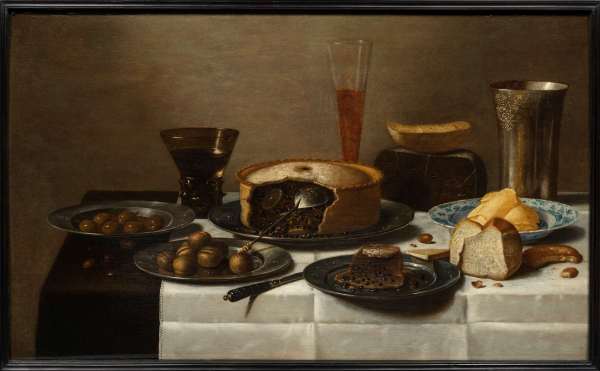
Above: A Still-life with Bread, Cheese and a cut Pie. Floris van Schooten, (between 1585 and 1588 – buried 14 November 1656), Dutch Painter. Oil on panel. Housed at Koetser Gallery.

Blog at WordPress.com.

Up ↑