Dragon Age the Veilguard: I waited ten years for this?

I love the Dragon Age games—I own all the novels, comics, and the cookbook. I am a sucker for this series. I will defend DA2 out of loyalty. I’ve gotten thousands of hours of enjoyment out of the Dragon Age games and I will get thousands more in the future. 

In preparation for Veilgaurd, I replayed Origins and 2. I listened to the audiobooks. I reread the comics. I also imposed a content embargo, meaning I didn’t watch or read anything about Veilgaurd and made the decision to go in blind.

Milquetoast, Dull, Tedious, and other Adjectives

Dragon Age 2 catches a lot of flak for “not being an RPG.”

Well, Dragon Age: The Veilguard, saw that and said “hold my lyrium potion.” Or at least it would, if Veilguard had any lyrium potions.

Much like the aforementioned lyrium potions, Veilguard is missing something. The game is polished, pretty to look at, but every time I boot up the game, I leave it feeling intensely unsatisfied, like I’m playing a spin-off and not the actual sequel to Dragon Age Inquisition.

Trying to put words to what’s missing is a staggering challenge, mostly because there are just so many words that qualify.

To put it bluntly, Veilguard commits the greatest gaming sin: it’s really fucking boring. 

The game feels cold. Its charmless. Its tedious. The combat is terrible. Thedas feels empty. The environments are pretty, but there’s nothing interesting in them. The characters have vague, almost non-existent motivations. There’s not a single memorable score. Not a single memorable character interaction, villain, or NPC. The companions are uninteresting. There is a general, intense, noticeable lack of tension. Edgeless, clinical, sanitized, Disney-esqe.

Veilgaurd left me asking, with great disappointment: I waited ten years for this?  

Would you like to gather your party and venture forth?

For some unidentifiable reason, BioWare made the choice to overhaul Dragon Age’s combat system, turning it into something more akin to “baby’s first souls-like.” It’s toothless and dull, requiring little beyond button mashing. The game helpfully [read: hand-holdy] reminds you whenever your team can complete a combo.

Part of the combat issue, I believe, stems from the collapse of the class system. Picking a class in Veilguard seems to be wildly irrelevant.

Mage class is favorite class in DA. I enjoy controlling the battlefield from a safe distance, setting up elemental based traps, containing the fight, while using my warrior companions to tank, and my rogue to lay on damage—this is the typical set up for most companion-based RPGs.  

Veilguard has done away with that. You can only select two companions for your party, which doesn’t seem like an issue in and of itself until you realize that your companions’ abilities are locked behind cooldowns (think Mass Effect).

This means, if you play a mage and you want to draw enemy damage away from you, you must bring Davrin. He is the only companion who can taunt. If you use taunt, you can’t use any of Davrin’s other abilities until taunt completes its cooldown, effectively locking him out of the fight.

Oh, and taunt stops working the moment you strike a target.

When playing as a mage, you spend most of each combat encounter running away because the enemies are always aggroed to you.

The enemies don’t really target your companions, begging the question: why even have companions?

The companions don’t have health bars, they never go down, they teleport to targets only on command, and the player can clip right through them.

Sometimes, I forget the companions are even there, helpfully, the game has them shout out “I’m ready!” “Snipers!” “They have us at range!” to remind me that I’m being haunted by the ghosts of BioWare Past.

As far as I can tell, the companions basic attacks do very little—if any—damage. Rarely do the companions finish off a fight. As the player, I always strike the first blow, and the final, on each and every enemy.

Although simple to understand and even master, the combat system is tedious. You bring two companions who can set up triggers and detonations for high-damage combos—bonus if you also have abilities that trigger and detonate.

The game grinds to a halt while I slog my way through another combat encounter filled with copy-paste enemies that all feel and fight the same. Fighting Qunari feels like fighting darkspawn feels like fighting Ventori feels like fighting demons. 

Because the enemies are all the same, there’s no need to change your strategy. Bring the two companions that earns you the “Triple Threat” bonus and then spam those abilities whenever available one enemy at a time. There’s no reason to try and attack multiple enemies at once, each is a sponge. You’re better off focusing on a single target and trying to subtract, one by one, the enemies attacking you.

Just to reiterate—attacking you. The enemies don’t really attack your companions. They’re ghosts. Insubstantial. They don’t even stand in the background of cut scenes.  

BioWare has created some of the best companion characters that I know of. Many of them have extremely well-written character arcs, backgrounds, and compelling romances. Garrus from Mass Effect and Alistair from Dragon Age Origins come to mind.

Romance has become a big part of what sets BioWare games apart, although, I think it can be argued that romance has become too much a part of BioWare games. But there is something fun and rewarding about connecting with an interesting character on deeper level, role-playing as their lover, having quiet moments of tenderness with them.

Unfortunately, Veilguard suffers from the same problem that plagued Dragon Age 2. Because your companions are all “pansexual” the friendship feels like romance and romance feels like friendship.

There’s no romantic tension, or there’s an inappropriate underlying romantic tension. Its off-putting and awkward.  

It’s the worst of Dragon Age 2’s companions mixed with the worst of Mass Effect Andromeda’s companions. Its lazy writing, it’s unrealistic, its uninteresting.

Never have I played a game with such a roster of milquetoast characters. They are unsubstantial, analogous, hardly even characters. More like an arbitrary addition, grudgingly there because the fandom simply expects them to be.

Not a single companion says anything interesting. Not a one challenges me in a meaningful way or allows me to challenge them. We are like the imaginary characters in a HR Sexual Harassment training course. Mind-numbingly agreeable, belonging only to the dull imaginations of a Human Resource Manager.  

Not one character has a defining moment—and why would they? I do all the work, even in their own personal quests.

“I don’t work for the Inquisition.”

For the life of me, I cannot figure out why Rook is involved in the hunt for Solas.

Varric hired me, or I’m on loan from the Lords of Fortune—I genuinely do not know my character’s personal motivations.

There are no personal stakes for Rook, outside of a vague “the world is ending” feeling. You even tell the Inquisitor, the person sworn to stop Solas, that you “don’t work for the Inquisition.”

So why is Rook here? What is the inciting incident that brought Rook to work with Varric in the first place, especially if it’s not because they’re an Agent of the Inquisition?

The Hero of Ferelden was conscripted. Hawke was self-made. The Inquisitor was a victim of fate. Rook is… here?

To illustrate my point, one of your companions, Bellara, asks Rook why they’re “doing all this.” I had three response options: “Someone has too;” “Redemption, I guess;” and, “I don’t know.”

And that just really sums up Veilguard in its entirety. Rook doesn’t know why they’re here, and neither do I.

Veilgaurd doesn’t allow you to craft Rook beyond cosmetics, you can pick their sex, their pronouns, their scars, even add cataracts. But if you’re looking to create an interesting role playing experience, you’re out of luck.

Every response Rook has in every interaction is a slightly different shade of agreeable. There is no room for conflict between you and your companions, no place to disagree, even slightly, when a companion is out of line.

Rook is edgeless, an ineffective middle manager trying desperately to avoid an employee complaint.

Part of my defense of Dragon Age 2 is that you can read the ambition between the lines. Everything about DA2 falls short, but none of it feels shallow, none of it reads like a mass-appeal Pixar flick.

DA2’s serial killer arc doesn’t cinch it, but its implication are brutal; the blood magic that infects Kirkwall is clearly influencing the city, but you’re suspicions are never quite satisfied; Mages are suffering, but so are the Templars, and the game doesn’t do enough to show the player how mutual suffering builds mutual suspicion and mutual hatred.

But at least DA2 felt like a rowdy band of miscreants hunting up trouble, causing problems for themselves and others, sometimes, even without remorse.  

Veilguard’s quests are fairly cut and dry. They are complete, they provide further explanations of the lore, they confirm suspicions I’ve had since DA2, some of them are even interesting in the moment, yet I can barely remember them.

The whole game feels shallow, cold, unserious.   

It gets worse.

As I completed the game and marinated on my thoughts, one thing became shockingly clear to me.

Everything about Veilguard feels envious and resentful.

At the beginning of the game, you are able to design you Inquisitor and it asks a couple questions about your previous game state. My favorite Inquisitor is a female, human mage, who romanced Blackwall. The background questions don’t even differentiate between the classes of your Inquisitor, despite the fact that being a Mage Inquisitor should have deep implications for the end of the Mage-Templar War.

But that war never gets mentioned.

It gets worse—eventually, you get a letter from the Inquisitor that tells you how Southern Thedas is faring amidst the blight and you learn that Denerim and Redcliffe have been destroyed, Kirkwall has evacuated and ruined. Skyhold is barely holding on. Orlais is fighting Venitori and not answering any of the Inquisitor’s letters.

My heart sunk when I read that Denerim and Redcliffe were destroyed because those are places I care about.

As the Warden, I fought to put Alistair on the throne, to save Redcliffe from the Undead. As Hawke, I put time into cleaning up Kirkwall’s crime-riddled streets. As the Inquisitor, I traveled from Ferelden to Orlais closing rifts, stopping demons, and Red Templars.

Veilguard does not mention any events from the previous games.

Hawke’s name is never stated, despite that Hawke is Varric’s best friend. The last thing we heard of the Warden is that they were at Weisshaupt, yet, the Hero of Ferelden is never mentioned. The Divine is never mentioned. No one discusses the Circles or Templars or the fallout from their war. The Inquisitor, who, at the end of the Trespasser DLC, swore to save or stop Solas has the force of presence of a potato.    

The continuity of Dragon Age is gone, destroyed. Shoved aside.

It gets worse—the “secret” ending offers us a glimpse of what BioWare has “planned” for the next entry.

A shadowy organization Inquisition players will immediately recognize as the Executors, have been the dark puppet masters all along. They convinced the Magisters to enter the Fade, they guided Loghain into betraying Ferelden, they whispered to Bartrand about the Idol, they aided Corypheus.

Loghain didn’t come to the conclusion that he must kill Calian in order to save Ferelden from the Orlesian’s. He was manipulated into his actions.

The red lyrium didn’t corrupt and amplify Bartrand’s innate greed—the Executor’s did!

The Inquisitor wasn’t at the wrong place at the wrong time, they, the Divine, and Corypheus were all victims of shadowy machinations!

A lot is said about the hunt for the “modern” audience and the plundering of beloved franchises. I said above that Veilguard feels shallow, but perhaps it’s better to say that its hollow. Like something emptied out of its soul.

Veilguard doesn’t feel so much like soft reboot as it does a message of resentment and envy.

There are two explanations for this: the writers at BioWare are too cowardly to take a shot at creating a different franchise, or the writers at BioWare resoundingly resent their predecessors.

Neither explanation is nice, neither is how I want to feel; but cowardice can be forgiven. Resenting the story, resenting the choices, resenting the players—that’s not something that’ll induce me to give them another shot.

Conclusion

Enough digital ink has been spilled regarding wokeness and Dragon Age and I have no intention to add to it, other than to note that “wokeness” is an excuse. It’s a crutch used by both sides to obfuscate legitimate criticism.

Veilguard has more problems than an uncomfortable discourse about identity.

Veilguard is poorly written, the combat is unfun, and the story is disjointed and hollow, its characters are limp and insubstantial, it had none of the charm I associate with Thedas, it utterly disregards the former entries and hopes you don’t notice—trust me, you’ll notice.

To paraphrase G.K. Chesterton: a good story tells us the truth about its hero. A bad story tells us the truth about its writer.

The truth that Veilguard tells me about its writers is unbelievably disheartening.

I don’t recommend Veilguard, not even for hardcore Dragon Age fans like me.

Things I liked

There’s actually a reason why dragons need to be hunted and slain.

Manfred.

Complaints I couldn’t include above

The HUD is terrible. The menus system is clunky.

The enemies are just copy-paste reskins of each other. They all fight the same, have the same abilities. There is no variety of peril.

Classic enemy types have been redesigned. Enemies are indistinct from each other. The darkspawn are cartoony and visually bland.

There’s a surprising lack of grim-dark in my grim-dark fantasy game. Tevinter has been hyped up as the evil empire and yet it has zero implications for the plot and you wouldn’t even know they practice slavery if an NPC didn’t tell you.

Lacks the small, charming elements I associate with Dragon Age: no Elfroot to pick, no lyrium potions, hardly a mention of the extremely poetical Chant of Light, “would you like to gather your party and venture fourth?”, bees.     

Solas is wasted as a villain.

Varric’s death is cheap and leads me to believe that he was used as a lure to old fans.

I’ve gotten more enjoyment out of making fun of this game than actually playing it.

ABOVE: Saint George and the Dragon. Bernat Martorell, Catalan, d. 1452. Tempera on panel. A picture I took at the Art Institute of Chicago, it is most impressive in person.
Review: To Sleep in a Sea of Stars, Christopher Paolini

Christopher Paolini and I go way back. Growing up I loved the Inheritance Cycle—or rather, I loved the first two books. Eagon was a fun ride for what it was although it took me a second reading really to appreciate Eldest. Unfortunately, by the time I reached high school I had, for the most part, moved on.

I eventually did finish Brisingr, but it left nothing to me. I barely have any memory of actually reading it. When Inheritance came out, I simply ignored it and seldom, if ever, thought of Paolini again.

A few months ago, a coworker told me about To Sleep in a Sea of Stars, a sci-fi offering from a now very grown-up Christopher Paolini.

I thought, great, maybe this will ignite my love of his works? He’s an adult now, he has experience, gravitas. I’ll give this a read.

To start off this review, I want to say that I don’t regret reading Stars. It was fun, a solid reading experience. But the book left me with a sense of missed opportunity, of near-incompleteness.

There’s a lot of good ideas in this book and each one is sort of picked up, given a cursory examination, and gently set back down again as we move onto the next item of interest. After finishing the novel, I just couldn’t shake the sense that Paolini told the wrong story—that he missed out on the far more interesting tales going on it the background.

Part of what makes the background seem so much more interesting is the absolute bore of a character that is Kira, our POV main protagonist.

Kira has the flavor a passive observer. Things happen to Kira.

Some of this passivity is a product of the universe she inhabits—one that takes orders. Kira is a scientist for a major corporation, she takes orders or she doesn’t get paid; the government is a military dictatorship and she does what they say because she’s a good citizen.

When Kira does finally muscle up some agency, its too little to late. Her character is one that allows things to happen to her, why the sudden shift in attitude?

A story where things happen to an everyman character isn’t necessarily a bad one, but passivity in fiction can be perilous for the writer. There are time where Paolini seems to peek out of the clouds and offer his characters a dues ex machina.

“Wow, that was lucky!” Isn’t really the kind of thing a reader wants to be thinking about how the last story crisis played out. There’s a time and place for that kind of narrative trick, but for Kira, it just reiterates her passivity. She is not calm, cool, collected, or competent. Moments for character growth are unearned—or worse, boring.

Which leads me to my next big issue with Stars. The space travel is boring.

Because of the way Paolini designed FTL space travel, it necessitates that most of the characters go into deep freeze. Kira, immune to the drugs that put people under, spends weeks by herself and Kira simply isn’t interesting enough to make these long periods of narrative fun or stimulating.

Kira’s “progress” made during these FTL trips are a slog to read through, lending to the overall sense of her nonparticipation. Her development feels unearned because the only person she really contends with is herself.

My third, and perhaps my biggest issue with Stars is the direct cause of that sense of incompleteness I mentioned above.

Paolini has created a horrific galaxy filled with technological marvels that stretch the bounds of science and good sense. He’s placed normal people into a place of deep disquiet, but whenever he draws close to pulling out a thread of that existential terror, he draws back and I’m left asking “wait, what? Go back to that, talk about that!”   

At some point, the rebel alien faction mentions that they agreed with the main alien faction’s original plan to invade and conquer human space, they only changed their minds because they felt they needed the help of the humans to defeat a bigger threat.  

This revelation, which is great fodder for storytelling, is barely touched outside a mention here or there.  

But it goes deeper than just missed opportunities.

Like most modern sci-fi, Stars embraces an unquestioning endorsement of Gnosticism. The characters are only their minds, not the flesh that encases them working in tandem with their souls. Despite that many of the characters have become something else, they insist that they have not, that it’s still “them inside.”

But this isn’t true; by the end, Kira becomes something else in the same way Ship Minds are something else.

I think Paolini wants the reader to feel happy for Kira. She has found peace, or at least purpose. But its hard to reconcile what I’m told to feel with the actuality of what he is describing.

Kira is a Lovecraftian nightmare, a color out of dark space. When she returns from her sojourn, when all her friends are long dead and there is nothing left to tie her to the humanity she is no longer a part of, what’s to stop her from becoming the tyrant of the future? She’s already showed signs of it—spying on her friends, passing out all-powerful gifts, making demands of reasonably skeptical government leaders.

And it’s that disquieting, horrific future that I’m far more interested in. Maybe in the sequel, Paolini will deal with these lingering questions? Maybe Stars is the villain’s origin story? Maybe we’ll meet a Ship Mind made a ship’s mind against their will? Maybe someone will stand up to the military dictatorship? I’m not terribly hopeful, but taking a stab as any of those questions would do a lot towards getting me interested in the next book.

Miscellaneous notes

I’ve been telling people that To Sleep in a Sea of Stars reminds me of Mass Effect Andromeda in that I don’t like any of the characters and just when I think it’s going to let me have fun, it doesn’t.

This seems harsh until you learn that I didn’t hate Andromeda. But I didn’t like Andromeda for the reasons that Bioware wanted me like to Andromeda.

Most of the fun in Andromeda came from being deliberately annoying to my shipmates or picking it apart for its questionable plot or finding interesting ways to break it. In other words, Andromeda was fun when I didn’t take it seriously.  

Towards the end of Stars I couldn’t stop laughing. The ending is mostly silly or it’s saccharine to a ridiculous degree. I’m even laughing as I write this because some of the ending is that outlandish.

Stars is also like Mass Effect in the sense that it’s Mass Effect. There’s a lot of similarities right down to the fact that the audiobook is voiced by Jennifer Hale, the voice of Female Shepard. Paolini doesn’t try to hide this fact, he was upfront with Mass Effect’s influence on his work, and it doesn’t really bother me, but it’s there.

Final Thoughts    

Paolini’s capacity for creativity is undiminished. What he lacks is the writing chops to deal with his topics in a charming and stylistically interesting way. To Sleep in a Sea of Stars is competently written, creatively charged, and fast-paced enough to make its hefty page count a relatively easy read. But there’s little to go back to and most of what I’ll recall years from now is what made it entertaining for the wrong reasons.

I don’t regret reading it, but I can’t recommend it.

I write weird tales of my own, you can see them here! Follow me on Twitter/X.

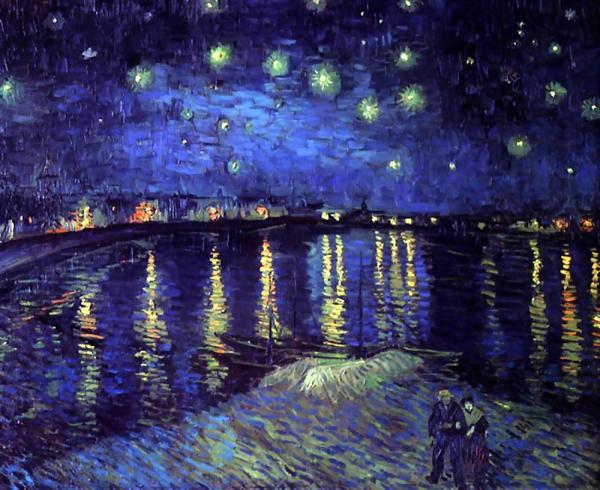
Above: Starry Night Over the Rhône. Oil on Canvas. Vincent van Gogh (1853-1890), Dutch. Currently housed in the Musée d’Orsay in Paris, France.

Petals from my Florilegium: Meditations on the Tarot, Anonymous

I keep a commonplace book where I collect phrases, proverbs, sentences, or ideas like a haphazard bouquet of wildflowers. I pick them as they come to me, with no curation save what I share on this blog.

In this series, I’ll offer a quote and meditate on why it deserved to be preserved in my Florilegium.


“Christian mysticism speaks of the ‘gift of tears’ – as a precious gift of divine grace. The Master cried at the tomb of Lazarus.”

Meditations on the Tarot, Anonymous

The shortest sentence in the Gospels is “Jesus wept.” (John 11:35). This verse holds particular significance to me because it was the first time I encountered Jesus as the Son of Man. This short sentence forced me to confront the reality of Jesus as a both human and divine.

His friend, Lazarus, was three days dead. He knew that with a word he could raise his friend from the dead. Yet, when confronted with the awful reality of death, Jesus wept.

It’s hard not to reckon with that realization. God came down to earth and met us, as Bishop Barron likes to say, in the muddy waters of our sinfulness. And when his friend died, he mourned with Mary and Martha.

The Anonymous French Mystic behind Meditations on the Tarot does not encourage the Faithful to seek out tarot cards. This book is not about telling the future or seeking signs from the “other side.” And I, as a Roman Catholic, am distinctly advising you to leave tarot cards as they are—superstitious paper, that, like all bits of paper, can become idols if we let them.

But the Major Arcana of tarot, which evolved into the face cards of a standard 52 deck, are rife with symbolism—particularly Christian symbolism. This fact cannot be ignored or pushed aside. French tarot, those used for cartomancy, are a product of a deeply seeded French Catholic culture.

Our Anonymous Friend works through each of the Major Arcana breaking open each suit in order to show the meaning underneath the patina modern occultism painted over them. He works each card out as a letter to his readers, the quote above regards the High Priestess.

The gift of tears, as a precious gift from the Almighty, broke open John 11:35 for me. Our Anonymous Friend regards that gift as sacred, a mystical experience. My mind wanders to the Great Carmelite Saints, Teresa of Avila and John of the Cross.

Both Saint Teresa and Saint John of the Cross had mystical, passionate visions. The ecstasy left them both ill, weeping, and in a pain so terrible it could only be called pleasure.

Our Lord, in his Passion, faced the cruelest of humiliations and torments and was killed by the very people he had come to save. But under those layers of agony, there was hope. It had to be this way. Blood can only pay for blood; he had come to ransom us. That was pleasure so powerful, it could only be called pain.   

When Jesus weeps, he makes weeping sacred. Jesus validates all human emotion, sharing the worst of them all—grief—to make it clear that what we feel is real and true. Emotions like grief, sadness, anger, etc, should never control us, but they are valid, and most importantly, their undercurrent is always joy.

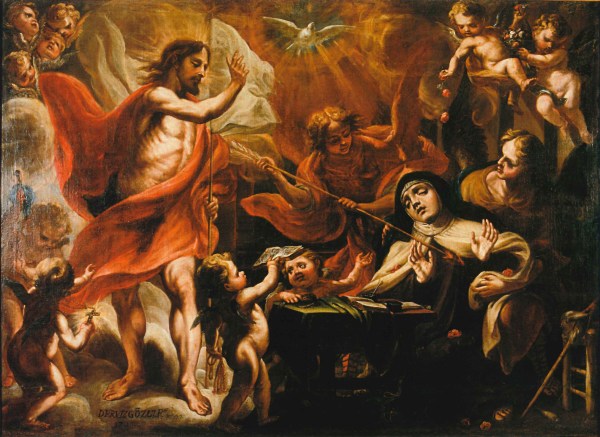
Above: Transverberación de santa Teresa de Jesús con Cristo Resucitado (Transverberation of Saint Teresa of Jesus with the Risen Christ). Oil on Canvas. Pedro Ruiz González 1640 – 1706. Spanish Painter. Housed(?) in Church of Saint Mamés (Magaz de Pisuerga), Spain.

Like weird tales? I write my own, you can find them here! You can also follow me on Twitter/X!

Studying Classic Poetic Forms

For the past few weeks I have been studying classic poetic forms. I’m doing this because I want to be a better writer, but also because I’ve written a character who is a poet, yet he never writes any poetry. I want him to be a believable poet, so I need to become familiar with poetry.

I’ve written a single poem so far and just writing that one poem has shown me that it’s not impossible to write classic poetry if you go about it in a systematic way.

What I find that I struggle with the most is the actual keeping of the form. That is, the rhyme scheme, the meter, the number of stanzas. A quick search online netted me some worksheets to help me write a sonnet – which is great! But I couldn’t find any free forms for a villanelle or a sestina.

So, I made some. For a villanelle and a sestina, at least. I’ve found the forms extremely helpful, which is why I converted them to PDFs and am making the available here. They are super basic and you’ll need to know about how the poetic form works before they’re actually useful. But, if you need them, here they are.

I hope these forms help you!

Like weird tales? I write my own, you can find them here! You can also follow me on Twitter/X!

Writers Must Read…April Blood by Lauro Martines

He was seventeen years old and already wore the red. Cardinal Raffaele Sansoni Riario was the grand-nephew of Pope Sixtus IV. Although still studying canon law in Pisa, he had been invested by the Holy Father with the diplomatic powers of a Papal Legate. It was under the Pope’s authority that he was in Florence.

On Sunday, April 26th 1478, the young Cardinal was celebrating High Mass at the Cathedral of Saint Mary of the Flower when violence splattered blood across the sacred floors of the Duomo.

Terrified and confused, the youth threw himself behind the altar and prayed for God’s protection amidst the screams of women, children, and the outraged shouts of “here traitor!”

Not more than thirty yards from where the Host had been elevated, Giuliano de’ Medici was stabbed nineteen times by Bernardo Baroncelli and Francesco de’ Pazzi. Closer to the altar, a pair of Priests attacked Giuliano’s older brother, Lorenzo.

Lorenzo’s employee and close friend, Francesco Nori stepped between him and his attackers, sparing Lorenzo’s life at the cost of his own. Another servant fought off one of the Priests and was wounded. Protected by his friends and servants, Lorenzo escaped into the sacristy with nothing but a small wound under his right ear. 

Trapped in the sacristy of the Cathedral, Lorenzo, known as the Magnificent, had no idea that his brother was dead.

Within just a few minutes the marble mosaic floors of the Florentine Cathedral were slick red with blood.

It was just the beginning. The bloodshed would extend for three days, overtaking the city of Florence in an orgy of violence. Hundreds would be killed in that three-day period, but the retribution for the death of Giuliano de’ Medici and the attempted assassination of Lorenzo the Magnificent would span years.

The glory of the Florentine Republic had long been waning by the time the Pazzi made their ill-fated attempt on the Medici’s lives. Although it would resurge from time to time, the Republic was on its last legs. Lorenzo de’ Medici, a man as brilliant as he was shrewd, would not waste the opportunities that his brother’s sacrifice revealed.

When the Lord Priors or, Signoria, Florence’s top ruling council, heard of the violence they immediately called in the Eight—an inquisitorial office made for rooting out and prosecuting political crimes. Prisoners were taken, including the men who murdered Giuliano and attempted to murder Lorenzo. Laws were suspended and emergency powers were delegated. Justice would be swift and cruel.

Foreign mercenaries who had been brought into the city were immediately massacred, thrown out the windows of the Palazzo della Signoria which they had occupied in the attempted coup.

The first conspirator to hang was Jacopo Bracciolini. A rope was put around his neck and he was thrown out the top window of the Palazzo overlooking the Piazza della Signoria. Two hours later, he was joined by Francesco de’ Pazzi, he had been the one to shout “here, traitor!” and in his fury to slay Guiliano, had stabbed himself in the thigh.

Then, shockingly, the Archbishop of Pisa, Francesco Salviati was hung, as well as an unidentified cleric. More men would hang from the Palazzo windows that day.

In the words of Niccolo Machiavelli, who was a child at the time of the Pazzi Conspiracy, there were “so many deaths that the streets were filled with the parts of men.” (pg. 128)      

The violence began to slow only when someone realized that the mob violence could easily turn on the government elite, especially because the 1470s had been a time of famine. But that didn’t mean that Lorenzo’s vengeance was over.

Cause and Effect

I make no secrets about my fascination with Florentine politics. It started with Dante and a desire to better understand his Divine Comedy by studying the man and the world he belonged to. It turned into a mild obsession that may or may not have contributed to my Conversion.

While the plots, schemes, and drama are mesmerizing, what makes Medieval and Renaissance Florence such a captivating study is the people. Florence is one of those strange places in history where great men all seemed to promulgate.

From Dante to Petrarch to Boccacio and Michelangelo, Donatello, Da Vinci, Botticelli, Giotto, Machiavelli, Brunelleschi, Savonarola, and Amerigo Vespucci, America’s namesake—yes, that’s right. Florence’s influence even endowed the United States with its name. The Renaissance began in Florence and was bankrolled by Florentine gold and Florentine blood.

But why should a writer care? Why should I recommend April Blood, by Lauro Martines?

On a very basic level, a story is about cause and effect. Something happens and a character must commit to an action in response to that event. A very good story layers causes and effects on top of each other. Soon, a story stars looking like ripple in a pond.  

I can think of no better place to meditate on this fundamental building block than in 16th Century Florence. April Blood, like any good tale, is a story about cause and effect. But unlike a novel, the characters and the plot were real. Every man involved in the Pazzi Conspiracy, from the victims to the conspirators, had a reason to act the way they did. Whether those reasons are justifiable is irrelevant. This complex web of money, family, and politics, merely proves my point.

Complex Characters

Lorenzo de’ Medici was raised to inherit his father’s patrimony. That patrimony was “the head and heart of a tightening oligarchy,” a tangled web of banking interests, political machinations, and marriage alliances (April Blood, pg. 88).

Lorenzo was 20 when a delegation of Florentine politicians offered him the reins of the state. Which, he took. The power that his grandfather, Cosimo, had gathered was so weighty that, even if the Medici had wanted too, they would not have been able to set it down without great personal risk.

“Lorenzo…aimed to hold power like his grandfather Cosimo, ‘with as much civility as he could manage’, which of course meant vote-rigging and ‘handling’ (that is, fixing) the purses for high office.”

April Blood pg. 95

Purse handling is an unfamiliar term for those unacquainted with Florentine Republicanism. In Florence, the Signoria, a council of nine men, led by the Gonfaloniere were selected randomly for two-month terms. By “handling the purse,” Lorenzo ensured that the random officials selected for office were the correct random officials.

Under the control of the Gonfaloniere and the Signoria were several different councils and committees—the Cento, the dreaded Eight, the Committee of War, etc.

Lorenzo indirectly controlled the Florentine government by ensuring that people friendly to the Medici were in power. This didn’t always work, so, naturally, after loosing control of the Signoria, Lorenzo resolved to ensure that it didn’t happen again. The moment Lorenzo regained control of the government; he pushed forth a series of:

“beautifully- orchestrated ‘reforms’ [that] had been a matter of timing, numbers, disinformation, intimidation, bribery, and electoral machinations. This was Renaissance statecraft as art: the paradigm of what it was to rule by ‘civil’ and ‘constitutional’ means in Medicean Florence.” April Blood, pg. 96

Somewhere along the line, Lorenzo, who was related to the Pazzi family through his sister’s marriage to Guglielmo de’ Pazzi, began to sense the ambitions of the Pazzi Family, particularly, those of Jacopo, the Pazzi Patriarch. With his control over the purse, Lorenzo began to halt their political advancements, barring the Pazzi from entry into high political office.

We may never know what the final straw was for the Pazzi family, all of them seemed to have had their own motivations, but one motive does come into sharp focus. In an act of pure spite, Lorenzo, against even the advice of his most trusted advisors including Guiliano, pushed forth a law that deprived daughters of major inheritances if they had no brothers and were flanked by one of more male cousins.

This law purposefully disinherited Beatice Borromei, the wife of Giovanni de’ Pazzi and barred the Pazzi from taking control of her large fortune.

Of course, this move was not done in a vacuum. Lorenzo forced that bill through because the Pazzi had been disrupting his imperialistic diplomatic plans.

The Pazzi, against Florentine (read: Lorenzo’s) diplomatic program, fronted Pope Sixtus IV a loan so that he could purchase a piece of land for his nephew, land that Lorenzo had wanted for Florence. To punish Lorenzo for not lending him money, Sixtus removed the Medici bank as Papal Bakers and gave the contract to the Pazzi bank.

To make matters worse, the Pope then elevated Francesco Salviati to the Archbishopric of Pisa. Pisa, at the time, belonged to Florence, and Salviati was a Pazzi relative. Lorenzo had good reason to believe that Salviati would be elevated to Cardinal and he was furious that he had not been given a say in the selection.

But that’s just the master of realpolitik.

“He was to have two souls always, two sides: one for literature and the other for callous action in the world.”

April Blood, pg. 91

I don’t think it’s an exaggeration to say that without Lorenzo the Magnificent, the Renaissance might have gone very different. Although he was a poet himself, his most important contribution to the West was his patronage.

The network of patronage went beyond bankrolling some of the greatest artists the world has ever seen (Leonardo de Vinci, Michealangelo, Sandro Botticelli). He was instrumental in connecting artists and earning them commissions. I think it’s safe to say that Lorenzo spent all this capital (social and monetary) out of a pure love of art.

But Lorenzo was not the only Patron of the Arts in Italy. There was one man in Rome to whom all Christendom owed their allegiance.

He was born Francesco della Rovere and entered into Church life as a Franciscan. When he was elected Pope, he took the name Sixtus IV. He would complete three mighty achievements: the construction of the Sistine Chapel, the creation of the Vatican Library, and the founding of the Spanish Inquisition. But even those accomplishments paled in comparison to his nepotism.

Sixtus IV raised nepotism to an art form. He was surrounded by nephews, nieces, grand-nephews, brothers, etc. Cardinal Raffaele Sansoni Riario the seventeen-year-old boy mentioned above, was his grand-nephew! The land that he secured with a Pazzi loan was for his other nephew, Girolamo Riario.

It would take more ink and time to list every relative that Sixtus IV raised and enriched. The two mentioned above are merely the most important for the purpose of this essay.

Girlamo Riario, along with the Archbishop of Pisa, were probably the originators of the plot to kill the Medici brothers. Perhaps sensing an opportunity to tighten his nepotic hold on Italy, the Holy Father agreed that Florence needed a change in government.

“His Holiness definitely wants and change in the government in Florence, but without anyone’s death…His Holiness said to me I want no death not for any reason. It is not part of our office to consent to any person’s death, and though Lorenzo is a scoundrel and behaves badly with us, yet on no account would I wish to see him dead…I tell you I want no man dead but a change in government, this yes.” April Blood, pg. 158

Here was a man devoted to his family while simultaneously committed to the Franciscan order. He had taken a vow of personal poverty, yet he poured out money like water to build one of the most glorious devotions to God. He was the Pope, the Vicar of Christ, the Prime Minster of Christ’s Kingdom on earth, yet he connived to see men murdered—surely, he knew what he was saying? He could not have been that naive. A man does not become Pope by being naïve.       

If You’re Going to Kill a King 

It goes without saying that if you plot an assassination, you better not fail. The April plot was more than just a disgruntled family looking for vengeance. It was a cadre of angry, ambitious men ranging from a banker, to an archbishop, to a duke, to a king.

Lorenzo learned the details of the plot, including Pope Sixtus IV’s involvement, through the confession of one of its conspirators—Giovan Battista, Count of Montesecco. The Count was a mercenary

Date eight days after the attempted assignation of Lorenzo, Giovan Battista penned his confession, pinning the plan on three major players: Archbishop Salviati of Pisa, Francesco de’ Pazzi, and Count Girolamo Riario, the Pope’s nephew. His confession went on to implicate the Holy Father, the Duke of Urbino, and the King of Naples.

Lorenzo hardly needed the confession to know that the Pope was involved. Afterall, his would-be killers were hidden among the courtiers of his grand-nephew, Cardinal Raffaele Sansoni Riario! I doubt the seventeen-year-old had any idea that his train of servitors was carefully choreographed to get the conspirators into Florence.

Regardless, the boy made a fine hostage, keeping the Papal Army at arm length.     

Of course, the Pope has more tools than an army. Sixtus ordered an interdict upon Florence. In lay-speak, the Pope was ordering all Priests to withhold the Sacraments from Florence and her client cities. He further excommunicated Lorenzo and the Signoria.

An interdict was designed to level pressure on a ruler from the bottom up. A city under Papal Interdict was denied the Source and Summit of Christian Life (the Eucharist), and furthermore, the Sacraments of Baptism, Confession, Last Rites, etc. For the poor of Florence, this was a terrible, painful blow.

It wasn’t a complete blow, because there were plenty of Archbishops and Priests who sided with the Medici, but this pressure would surely build until it blew.

Giovan Battista’s confession, spread through a newfangled device called a printing press, became a powerful arrow in Florence’s quiver.

“Florentine political leaders printed and circulated the confession, in a campaign to denigrate and subvert the interdicts Sixtus has imposed on Florence, Pistoia, and Fiesole…[the Count’s] confession, however, has large shadows; it implicates only the ringleaders; information about the King of Naples and the Duke of Urbino is suppressed; motives are either ignored or made too general; all minor confederates in the web of secrecy are passed over in silence; and the solider himself…keeps hinting that the plot was harebrained.”

April Blood pg. 164-165

The King of Naples, called Ferrante, had a bone to pick with Florence over various diplomatic agreements and was willing to take any excuse to side against the city. Neapolitan and Papal armies began to range the borders of Florence, attacking peasants, hijacking trade routes, and causing general mayhem.  

The Pope and his nephew, Girolamo, insisted that peace was impossible until Lorenzo reported to Rome and begged the Holy Father’s forgiveness.

Under Spiritual threat from the Pope and physical threat from Ferrante, Florence was faced with a terrible decision: hand over Lorenzo, or face destruction.

“The crisis peaked and Lorenzo was driven to the wall. Day after day, for months, working on the maestro of the war office Ten, he did nothing but direct policy, sweat out decisions, and write of dictate countless letters. He was desperately overworked. Complaints and murmurings against the regime gained momentum. Trade in wool and silk, the backbone of local industry, had declined sharply. Business travel and employment suffered. The premise of Florentine cloth merchants and banks had been shut down in Rome and southern Italy. To top it all, bread prices had been rising since about 1473. Rioting broke out in the streets of Florence.”

April Blood, pg. 186

Facing riots, raids, and spiritual despair, Lorenzo moved in the only way left to him.

In a courageous act of pure patriotism that struck even his enemies as praiseworthy, Lorenzo left Florence on a diplomatic mission to Naples.

“The move struck contemporaries as sensational, and it has often been the occasion for awe and praise of Lorenzo’s courage, patriotism, genius, luck, and statecraft. None of these can be taken away from him: he was a vastly gifted man…”

April Blood, pg. 188

It difficult to overstate to the modern person just how dangerous a decision this was. Lorenzo was walking into a situation in which he would be totally under the power of the King of Naples, sure, it was under a diplomatic flag, but Ferrante wasn’t the kind of man to let that stop him—he once convinced the Turkish Sultan (a Muslim) to attack Venice (a Christian city) because it was politically convenient to him. If he wanted to bundle up Lorenzo and send him on to Rome and certain death, then he most certainly would have.

But that didn’t happen. Instead, the Neapolitan King got to know Lorenzo, and in getting to know him, began to like him. Concessions were made, but Lorenzo’s charm remained his most impeccable weapon.

And with the slide of a silver tongue and a dash of luck, the Pazzi War came to its end.          

That Bitch, Fortune

The hidden character behind the whole bloody scene is a force the medieval and renaissance mind knew all too well.

The modern mind often dismisses the concept of “luck” as mere superstition, but the fact of the matter is that fortune is a lively factor in the movement of the world, even now. I thoroughly believe in the medieval concept of fortune and April Blood does a good job of showing fortune in action.

For all it’s changes, mistakes, and fumbles, Florence was politically ready for a change of leadership. Lorenzo was popular, but he wasn’t that popular.

“Despite the failure…it may be easily argued that the plot was driven by an accurate sense of what was practical and feasible. If Lorenzo had been killed along with Giuliano, or if Archbishop Salviati and Messer Jacopo [de’ Pazzi] had managed to take the government palace…would have forced a change of government in Florence; and change made, to be sure, with the zeal and assistance of hundred of alienated citizens and returned exiles.”

April Blood, pg. 173               

It was Dame Fortune who spared Lorenzo that blood-soaked day in April. It was Dame Fortune who turned Ferrante from a foe into a friend. Then, Dame Fortune would come to Lorenzo and Florence’s rescue again:

“Lorenzo’s luck held out. ‘Dame Fortune’ – as many contemporaries would have said – came to his aide less than five months later [after leaving Naples]. Early in August the Turks stormed Otranto in the far south of Italy, killing about 12,000 people and taking another 10,000 into slavery. All at once Ferrante faced a military crisis…and Pope Sixtus was forced to organize action against the infidel…Dropping his hard line against Florence.”

April Blood, pg. 196

Final Thoughts

Sometimes writers put themselves in a jam. They back their characters into a wall and to get them out, they have to rely on a deus ex machine. What a cheap ending! The reader says in their review.

Don’t get me wrong, I’m not a fan of cheap endings, but let’s face it—history is full of cheap endings. Lorenzo talked himself out of a war with Naples and the Pope. There was no great last stand, no clash of arms, no falling on swords. Lorenzo won through a series of charming conversations made at quiet dinner parties held in the Naples Branch of the Medici Bank.

The single most important rule of fiction is that it must make sense and real life is under no such obligation.

Still, I think it’s a good idea to think about fortune and the way it affects our lives, and the lives of our characters. Cause and effect must ultimately make room for “Dame Fortune.” When she turns her wheel, we have no choice but to turn into the skid, for good or ill.

April Blood is a great book; it really highlights the tangled web of family, money, and politics that was the lifeblood of Renaissance Florence. I glossed over a lot of details to get to my point, but I hope it encourages you to pick up the book yourself. It’s these real-life examples that I think can really provide a framework for fiction.       

As to the Medici and the Pazzi, Machiavelli, I suspect, would call both tyrants. Different sides to the same autocratic coin. He might also say, that sometimes, you get what you deserve and that Fortune is a real bitch.

I wrote a Writer’s Must Read on Machiavelli, check it out here.

Like weird tales? I write my own, you can find them here! You can also follow me on Twitter/X!

Above: Tile floor of the Cathedral of Saint Mary of the Flower (the Duomo) in Florence, Italy.

Blog at WordPress.com.

Up ↑