C.S. Lewis’ The Discarded Image.
Lewis’ was a master of medieval and renaissance literature. Like his fellow Inkling, J.R.R. Tolkien, he had the mind of a true medievalist. The Discarded Image was his final published work. It is a testament to his academic thought.
The Discarded Image takes us through the mind of medieval man. “At his most characteristic, medieval man was not a dreamer or a wanderer. He was an organizer, a codifier, a builder of systems. He wanted ‘a place for everything and everything in the right place.’ Distinction, definition, and tabulation were his delight.” (10)
From that need to organize, codify, and build, the medieval man Model of the Universe that was the synthesis of everything—science, theology, math, history. It all comes together into the richly complex system and beautiful model of the Cosmos.
Lewis’ writing is pointed. He never wastes a word. It is both easy to read and yet intimidating to the casual reader. So long as you’re familiar with the writers, artists, and thinkers [Dante, Chaucer, Spenser, Gower, etc.] then you’ll have little trouble following along.
Unfortunately, when Lewis does not translate his quotes into modern English. If you are unfamiliar with the modes, you may have to do a little googling.
Although I haven’t finished the book, I can see the Discarded Image becoming a contender for my Writer’s Must Read list. The Discard Image easily provides a view into the medieval mind, enhancing the way I think about medieval art and story by summarizing the complex way medieval man viewed the world around him. By the end, I’m sure I’ll lament that so beautiful a Model was cast away like so much historical debris.
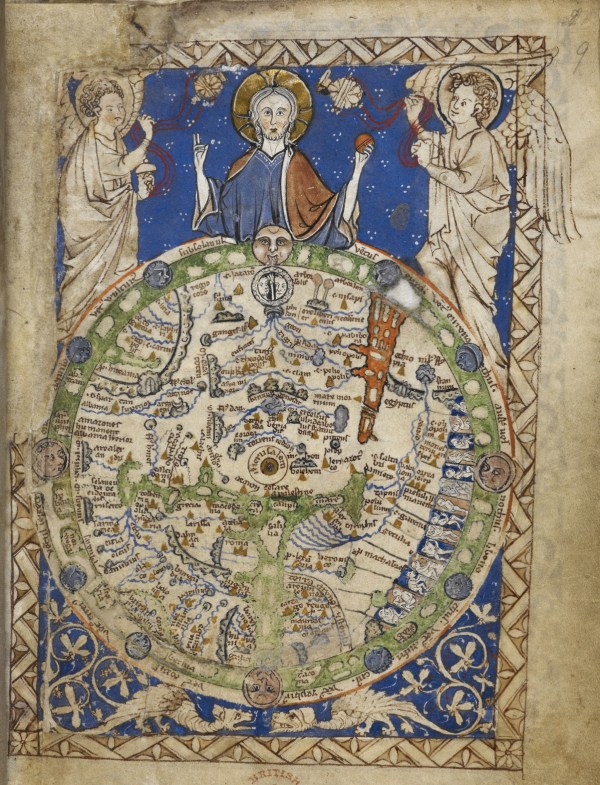
Above: Map of the World from a Latin Psalter. England. 13th – 15th Century. Held by the British Library.
 The Salon at Elfland