Sincerity as a Storytelling Tool

I fell in love with Star Wars when I was in High School. I couldn’t tell you why SpikeTV was playing episodes I-VI. I don’t remember what I thought of the Prequels or even a New Hope but I do remember when I realized that I really liked Star Wars.

“I love you.”

“I know.”

The swell of the music, the way the light plays on the faces on Han and Leia. The unwinding of romantic tension for the tightening of thematic tension. That was where Star Wars became my comfort story.

It would take many years for me to work out just exactly what made Star Wars so special. Part of figuring it out came from maturing as a writer, discovering the evergreen-ness of the Hero’s Journey, converting to Catholicism, and subjecting myself to the Disney sequels.

It’s in the shadow of the Disney sequels that the original Lucas Star Wars shine brightest.

If there is one thing the Disney sequels lack, its true sincerity, summed up in the oft quoted, highly meme-able phrase “somehow, Palpatine returned.”  You can see the pain in Oscar Issac’s eyes as he says the line.

Palpatine returning isn’t anything new, the Dark Empire comics brought him back in the so called “Legends” canon. It isn’t a bad plot point in and of itself.

The problem with the Disney prequels is that Palpatine returning is too little too late. As it turns out, true sincerity requires intentionality.

Abrams’ so called “mystery box” is a story telling device of unabashed insincerity. If I refuse to open a present, I’m not conveying my sincere love for the giver because I find the wrapping pretty, or the mystery of the gift so thrilling I can’t make myself open it. The gift is what’s inside, not the mystery of what’s inside.     

This lack of intentional sincerity is contrasted against Rian Johnson’s deep, unbending, sincere belief that true heroism doesn’t exist.

Continuing with the gift analogy, this is like opening the box and instead of politely thanking the giver and shoving the gift in a closet, I take the item out and smash it before their very eyes.

Johnson’s post-modernism is incompatible with the very nature of Star Wars. That Disney’s Lucasfilm couldn’t see that, shows what really effected the Disney sequels was this discordant relationship with sincerity.      

God, who is true, good, and beautiful made a universe that is true, good, and beautiful. Art is a reflection of the universe. Art shows us what is true, good, and beautiful. Therefore, art shows us God.

Stories fail when the true, good, and the beautiful are denied.

This is why, despite that I am a longtime fan of A Song of Ice and Fire, I know that I will never see a satisfying ending to the series.

Martin has written himself into a corner. He has two choices left to him; he may either deny the philosophical underpinnings of his work, recanting in his belief that heroism, sacrifice, and greatness are unreal; or he must allow the natural ending of his worldview to play out, showing a world of eternal winter as the white walkers sweep, unstoppable, over Westeros.    

Regardless of Martin’s theoretical ending, A Song of Ice and Fire will be a failure in storytelling.

By failure, I don’t mean they don’t make money, they don’t wow audiences, they don’t have anything redeeming—I mean, they tell deeply unsatisfying stories that grind like sandpaper against the human spirit.

Man knows, intrinsically, when he has heard a good story, because good stories are written on the heart.

The good and beautiful truth of Star Wars is that Luke Skywalker’s self-sacrificial love for his father was strong enough to redeem him.

And that truth asks us a disquieting question. Do I love my father enough to thrown down my lightsaber?   

More than that, it makes a suggestion that the post-modern mind unequivocally rejects: Because Luke Skywalker was willing to sacrifice himself to redeem his fallen father, he is a better man than me.   

But let’s circle back to George Martin.

By his estimation, heroes aren’t real because they’re too naïve to exist. He begins A Song of Ice and Fire with the execution of the only honorable man in Westeros. Eddard Stark’s heroism has lost him his head, destroyed his family, and plunged the kingdom in chaos.

And just in case you didn’t understand that theme from the get-go, the Starks are again, destroyed by more foolish naive notions of heroism at the Red Wedding.

To make it even clearer—the only Stark, who by right of consanguinity, is the true King of Westeros, swears himself to self-sacrificial Order where they are not allowed to marry and have children.

Heroism, by the logic of Martin’s Westeros, is a literal, genetic dead-end.

This leaves me wondering, how would Star Wars be different if it were written by Martin? I suspect, it would look a lot like the Last Jedi, throwing away the essence of the story to make a vapid counterpoint about the Return of the Jedi.

All things are pointless, the Disney sequels say, there are no heroes, even villains are as insubstantial as a Force ghost. There is only power.

And this incoherent belief system sowed the seeds of an incoherent ending, where the name of a hero is taken and wielded like a sword, because it was never Luke Skywalker’s inborn goodness that redeemed Anakin Skywalker, it was his power that did so.

Sincerity is a hell of a storytelling tool. If you’re going to write about heroes, you should probably believe in them first.
Review: To Sleep in a Sea of Stars, Christopher Paolini

Christopher Paolini and I go way back. Growing up I loved the Inheritance Cycle—or rather, I loved the first two books. Eagon was a fun ride for what it was although it took me a second reading really to appreciate Eldest. Unfortunately, by the time I reached high school I had, for the most part, moved on.

I eventually did finish Brisingr, but it left nothing to me. I barely have any memory of actually reading it. When Inheritance came out, I simply ignored it and seldom, if ever, thought of Paolini again.

A few months ago, a coworker told me about To Sleep in a Sea of Stars, a sci-fi offering from a now very grown-up Christopher Paolini.

I thought, great, maybe this will ignite my love of his works? He’s an adult now, he has experience, gravitas. I’ll give this a read.

To start off this review, I want to say that I don’t regret reading Stars. It was fun, a solid reading experience. But the book left me with a sense of missed opportunity, of near-incompleteness.

There’s a lot of good ideas in this book and each one is sort of picked up, given a cursory examination, and gently set back down again as we move onto the next item of interest. After finishing the novel, I just couldn’t shake the sense that Paolini told the wrong story—that he missed out on the far more interesting tales going on it the background.

Part of what makes the background seem so much more interesting is the absolute bore of a character that is Kira, our POV main protagonist.

Kira has the flavor a passive observer. Things happen to Kira.

Some of this passivity is a product of the universe she inhabits—one that takes orders. Kira is a scientist for a major corporation, she takes orders or she doesn’t get paid; the government is a military dictatorship and she does what they say because she’s a good citizen.

When Kira does finally muscle up some agency, its too little to late. Her character is one that allows things to happen to her, why the sudden shift in attitude?

A story where things happen to an everyman character isn’t necessarily a bad one, but passivity in fiction can be perilous for the writer. There are time where Paolini seems to peek out of the clouds and offer his characters a dues ex machina.

“Wow, that was lucky!” Isn’t really the kind of thing a reader wants to be thinking about how the last story crisis played out. There’s a time and place for that kind of narrative trick, but for Kira, it just reiterates her passivity. She is not calm, cool, collected, or competent. Moments for character growth are unearned—or worse, boring.

Which leads me to my next big issue with Stars. The space travel is boring.

Because of the way Paolini designed FTL space travel, it necessitates that most of the characters go into deep freeze. Kira, immune to the drugs that put people under, spends weeks by herself and Kira simply isn’t interesting enough to make these long periods of narrative fun or stimulating.

Kira’s “progress” made during these FTL trips are a slog to read through, lending to the overall sense of her nonparticipation. Her development feels unearned because the only person she really contends with is herself.

My third, and perhaps my biggest issue with Stars is the direct cause of that sense of incompleteness I mentioned above.

Paolini has created a horrific galaxy filled with technological marvels that stretch the bounds of science and good sense. He’s placed normal people into a place of deep disquiet, but whenever he draws close to pulling out a thread of that existential terror, he draws back and I’m left asking “wait, what? Go back to that, talk about that!”   

At some point, the rebel alien faction mentions that they agreed with the main alien faction’s original plan to invade and conquer human space, they only changed their minds because they felt they needed the help of the humans to defeat a bigger threat.  

This revelation, which is great fodder for storytelling, is barely touched outside a mention here or there.  

But it goes deeper than just missed opportunities.

Like most modern sci-fi, Stars embraces an unquestioning endorsement of Gnosticism. The characters are only their minds, not the flesh that encases them working in tandem with their souls. Despite that many of the characters have become something else, they insist that they have not, that it’s still “them inside.”

But this isn’t true; by the end, Kira becomes something else in the same way Ship Minds are something else.

I think Paolini wants the reader to feel happy for Kira. She has found peace, or at least purpose. But its hard to reconcile what I’m told to feel with the actuality of what he is describing.

Kira is a Lovecraftian nightmare, a color out of dark space. When she returns from her sojourn, when all her friends are long dead and there is nothing left to tie her to the humanity she is no longer a part of, what’s to stop her from becoming the tyrant of the future? She’s already showed signs of it—spying on her friends, passing out all-powerful gifts, making demands of reasonably skeptical government leaders.

And it’s that disquieting, horrific future that I’m far more interested in. Maybe in the sequel, Paolini will deal with these lingering questions? Maybe Stars is the villain’s origin story? Maybe we’ll meet a Ship Mind made a ship’s mind against their will? Maybe someone will stand up to the military dictatorship? I’m not terribly hopeful, but taking a stab as any of those questions would do a lot towards getting me interested in the next book.

Miscellaneous notes

I’ve been telling people that To Sleep in a Sea of Stars reminds me of Mass Effect Andromeda in that I don’t like any of the characters and just when I think it’s going to let me have fun, it doesn’t.

This seems harsh until you learn that I didn’t hate Andromeda. But I didn’t like Andromeda for the reasons that Bioware wanted me like to Andromeda.

Most of the fun in Andromeda came from being deliberately annoying to my shipmates or picking it apart for its questionable plot or finding interesting ways to break it. In other words, Andromeda was fun when I didn’t take it seriously.  

Towards the end of Stars I couldn’t stop laughing. The ending is mostly silly or it’s saccharine to a ridiculous degree. I’m even laughing as I write this because some of the ending is that outlandish.

Stars is also like Mass Effect in the sense that it’s Mass Effect. There’s a lot of similarities right down to the fact that the audiobook is voiced by Jennifer Hale, the voice of Female Shepard. Paolini doesn’t try to hide this fact, he was upfront with Mass Effect’s influence on his work, and it doesn’t really bother me, but it’s there.

Final Thoughts    

Paolini’s capacity for creativity is undiminished. What he lacks is the writing chops to deal with his topics in a charming and stylistically interesting way. To Sleep in a Sea of Stars is competently written, creatively charged, and fast-paced enough to make its hefty page count a relatively easy read. But there’s little to go back to and most of what I’ll recall years from now is what made it entertaining for the wrong reasons.

I don’t regret reading it, but I can’t recommend it.

I write weird tales of my own, you can see them here! Follow me on Twitter/X.

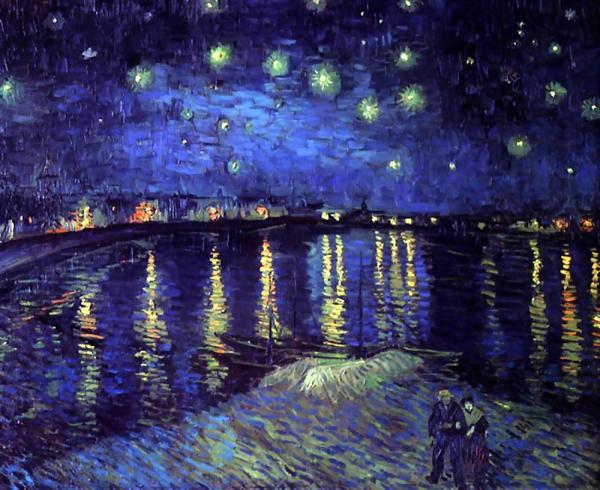
Above: Starry Night Over the Rhône. Oil on Canvas. Vincent van Gogh (1853-1890), Dutch. Currently housed in the Musée d’Orsay in Paris, France.

Anvil Issue #2 is Funding Now

Anvil: Iron Age Magazine is no longer funding, but can be purchased “in demand” on Indiegogo. My short story, Afflicted: Nourritures les Ver, will be included in this issue along with a number of comics and shorts by other independent authors like me.

I can only speak for myself, but I am extremely excited about this magazine and my small place in it. I believe Nourritures les Ver will fit comfortably on the shelves of fantasy, sci-fi, and horror fans alike. I hope the blurb below whets you appetite for more.

Afflicted: Nourritures les Ver by Jaime Faye Torkelson

Amélia Mitre is Afflicted. Cursed by a pact of her own making, she is made to follow the Weird Way of Scealfe, God of Death of Decay. Summoned to the industrializing city of Beauanne, the Cursed Doctor finds herself investigating a disturbing disease that defies the laws of nature and therefore, the laws of her dark patron. She must discover the origins of the plague and punish anyone foolish enough to pretend rivalry with the God of Death.

If you choose to support Anvil, let them know I sent you. Your support, no matter how small, helps keep the flame of independent IPs alive and I cannot thank you enough!

My thanks, first and foremost, to God, who likes stories more than I do.

Secondly, the team at Iron Age Media has been great to work with. I highly recommend you check out their website.

And, finally, to the readers, who deserve good stories I hope my small offering fits the bill.

Above: a handful of worms in coffee ground compost, which makes excellent worm food.

Blog at WordPress.com.

Up ↑