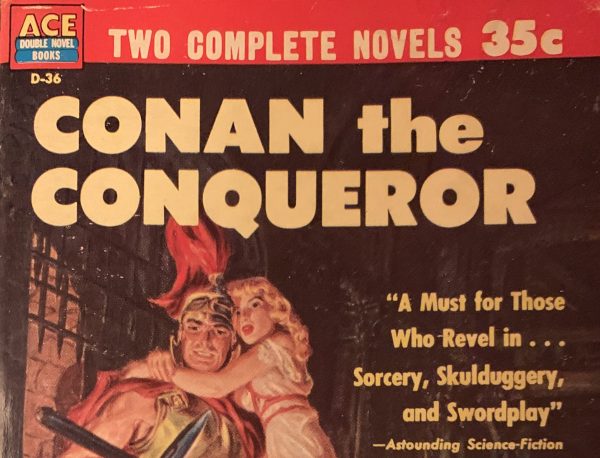
Conan Confronts Christ

What hath Cimmeria to do with Jerusalem?  

This is a weird one, I’m going to have to ask you to just go along with this…meditation?

I say meditation because I’m not sure it’s a complete thought. I’m certainly not going to stake anything on it, or consider it some great piece of theology. It’s just a meditation. A splinter in the mind, something I want to wiggle out.

I keep a Florilegium, or a commonplace book. I started keeping it in May of 2022. Among the petals are various quotes, sayings, snatches of poetry—anything and everything—that sticks out to me. I’ve got scripture, jokes, historical facts, bits of advice, bits and bobs of fiction I enjoy.

Part of the exercise of keeping a Florilegium is memorization. Its far easier to memorize something that’s been deliberately hand written than it is simply try to recall it.

It also gives some form to my life, like a journal. I know that during the years of 2022 – 2024, I was deeply engrossed in studying the Bible leading up to my Baptism in 2023. So my first volume is mostly scriptural passages intermixed with quotes from GK Chesterton, Bishop Robert Barron, Dorothy Sayers, and the Spiritual Combat.

Towards the end of the book, as 2024 begins, you see more Frank Herbert, Frank Sneed, C.S Lewis, and Robert Howard’s Conan of Cimmeria.  

Robert Howard was a poet—a deeply passionate, visceral poet. He was a master of alliteration, especially in his Conan stories.

“The dead are dead, and what has passed is done!”

“…savored too strongly of sorcery for comfort.”

Civilized men are more discourteous than savages because they know they can be impolite without having their skulls split, as a general thing.”

When Conan speaks, he has the cadence of rolling thunder or a beating drum, while Howard’s narrative sometimes has the soft silky ‘s’ that cry out to be read aloud. My appreciation for Howard’s character is one of poetry. Conan is resoundingly full of life—pagan life, to be sure, but he springs forth like the poetry of the Iliad or the Odyssey.     

There is an eternal, although I suspect, perfectly settled question about the place of Pagan literature in the life of the Christian. Should we indulge in the flights and fancies of the Pagans? The Iliad is akin to a sort of Greek Scriptures, does it have anything of value for the Christ-Follower?   

Tertullian, although speaking of Greek Philosophy, said “what hath Athens to do with Jerusalem?”

“Let me live deep while I can; let me know the rich juices of red meat and stinging wine on my palate, the hot embrace of white arms, the mad exultations of battle when the blue blades flame and crimson, and I am content. Let teachers and priests and philosophers brood over questions of reality and illusion. I know this: if life is an illusion, then I am no less an illusion, and being thus, the illusion is real to me. I live, I burn with life, I love, I slay, and I am content.” – Robert Howard, the Queen of the Black Coast

“… let me know the rich juices of red meat and stinging wine on my palate…” for the past several months, when I receive Eucharist, and cross myself and kneel in absolute thanksgiving for this body, given for me, that I may have eternal life, and have it abundantly, this quote keeps coming unbidden to my mind.

Stinging wine on my palate, I muse, as the Blood of Christ, under the species of wine, lingers on my tongue.

The entirety of the quote is pure pagan speculation. Conan is in a discourse about the afterlife with his lover, the Pirate Queen, Bêlit. Conan’s people, the Cimmerians, do not believe in a comforting afterlife. Bêlit does, especially in the various afterlifes offered by the Gods of the Shemites.

Mostly, Bêlit believes:

“There is life beyond death, I know, and I know this too, Conan of Cimmeria…my love is stronger than death! I have lain in your arms, panting with the violence of our love; you have held and crushed and conquered me, drawing my soul to your lips with the fierceness of your bruising kisses. My heart is welded to your heart, my soul is part of your soul! Were I still in death and you fighting for life, I would come back from the abyss to aid you—aye, whether my soul floated with the purple sails on the crystal sea of paradise, or writhed in the molten flames of hell! I am yours, and all the gods and all their eternities shall never sever us!”  – Robert Howard, the Queen of the Black Coast

Bêlit speaks with the eroticism of the Song of Solomon: “set me as a seal upon your heart, as a seal upon your arm; for love is strong as death,” Song 8: 6RVS2CE.

If the Song of Solomon is about the Eternal Bridegroom and His Bride, longing for each other, then perhaps, Bêlit is no so far off the mark as she may seem. C.S Lewis spoke of the pagan’s “good dreams.”

Perhaps Conan dwells in the same “good dreams” as those of Odysseus and Hector?

Maybe even the Christian is meant to dwell in a world of high adventure in the time before the oceans drank Atlantis.

Perhaps Conan puts before me, as Tolkien says: “the one great thing to love on earth: the Blessed Sacrament…There you will find romance, glory, honour, fidelity, and the true way of all your loves on earth.”

I receive Christ in the Eucharist, and while I am on earth, I am extolled to live deep, to know the rich juices of red meat and stinging wine on my palate, to one day embrace a husband and dwell together as an icon of the Trinity; to fight in the mad exultations of the spiritual battle where the blades flash blue and crimson, until the earthly pilgrimage is done, and be content.

That’s the romance, that’s the adventure! The glory of God, Saint Irenaeus says, is a human being, fully alive. And who is not fully alive, but a man who declares: “I live, I burn with life, I love, I slay, and I am content.”   

Final Thoughts

I am not saying Conan is a Christian hero-type, nor am I sneaking any incoherent “universalism” into my religious thought, (I am resolutely orthodox). I am, however, making use of Justin Martyr’s conviction that all well said things rightly belong to us Christians.

Robert Howard, by all accounts, was not particularly religious, and even if he were I can only doubt that he would be Catholic. He was much in love with his native Texas and the Southwest in general, and I suspect that would incline him towards the Protestant viewpoint of his native land.

But there’s something about Howard’s writing, especially in his Conan stories, that marks me as incarnational. His work is visceral, it feels fleshy, substantive. I first wrote down the “Let me live deep” quote because I was enchanted by the image of red beef and wine, so much so I thought I could almost taste it.

It was the Eucharist which drew me into Roman Catholicism. Once I had read the Bread of Life Discourse, I could not imagine myself in any other Church but the one that took Jesus literally. So it only makes sense that these two figures, Christ, and Conan, must confront each other in the corner of my thoughts.

I think I’ll keep taking Conan with me to the Eucharist.


Are you as interested in tales of high adventure as I am? I write my own, you can find them here.

You can also follow me on Twitter/X.

I’ve discussed Conan before, check it out here.

ABOVE: the cover of “Conan the Conqueror” (AKA: The Hour of the Dragon), by Robert E Howard. Art by Norman Saunders from 1953 for an ACE Double Novel.
A Gentle Introduction to Conan the Cimmerian

Conan casts a mighty shadow over the swords and sorcery genre. You might even say, Conan is the genre. At the very least, he is the gold standard and all sword and sorcery fare is measured against the Cimmerian, regardless of the fairness of it.

The half-clad, sword-wielding barbarian is the trope de jour in all things swords and sorcery. From movies, to short story collections, to heavy metal music—if it’s swords and sorcery, it’s got buxom ladies, evil wizards, and loincloth bedecked barbarians.  

This isn’t a bad thing. I like tropes, I think they’re useful—good, even! And this trope is one of my favorites. I love a good sword-swinging savage man, bare-chested, blood covered, roaring insults against cowards and foes alike.

And if you like this trope too, Conan is your man. But, he’s also wily, cunning, quiet, pensive, chivalric, deceitful, womanizing, loyal, sneaky, brash—in other words, he’s complex.

Now, complex does not mean he completes a full “modern” character arc—in fact, he wouldn’t be Conan if he “changed” at the end of his tales.

“The Pulp Structure” as I call it, is about a character facing an obstacle or series of obstacles be they physical, mental, or both and overcoming those challenges. The story is found in the way they overcome the contest. Most importantly, they need to surmount the obstacle with their character or morality or ideology intact.

This resistance to change serves two purposes, it preserves the integrity of the kind of character that Conan is. It is also the mechanism that allowed Robert Howard to write Conan into all sorts of situations. The fun of a Conan story is in how Conan solves the problem before him.

“Hither came Conan, the Cimmerian, black-haired, sullen-eyed, sword in hand, a thief, a reaver, a slayer, with gigantic melancholies and gigantic mirth, to tread the jeweled thrones of the Earth under his sandalled feet.”

-The Phoenix on the Sword

This is Conan, a savage from the wastes of Cimmeria. A mercenary and robber. A man who has known great joy and even greater sadness. Impudent, knavish—he scoffs at kings and peasants alike. He lives, he burns with life, he loves and slays and is content. Plunder is seized and spent just as quickly—his philosophy, if a man like Conan has one, is this:

“I think of Life! The dead are dead, and what has passed is done! I have a ship and a fighting crew and a girl with lips like wine, and that’s all I ever asked. Lick your wounds bullies, and break out a cask of ale. You’re going to work ship as she never was worked before. Dance and sing while you buckle to it, damn you! To the devil with empty seas! We’re bound for waters where the seaports are fat and the merchant ships are crammed with plunder!” 

-The Pool of the Black One

Conan is not a man who goes out of his way to protect the weak. In fact, he doesn’t have a lot of respect or understanding for the weak and the poor.

By his estimation, the poor ought to get strong and rob the rich. The life of man is warfare, so men ought to take up sword and war. The strong will grow stronger because they are strong and the weak will die, because they are weak.

In this way, Conan is pure pagan. He would hear the words of Jesus “blessed are the poor” and sneer and ask how man is meant to eat a blessing.

This is best exemplified by the shadowy, utterly absent, cold and grim, god of the Cimmerians—Crom.

“Their chief is Crom. He dwells on a great mountain. What use to call on him? Little he cares if men live or die. Better to be silent than to call his attention to you; he will send you dooms, not fortune! He is grim and loveless, but at birth he breathes power to strive and slay into a man’s soul. What else shall men ask of the gods?”

-The Queen of the Black Coast

Conan’s fatalism is more Norse than it is Roman. His grim god’s attention promises doom, but despite that he seems to call out Crom’s name as if tempting fate, daring, maybe even demanding that promised doom so he might conquer it.

The Hyborian Age, the fictional pre-history setting of Howard’s Conan stories is awash in pagan fatalism. There is Bel, the god of Thieves; Mitra, the most widely worshiped and beloved of the gods; Set, the snake god of the Stygians who demands human sacrifice; the mysterious Asura. The good ones, if there are good ones, are Bel, Mitra, and Asura.

Conan does not call on any of them. Nor does he seem to care for their cults and practices. He has little regard for “blasphemy” and would do battle with a god if it suited him. The Priests of Asura have aided Conan in his journey, and Mitra has aided others in finding Conan’s help. He has spurned Set in a more physical way—slaying his children and confounding his priests.

For the average people of this mythical age, there appears to be little hope. This fatalistic caste system, where the strong prey on the weak, makes slavery, wanton cruelty, and human sacrifice the order of the day.

Power is all that matters, and those who don’t have it, live and serve at the pleasure of those who do.

Women are the particular victims of this system. Although Howard never spells out exactly what occurs in the flesh markets, harems, and pleasure palaces of the civilized nations, it is easily discernable to any but the most naïve of readers.

“…her worst oppressor had been a man the world called civilized.”

-Iron Shadows in the Moon

The tension between civilization and savagery is the red-hot pulse of the Conan stories. Howard does not hide what side he comes down on—barbarism is the superior. What Howard really appears to be doing is showing the ultimate end of degenerated civilizations. Rome degenerated and fell to “barbarian” incursions. The same fate befalls Aquilonia.

The difference, of course, is Conan.

He bucks against the spirit of fatalism. He forges his own path, mocks the gods. He has no need for the rules of civilization or savagery. If he is a barbarian, then I suspect we’d all wish to be barbarians.

“We do not sell our children.”

-Iron Shadows in the Moon

Conan says to a woman sold into sexual slavery by her own father. He’s never forced a woman against her consent, bought a human being, or forced a heavy tax burden on his people. He is a thing apart. Perhaps the only true example of rugged individualism that has and even will be.  

Conan is a renewing force; an infusion of fresh blood into a sickly man. He does not change, but all who meet him are changed. Slaves are freed, spines are steeled, villains are slain. In a bizarre, round-about way Conan is a liberator. Whether physically, or spiritually, Conan slaps sense into those around him, especially those who read him.

If you’re tired of tepid modern fantasy with it’s warmed-over Tolkienian platitudes, or handwringing, “grimdark” antiheroes; Conan might be the barbarian for you. Think of life! Think of rich red meat and stinging wine, think of passion and the flash of crimson blades, and be contented!

“Oh, soul of mine, born out of shadowed hills,

To clouds and winds and ghosts that shun the sun,

How many deaths shall serve to break at last

This heritage which wraps me in the grey

Apparel of ghosts? I search my heart and find

Cimmeria, land of Darkness and the Night.”

-Cimmeria

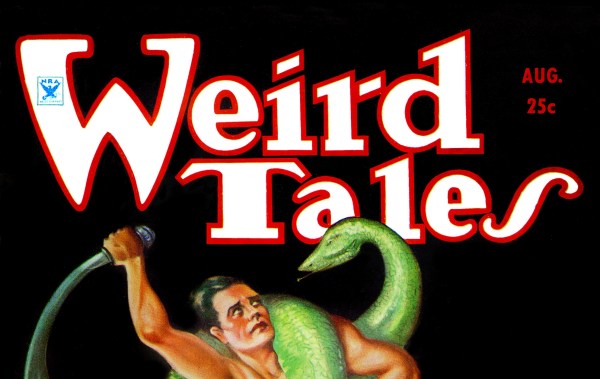
Above: A section from the August 1934 cover of Weird Tales featuring Robert E. Howard’s Conan the Cimmerian in The Devil in Iron.

I write my own weird tales, check them out here and follow me on X/Twitter.

Adventures in Storytelling 6

Entry 6, gathering brushwood.

There was a time in my life when I didn’t write short stories. And by that, I mean that I had this youthful, naïve belief that I was a “novelist” and would never write a short story. It was really just an excuse for the simple fact that I didn’t know how to write one.

In school we read tons of short stories—I even liked some of them—although none of them covered genres I read for pleasure. As a reader I’ve always gravitated towards fantasy. I like stories with swords and sorcery, something with an evil to overcome, heroes I can click with, and an adventure I can get lost in. 

Needless to say, the “great American short story” was not something I read unless a class made me. I don’t like Virgina Woolfe, I loathe Mark Twain, I don’t have the life experiences of Ernest Hemmingway or Edgar Allen Poe.

Short stories always felt like opaque little pieces of highbrow literature. High art, rich in irony, drama, and meaning, with messages or morals I usually disagreed with or a muddy, bleak modernist outlook I definitely disagreed with. They were the kinds of work I was expected to read and write essays about. All of them far from the kitschy, heartfelt fantasy I love.

When I finished high school and was able to distance myself from the drudgery of school work and look at short stories as a piece of fiction and not as an assignment, I bent a little. I discovered H.P. Lovecraft, Robert Howard, gained a deeper appreciation for Edgar Allen Poe, read Hemmingway and fell in love with him.

I still don’t like Virginia Woolfe, and I’ll never enjoy Mark Twain. But I found Flanery O’Connor and the short works of Leo Tolstoy. While F. Scott FitzGerald has become one of my favorite authors.  

But before any of that, I over-corrected and spent the first few years out if high school reading nothing but absolute junk food. I flew through every shallow, vapid, horrendous teen-fic fantasy I could get my young adult hands on.

I knew I was reading dreck, and yet I still imbibed. I was happy to drink up any piece of romance-laden, hand-wringing melodrama. I could slurp them up within a couple of days; the characters, setting, and story promptly forgotten as soon as I picked up the next terrible piece of mass produced, corporate trash.

And so my stubborn, arrogant “I’m a novelist” attitude metastasized. I wanted to be like these YA authors, you know, but better.   

But one day, I woke up and couldn’t stand the idea of picking up another novel.

Every book I’d read from high school until about 2015 was exactly the same. A plucky heroine who isn’t like other girls meets about 2.5 boys who needlessly squabble over her while the overtly masculine villain schemes and makes sexist comments until the heroine discovers her inner warrior and defeats the poorly contrived symbol of the patriarchy.

After that I found myself only reading non-fiction. Medieval history, specifically.

As I exhausted my local library’s poorly stocked history section, I turned to medieval literature. I read Dante’s Divine Comedy and Boccacio’s Decameron, various Arthurian tales, poems, etc.

I fell in love with Dante. His entry into my life spurred me into a frenzied trajectory that would alter the way I viewed the world. I’ll have more to say about my patron, later. Just know that it was through his work and my desire to understand it that lead me to reading Aristotle, Virgil, Plato, Homer, Plutarch, Machiavelli, Gottfried, Thomas Aquanis, Cretien de Toyes—

About the time the COVID lockdowns began, I started to really miss fiction. I wanted to escape, I wanted to be anywhere but in America circa 2020.

I was mentally exhausted by the drama going on in my real life, I was working full time, trying to write on the weekends. I watched as my future plans evaporated under the corrupting heat of COVID. I couldn’t focus on history the way I had been.

I tried to hop back into fiction; picking up some paperbacks from my local used book store.

I couldn’t read them. I didn’t have the patience or, rather, the tolerance for modern fiction anymore. I’d been feasting at the table of the Greats for so long, a mass market paperback seemed like thin gruel.

I mentioned in the last entry that COVID was a turning point for me. I had committed years of my life working on a novel that was too long to be published by an unknown author. I couldn’t abandon it; I won’t abandon it. But it was clear that I needed a different strategy.

As my life took a dark turn, I began to pull apart the things that bothered me about modern fiction—the pandering, the limp prose, the lame moralizing, the overwrought, needlessly complicated plots masquerading as “subversion”, the tiresome deconstructed heroes.

I knew I wasn’t the only one getting sick of the same-old-same-old, I just needed to find an in. An “in,” by the way, that I’m still searching for.  

Regardless of my chances of success I knew I could either quit entirely or make myself a better writer.

Dante loomed large in the back of my thoughts during this time, pushing me onward. He demanded excellence of himself, trusted that he possessed the tools to reach the absolute heights of his craft. Could I do no less?

What I began to understand was that I needed to learn how to write short.

Looking back, it felt like a monumental task.

The first thing I needed to do was relearn to enjoy fiction.

The Lord of the Rings has eluded me my entire life. This fact is highly embarrassing to me, but there is it. I could never make it past Tom Bombadil. I just couldn’t fall in love with the books like it seemed everyone else could. I knew tons about the books and about Tolkien but the prose never sang to me the way it seemed to sing to others.

I was aware of their Anglo-Saxon/Germanic heritage. I knew that Tolkien wrote the Hobbit specifically to be read aloud to children. I was also highly familiar with Norse, Anglo-Saxon, and Germanic storytelling and poetry because every medievalist, amateur or not, eventually realizes that they have to read Beowulf and the Norse Sagas in order better understand the cultural context of the history they’re studying.

These people did not write things down. Beowulf isn’t meant to be read; it’s meant to be heard.

I made the logical conclusion that I should listen to the Lord of the Rings. I bought an Audible subscription and started to relearn how to enjoy fiction.

It worked. Not only did I finally fall under the spell of LoTR, I rekindled a passion for fiction.

I began to listen to books at work, before bed, while I brushed my teeth, while I did the dishes, while I went for a walk. I even listened and enjoyed books I’d written off as unreadable while in high school.

Never in my life had I thought I would stay up until 2am listening to Pride and Prejudice. But I did that. More so, a book I once disliked became a book I enjoyed.

While I listened to the more time-intensive works, I started reading shorter ones. I was already a fan of H.P. Lovecraft, so I went looking for others like him.

I found myself getting really into horror, I picked up a lot of classic ghost stories. I learned about Weird Tales and met Robert Howard. I fell in love with his Conan the Cimmerian.

It was Howard that really woke me up to the possibilities of short fiction.

Conan is a fantasy hero; he gets by with a canny mix of cleverness and brute strength. He fights monsters, he steals treasure, he saves maidens, he even becomes a king.

All of Conan’s stories are self-contained and short (usually under 50,000). You can read Tower of the Elephant, or the Jewels of Gwahlur, skip Red Nail (you shouldn’t), and still get to know Conan and lose yourself in the Hyperborean Age.

Once I worked my way through every completed Conan tale, I knew that fire was kindled again. My stubborn unwillingness to learn was broken down, the debris removed as brushwood for the firepit.

While I was still adventuring with Conan, I took a chance and penned an old-school sci-fi short story and submitted it to Cirsova Magazine. It was my first, published in Spring 2023. I’m going to break that one open in the next entry.

For now, let me leave you with what writing this entry has taught me. I refuse to give up. Writing has the flavor of a Vocation. I am called to it.

Even if the fire goes out, as it did with me especially during that depression spiral of 2020-2022, you can start another fire, relearn, reframe.

Humble yourself and commit. Gather brushwood to burn, you’ll be surprised at what happens when you pledge yourself to becoming a better writer. It takes just one spark to set everything ablaze.  

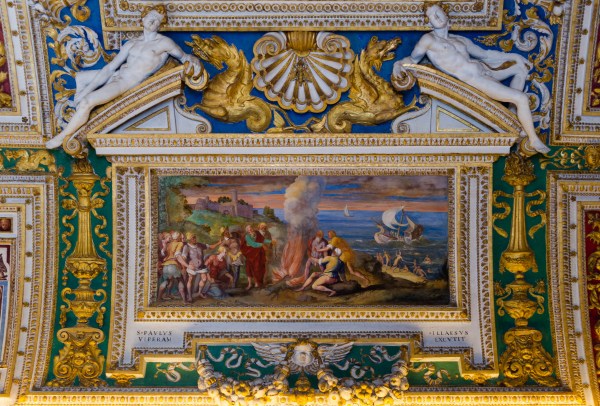
Above: Saint Paul bitten by a viper in Malta. Ceiling of the Gallery of Geographical Maps in Vatican City.

Blog at WordPress.com.

Up ↑