Writer’s Review: How to Write a Novel Using the Snowflake Method

If you’re familiar with my Adventures in Storytelling series, you’ll know that I’ve mentioned my preferred method of outlining. I started writing as a hardcore organic or “pantser” type. And while that method worked for me, I’d often find myself quickly losing control of the process and flying off into all sorts of interesting directions. In order to remedy this, I turned to a soft form of outlining I call wish-listing, where I jot down major plot points and connect and collate them as needed.

Naturally, I was intrigued by the premise of the Snowflake Method. The book promises a Goldilocks method, something in between plotter and pantser.

How to Write a Novel Using the Snowflake Method by Randy Ingermanson  

Many how-to-write books have little gimmicks to interest the reader, but I don’t think I’ve ever read a how-to with such a cute one. Mr. Ingermanson writes the book as a book, as in, it has a plot, characters, stakes, conflict, etc.

It’s cute and the charm managed to keep me reading. That said, it’s also short. Any longer than 160 pages and I’m pretty sure I would have gotten tired of it.

The way Mr. Ingermanson relays his information is through the plot and characters of the story.

Goldilocks is our protagonist. She has a dream: to become a best-selling author. The problem is, she doesn’t know where to start when it comes to writing a book. Goldilocks signs up for a series of writer’s workshops, hosted by the Three Bears, the eponymous Papa, Mama, and Baby.

Goldilocks quickly discovers that Papa’s method of plotting is far too rigid; Mama’s organic method is too open; but Baby Bear seems to be onto something with his method, one that splits the difference between his parents.

This method is the Snowflake Method, it is made up of ten steps and its underlining goal appears to be limiting the number of drafts and corrections without dulling the edge of the creative process.

The largest benefit to the rigid outline is its ability to see over the horizon and catch mistakes before they happen. While the biggest benefit to the organic method is the free flow of creative energy that gets words on a page. As someone who struggles with both methods, you can see why I find premise of the Snowflake Method interesting.

To see how it works, I actually took the time to write out a snowflake for a novella I’ve been planning. I won’t be listing any details here, as the snowflake is really designed for the writer, sharing it would give too much away.  

The Method consists of 10 steps:

  1. One sentence summary
  2. One paragraph summary
  3. Write a summary sheet for each character
  4. One page synopsis
  5. Write a character synopsis for each character
  6. Four-page synopsis
  7. Write a character bible
  8. List all the scenes
  9. Write a plan for each scene
  10.  Write your novel

Like most how-to-write guides, Ingermanson’s base is the Three-Act Structure. He also refers to it as the Three-Disaster Structure. His idea is that readers want three things: excitement, decision, and new directions—a disaster. Some might call this a plot point, or a beat. But it’s the incident that forces the character into confrontation with the plot, demanding they answer, and move the story forward.

So, let’s look at these steps.

One Sentence Summary

Fairly self-explanatory. Ingermanson states that it should “give [the reader] a taste of the story in twenty-five words or less.” (pg. 19) I actually call this a “mission statement” and use it as a statement of intent more for myself than anyone else, but I’ve been known to whip it out when a friend or family member asks me what I’m “writing about.” 

It’s a solid idea that I would recommend to the novice and expert alike. You want to be able to tell your friends and family what you’re writing, most importantly you want to be able to tell yourself what you’re writing.

One Paragraph Summary    

Again, another self-explanatory step. Each of Ingermanson’s steps build off the previous the steps, which is very intuitive. For the novice, this semi-solid structure may provide an example of what a writer needs to discern naturally.

The idea of the one paragraph summary is that you take the one sentence summary and expand it into five sentences, paying special attention to characters, setting, the disasters. It should hit all the story beats of each act and include your conclusion. Ingermanson doesn’t want you to bog yourself down with how you get to your conclusion or how characters respond to disaster so much as he wants you to draw the most basic of lines between persons, places, and events.  

Summary Sheet for Characters

For those familiar with my Adventures in Storytelling series, you’ll know that I’ve mentioned a character chart. I typically only make them for major characters and they not absolute, meaning, the character I chart might be completely different in the finished product.

The idea behind the chart is to throw every idea I have for that character down and I then draw lines connecting each piece of personality or backstory to each other. What I like to think I’m doing it making cause-and-effect clear to myself. Why is Character A like this? How did this event effect Character A?

Ingermanson’s character sheet is far from my blasé charts.

While Ingermanson makes it clear that this step isn’t necessary for every character, or that not every step within this step is needed for each character, this is where some of the tedium began to set in for me.

Ingermanson’s right, of course. There’s no need to produce a sheet for every character. As with my charts, it needs to be done for your main characters. You need to know your characters names, their values (“nothing is more important than X…”); their ambition (abstract desire); their goal (achievable); their conflict; their epiphany; a one sentence summary of their story; and a one paragraph summary of their life both in and out of the story.

As I said above, I struggled through this step. I worked out my main characters, wrote down some basic information for my minor characters, and moved on to the next step.

One Page Synopsis  

Unlike the one paragraph summary, the one-page synopsis might be useful for the marketing of a book. Editors and agents are busy people, they need a synopsis to hook them to make sure their time is used wisely.

Ingermanson suggest you take your one paragraph summary and turn each sentence of it into a paragraph.

For me, I found that easier said than done. But I understand Ingermanson’s point. It’s something that probably should be done. That said, I’ve done this only after I’ve finished a work.

I see the point; however, it does take that thin single paragraph and broaden the lines to build a skeleton which can be incarnated in the four-page synopsis.

Character Synopsis     

I’ll be honest, it was about here that I began to think that this method wasn’t really for me. I tried to convince myself that I’m just being averse to hard work, but that’s not being fair to all the hard work I’ve done in writing.

I determined that I would only write a synopsis for my two POV characters. Honestly, my conclusion was that the one paragraph summary I did of my characters in step 3 was all I needed.

Now, this might be because I’ve been brewing this novella for about a year now. It could also be that I don’t intend it to be a full novel. Frankly, this step felt “hand-holdy” if you catch my meaning.

Ingermanson is incredibly clear about how you don’t have to do all the steps of the Snowflake Method, and I appreciate that sentiment because this step isn’t for me. I don’t see its use other than to help you feel like you’re making some kind of progress.

Four Page Synopsis   

I skipped this step. I knew if I forced myself to write a four-page synopsis for my work, it would cause me to resent the Snowflake Method.

But I understand why he suggests it. Ingermanson is taking the rigid outline and hiding it in paragraphs instead of bullet points. He wants the writer to have their story idea locked down so that they know where they start and where they finish.  

Character Bible

Okay, so I was a little harsh on those last two steps. This step is a lot more useful to me. That said, it’s also something I would collapse into the character summaries of step 3.

Ingermanson’s character bible is meant to be the sheet that helps a writer keep track of the nitty-gritty detail of character, i.e., hair and eye color, age, height, DOB, favorite food, the way they take their tea, favorite movie/book, etc…

Not all these details are going to be relevant, although you should always make note of the way certain characters look, especially if they have certain defining features like scars or hair color. A character bible is the place to put that information.   

List all the Scenes

As Ingermanson says, the scene is the basic building block of any story. Each scene ought to play out the three-act structure in miniature, with a conflict and a resolution.

I didn’t do this or step 9. Why? Because I wrote a full page and half outline in step 4. And if I had completed step 6, what purpose would step 8 and 9 serve? I’ve already written the outline.    

In Chapter 8, Goldilocks realizes the crux of the method:

“The Snowflake Method was forcing her to think about things she hadn’t really worked out yet, but she could see that it was filling in the gaps in her story nicely. Every time Baby Bear asked a question, she could easily make up something on the spot to answer it.”

How to write a Novel using the Snowflake Method, Randy Ingermanson Chapter 8, page 69

Final Thoughts

The Snowflake Method is an ordering of the creative process. Its goal is to take the rigid outline and soften it with organic-looking paragraphs; Ingermanson cuts the hard work with fun work, and even gives approximate times you should give yourself to complete a task. He alternates the writer between character development and plot development to keep the writer from going lopsided in any direction.

Ultimately, I believe the Snowflake Method is a training tool. This book is not for people who already know how to write. This is for people who have no idea where to start, what to do, or where to finish. Honestly, I should have figured that out from the beginning. Goldilocks is a complete novice.

This feels like the kind of book a writer can use to get started. But after a while, you should start intuiting some of this process. Writing is an organic endeavor; you should always be getting better. Or as I like to say, where you start isn’t where you finish.

At some point, I think any writer who uses this method will eventually let it fall by the wayside as they develop their own writing tools. This is great for the novice. If you have absolutely no idea where to start, start here.  
Adventures in Storytelling 4

Entry 4, Carpe editorem, occide…continued.   

In my last entry I outlined four points that needed addressing in P1. I left off in the middle of my second round of editing and highlighted that I use my own tools to help identify my strengths and weaknesses. I made a list and focused on the nuts and bolts, things like -ly words and passive voice.

I want highlight one of the other two issues identified: lore/worldbuilding mistakes and inconsistencies; and, there are some things I simply don’t like.

I’m going to start with the first—lore/worldbuilding—because it’s easier to answer.

There is no end to the discourse regarding “worldbuilding.” There are endless books and articles on the topic, various charts and step-by-step guides on how to “build unique and imaginative places.” And that’s great, sometimes people need a guide.

Once you’ve come to understand the need for worldbuilding and mastered the concepts, your next step is to debate endlessly about when and where to use it, what qualifies as worldbuilding, and when its really just an infodump?

I’m not going to bore you with a lengthy discourse. I believe thoroughly that if you are writing, you are worldbuilding. Every sentence is an opportunity to build and deepen the unique flavor and culture of a world. It should be done in every kind of story, regardless if the setting is New York City or some far-flung elfland.

The danger with worldbuilding lies in the fact that sometimes it is an infodump.

In P1, I found that I didn’t really have a problem with infodumping. I killed that problem in one of my first drafts, working and reworking paragraphs and conversations to move information in a smoother way. I classified lore and worldbuilding information into two categories: absolutely necessary, and trivia.

Lore that is absolutely necessary is lore that is needed in order for the plot and the character’s actions to make sense. It is necessary to suspend a reader’s belief. For example, P1’s co-protagonist, R, has a background before meeting protagonist E. R’s background includes connections to an organization with an extensive history. That history must be told for R’s actions to make sense. Without that lore, R’s movements and thoughts become schizophrenic—unmoored from the reality of the story.

Lore classified as trivia is the nice little accoutrements that make a story unique, pretty, realistic. It’s the way someone styles hair or takes their tea. It’s how the road shunts to the left or how the flowers were blooming late in the mild spring. Fine details, those little things whose inclusion adds color but absence results in no serious loss to the central action of the story.

The issue was just how much lore I had.

If you recall from Adventures in Storytelling 1, I started P1 because a sense of overwhelming vastness that plagued my first abortive attempts at putting Project Paisley on paper. I knew I had something; I just wasn’t sure where to go with it. P1 was started to help me congeal—so to speak—my world.

In that, I would say I was successful. I believe the world I’ve created is colorful and realistic. Is it perfect? Of course not! But I think I have a world that is interesting and engaging. It’s made up of several counties, each with their own unique cultures.

That said, I didn’t start out that way. While writing, I spent a lot of time thinking about P1’s setting.

The main setting of P1 is an island-bound city, at the risk of oversharing, when thinking about this city I had two real cities in mind—London and Paris. I wanted to capture the things I liked about both cities. I thought deeply about how the ocean effects a city, it’s culture, government, etc. What considerations does an island-bound nation have to make regarding security? How does the sea change their food culture? What kind of jobs would their poor city-folk work? What of the prosperous?

In the end, I found myself asking, what would Paris be like if was actually on the coast of Normandy? What about London without the Thames?

My first draft was missing many of the key elements that I feel make this setting (as it’s written now) interesting. While I muddled through various technical problems, I found myself filling in the blank corners. Ordinary English idioms were rewritten to better relay the culture of a seafaring people, food became fish heavy, the peasantry became laborers and fishermen. I began to add these little details.

And that was just a single city. The religion of this world was terribly atrophied. I used a placeholder name for the main deity until a better name struck me in the middle of a slow work day. That bit of inspiration was just pure luck, the rest I had to force myself to sit down and think about.

When I began writing P1, I already had a small booklet that I jotted ideas in. It was in no way comprehensive, but it was helpful and allowed me to keep track of my thoughts.  

I’d written several notes about the religion of a particular civilization that acts as the “national antagonist” if that makes sense. This nation is in a strained relationship with the other nations. They’re less an actual threat and more a looming, invisible darkness that hangs over the characters like a Sword of Damocles.

With them, I had to ask myself, how weird am I willing to be? How strange and foreign do I go? I wanted to create a religion that would repulse all modern sensibilities. Something in the way of a mystery cult with elements of ancient fertility cults. I confided in some friends and the answer I got back is the same advice I would give to any writer. Be weird. Write what you want. Weird is where the fun is.

There is only one way to solve lore and worldbuilding inconsistencies. If its trivial, you can drop it. If it’s necessary, you alter it. Its perfectly possible for you to like the mistake more than the original idea. I’ve changed things to better match up with the mistake I made.

But, the more you have, the higher the chance for error. As I read through my second or third draft, I realized that my timeline was, well, fucked. I couldn’t keep my pacing tight. Things were moving either too quickly to be believable, or too slowly. Fixing this is easier said than done. I haven’t completely fixed it.

Before my most recent draft I sat down and did two things.

First, I worked out a primitive timeline. I went event by event and found that a perceptive reader would quickly take note of the awkwardness of the pacing. Conflict was happening so frequently that despite my clear delineation of day and night, it didn’t feel like there was enough time between problem and resolution.

Now, of course, piling catastrophe on catastrophe is part of being a writer. The action happens in between conflict and resolution. Because my story has a high element of political chaos, it was necessary for the conflicts to coalesce, or the solution to become a problem later in the plot. But I couldn’t make the pacing feel natural. I had to sit down and write it out, event by event, piece by piece, until I understood exactly what I was looking at.

I remain uncomfortable with my current timeline; I am working on fixing the pacing.

The second thing I did was go through each chapter and take out everything I could find that was lore related. I placed it all in a master document. This list has become an augmentation to my original booklet. I refer to it as needed. Now, anything inconsistent or repeated is glaringly obvious. By listing each piece of lore/worldbuilding with the chapter it was found in, I am now able to refer and correct.

You’ll note that these aren’t really solutions. They’re more like guides. The tasks I’ve made for myself are monumental and they cannot be solved in a few short sessions. As I write this entry, I’m actively in the middle of these corrections. I’m not foolish enough to think that I can work a perfect draft. Eventually, I will have to give in and let the story escape.

It’s hard to pinpoint a lesson when you’re actively attempting to fix something. The only thing I could offer my past self is this:

Writing is work, but a good story deserves your attention. Even if you can only work small pieces at a time, keep chipping away. Every correction, every setback, every mistake makes you a better writer.

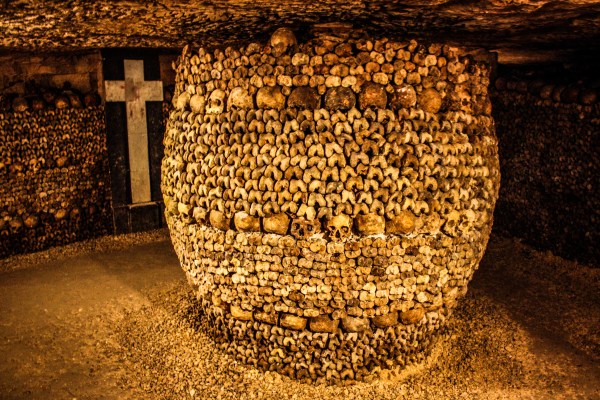
Above: a view from the Paris Catacombs. Consecrated in 1786, the Catacombs are the final resting place of countless Parisian dead. May the souls of the faithfully departed, through the mercy of God, rest in peace.

Four Letter Words

The following contains profanity.

Let me start this off by stating that I have no problem with curse words. I curse—too much, actually—but I’m not interested in shaming anyone. I am interested in the efficacy of profanity as it pertains to writing.

A long time ago I picked up a book on writing prose. I expected it to be a quick read, it promised a step-by-step guide to writing better, more dynamic prose. What I didn’t expect was for the author to immediately call me a bitch and then tell me to put the book down if I don’t like cursing because the author does a lot of it.

Okay, whatever. I said to myself. I got about a chapter in and realized that almost every paragraph had a swear word in it.

I put the book aside and haven’t picked it up since. I began to question if this was someone I wanted to learn prose from. Not because I don’t like cursing—I don’t, to be honest, but it’s habituated in the culture and I’m perfectly guilty of using cuss words so I’m not judging the author for using vulgarity.

I’m judging the author for writing prose so damn onerous it became tedious to read.

I don’t remember where I heard it, but I picked up a piece of advice regarding curse words and writing. The advice went something like this: “save it for when you really mean it.” I took that advice to heart. There is cursing in my writing, I’ve got no problem dropping a “damn” or a “hell.” Sometimes I even exercise my creative liberty with a “damnation” or a “hellfire.” But before I drop anything harder, I think about the impact of that word.

Words are powerful. There is a reason why some phrases, some sentences, some stories stay with us. Words make an impact, for good or ill.

The Harry Potter series is filled with colorful aphorisms: “Merlin’s beard,” “Merlin’s pants,” “galloping gorgons” the offensive “mudblood.” But the most famous, most powerful cuss said in the Harry Potter series is said by the least likely person, an all-caps piece of formatting art:

“NOT MY DAUGHTER, YOU BITCH!”

-Molly Weasley, Harry Potter and the Deathly Hallows

This was absolutely thrilling to my teenage self. It felt very grown up, very earned. Molly Weasley said what we were all thinking. We’d been on this journey with Harry and friends and Bellatrix Lestrange was one of the villains most in need of some violent correction.

There’s a lot of power behind the fact that this is really the only time a true “muggle-world” curse is used in the Harry Potter books. By saving this pejorative until the end, by having it said by a character no one would expect, by using it on someone who unmistakably deserved it, Rowling punches the word home. It does not become trite and tired, it remains forceful, meaningful. Bellatrix Lestrange was a bitch, she died like a bitch, and Mrs. Weasley is a bad bitch.

From my own writing, I wrote a character who was disgraced royalty. This character hid the effect of that shame by acting disgracefully, using curses, blasphemies, and unbecoming language to make it seem that the shame was a choice, not something forced upon them. The character’s business partner never used foul language and often chastised the other character for their uncouth behavior. Character B was well aware of Character A’s past and knew them to better than a common thug.

To get this theme across, I put a lot curse words in A’s mouth and at some point, during the editing process I heard that piece of advice from above. Suddenly all the piled up “fucks” and “shits” started to become repetitive. Annoying even, like clutter. My prose was overburdened with words that began to lose any semblance of meaning.  

A word loses its strength with every repetition. Psychology calls this phenomenon semantic satiation, where a word repeated temporarily loses all meaning. After the fifth of sixth curse in as many (or fewer) paragraphs, I found the curses to be like dirty laundry piled up in the corners of a room. Annoying, nagging, in need of a good wash.  

So, I took up the task to remove all but the most necessary swears. I found that this exercise was ultimately better for the work. I came up with charming little ejaculations not unlike Rowling’s “Merlin’s beard” that added cultural flavor to the world. Character B still reacted to these phrases with offense, but I peeled away the meaningless white noise that “fuck” had taken on in the story.

As a bonus, when I do whip out the above curse, it was suddenly and powerfully steeped in meaning. The scene is an airing of grievances. Character A accuses B of wanting to “fuck” and it’s meant in all the dirty, grimy, objectification that word entails. Greatly insulted, B turns the phrase around. This is the only time B curses in the story and it shocks A into silence.

All this is said with a big heaping spoon of it’s my opinion. Still, I think “save it for when you really mean it, when it will be most powerful” is pretty good advice. Perhaps if we all took this advice to heart, our interactions with each other would be less cluttered with nonsense expletives turned filler.  

Take the advice, or don’t, fuck if I care.     

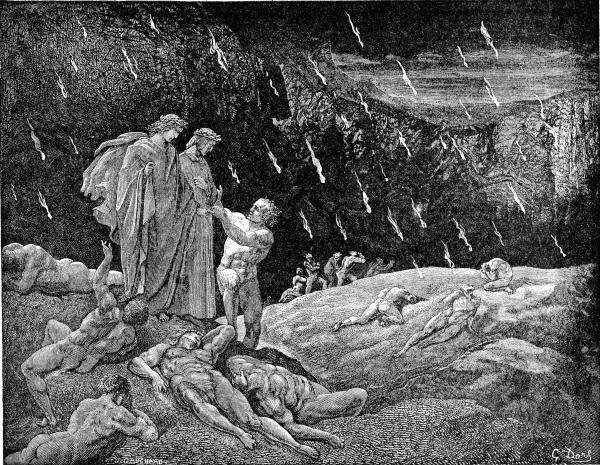
Above: Illustration of Dante Alighieri’s Divine Comedy, the Inferno Canto XV. Gustave Doré (January 1832 – January 1883). French. Engraved Print.

Don’t forget to check out the crowdfunding pages for Anvil Issue 2, where my short story, Afflicted: Nourritures les Ver, will be published! For more info, click here.

Writer’s Review: The Secrets to Creating Character Arcs

Before I began writing these reviews, I had a simple criterion for selecting a how-to-write book: I judged the cover.

The cliché “never judge a book by its cover” is more like an aspiration, sort of like “reach for the stars.” No one is actually going to reach up and grab a star and no one is ever going to not judge a book by its cover.

I admit, it’s not a great method. But, when it comes to reading into a topic where you’re not really sure where to start, it’s a utilitarian method. I mean, how else are you supposed to select a book? Considering the books in this genre are designed for mass-appeal you just have to dive in.

Today’s book is one of those I selected based on the cover. I just like it, its simple and striking.         

The Secrets to Creating Character Arcs: A Fiction Writer’s Guide to Masterful Character Creation (Growing Authors out of Writers) by John S. Warner

I can’t tell you anything about John S. Warner. He has a Facebook and a Goodreads page, but it appears that everything he writes is how-to-write books. I have no problem with this, readers are the best at telling writers what they want to read.

The Secrets to Creating Character Arcs: A Fiction Writer’s Guide to Masterful Character Creation (Growing Authors out of Writers) is made up of ten chapters with an introduction and concluding remarks. It’s a little less than 200 pages, making it a quick and easy read.

Warner starts the book with a quick explanation of what he calls The Holy Trinity: Plot, Structure, and Characters. A good story, he writes, is made of this union. I can agree here, but this isn’t really ground breaking. It took a few more chapters for me to finally feel like I was getting something worthwhile from this book.  

Warner’s next step is to discuss the Trinity in further detail. He starts with plot. He provides some advice.

  • Your plot should provide a smooth flow to the story
  • The focus of your plot should be on the leading characters of your story
  • Your plot should have a clear insight into your protagonist’s psyche
  • The plot should start with a bang
  • Your plot should grab the emotions of your readers, but let go in the end

Again, nothing here that I wouldn’t call intuitive to the practicing writer.

However, once he begins breaking down what he means by plot points, I feel like we’re finally getting into some nitty-gritty. It was about here that I began to enjoy it. You see, this book falls into a category I would classify as a “beginner’s basics” or an “expert’s vindicator.”

What Warner begins to discuss now are the seven plot points.

  • Inciting incident
    • First point
      • First pinch
    • Midpoint
      • Final pinch
    • Second point
  • Resolution

He fleshes out each bullet point and then describes how the arrangement of these points is structure.

I then began to contrast what Warner was writing with my own personal techniques. I saw how they differed and how they overlapped. I realized that I didn’t need to read this book, but I wanted to. Warner’s book was simple enough that it was making me think about my own theories.

Warner calls it plotting—writing down the desired events of your story—I call it wish-listing. When it comes to ordering these points, we both call it structuring. These are just a few examples of our overlapping.

Warner dedicates a good chunk of the book to some quick outlines of various, popular structures like Save the Cat’s Beat Sheet and the Fichtean Curve. This a helpful for someone who is not familiar with these structural modes or for someone who wants a refresher.

Once Warner finishes up his explanations of the first aspects of the trinity, he moves on to the real red meat of the book: characters and characterization.

He begins with the bones of a character—what he calls the three pillars of characterization. They are Physical Characterization, the distinct physical details of your character like a scar, scabby knees, or left-handedness. Psychological characterization, those psychological details that help you build a character’s personality, their fears, biases, secrets. Lastly, social circumstances, your character’s place in a society, their school, profession, etc.

I appreciate that Warner writes on archetypes, but stays away from the traditional Jungian archetypes. He keeps it minimal, focusing on Protagonists, antagonists, mentors, sidekicks, and skeptics.

Warner finishes the book with several chapters on crafting characters. He provides questions, some basic tips, and outlines to help you write. There isn’t really anything here to write home about.

Final Thoughts

As much as I enjoyed Warner’s Creating Character Arcs, I can’t say that there is much here for experienced writers. There were many sections that I found helpful for formulating my own ideas on writing, but I can see how that wouldn’t be useful for every writer.

Certainly, if you’re a beginner looking for a more structured way to craft characters, Warner’s book might be a good starting point.

Skippable, but useful for certain purposes.   

Don’t forget to check out the crowdfunding pages for Anvil Issue 2, where my short story, Afflicted: Nourritures les Ver, will be published! For more info, click here.

Anvil Issue #2 is Funding Now

Anvil: Iron Age Magazine is no longer funding, but can be purchased “in demand” on Indiegogo. My short story, Afflicted: Nourritures les Ver, will be included in this issue along with a number of comics and shorts by other independent authors like me.

I can only speak for myself, but I am extremely excited about this magazine and my small place in it. I believe Nourritures les Ver will fit comfortably on the shelves of fantasy, sci-fi, and horror fans alike. I hope the blurb below whets you appetite for more.

Afflicted: Nourritures les Ver by Jaime Faye Torkelson

Amélia Mitre is Afflicted. Cursed by a pact of her own making, she is made to follow the Weird Way of Scealfe, God of Death of Decay. Summoned to the industrializing city of Beauanne, the Cursed Doctor finds herself investigating a disturbing disease that defies the laws of nature and therefore, the laws of her dark patron. She must discover the origins of the plague and punish anyone foolish enough to pretend rivalry with the God of Death.

If you choose to support Anvil, let them know I sent you. Your support, no matter how small, helps keep the flame of independent IPs alive and I cannot thank you enough!

My thanks, first and foremost, to God, who likes stories more than I do.

Secondly, the team at Iron Age Media has been great to work with. I highly recommend you check out their website.

And, finally, to the readers, who deserve good stories I hope my small offering fits the bill.

Above: a handful of worms in coffee ground compost, which makes excellent worm food.

Blog at WordPress.com.

Up ↑