An Update No One Asked For

But, boy, writing it was cathartic.

When I set out to work on this blog, I had hoped to be consistent in my updates. That thought was quickly thrown out the window when I realized that I didn’t have much of anything to say and in trying to practice what I preach, I decided to say nothing but for the occasionally interesting (at least to me) thought.

Now I’m writing this to give you a bit of an update.

Whew, friends, but the two years have been…we’ll call it an “adventure” instead of “an ever-widening nightmare of failures and fuck-ups.”

That’s probably a little too harsh, but for a while I really did feel that way. Far from trusting the Lord, I fell back into my old habits and started despairing over my lot in life. Little did I know, the Lord was preparing me for something else, the totality of which I still don’t fully understand.

But that’s neither here nor there, what I wanted to get across in this post is that you may notice that my fiction writing has gone quiet. I haven’t made any posts about my short stories or that novel I’ve been working on for the last year and change and unfortunately that silence might drag on for a little while more.

You see, as part of that long list of failures—er, adventure—is that I lost my job and spent about three months absolutely disoriented by how and when everything I had planned went wrong.

In the wake of 2024: relationships imploded, projects abandoned, plans shredded, ideas were cursed, everything and anything that could go wrong, went very, very, very wrong.

Hindsight is 20/20, but I’ve worn glasses my entire life and don’t have 20/20 vision. The incomplete picture of 2024-2025 is something that may sharpen into focus within another year of two.  

I’m not complaining, even if it seems like I am.

All of this is grist for the mill. A writer needs experiences, and nothing is a more visceral experience than heartbreak and humiliation. I look back on the past two years and see the narrative thread, however faintly, trusting that the Lord Jesus knows me better than I do and that His plans are always better than mine.

So, what am I up to?

At the prompting of the Holy Spirit, I’ve embraced my desire for higher education and am now pursuing my Master’s Degree in Catechetics and Evangelization (that is, teaching and proclaiming the Faith) so that this blunt instrument might become a more useful tool for the Lord and His Church. I’ve also taken on a full-time job to coincide with going to school. This is because I ascribe to the “rip the band aid off” philosophy of rapid personal change.  

A new short story will be published in summer 2026 with Cirsova.

If you were a fan of Afflicted (Anvil Magazine #2), you’ll like this one: Dr. Amélia Mitre is back in Afflicted: the Hands of Hanged Men. I’ll update you as the time for publication come nearer. I really like this one, it’s dark, spooky, and a bit longer than the first.

The novel I’ve been working on since January 2024 was completed back in April of this year and went through a first round of edits in May. It was handed off to a professional editor in August and came back to me in early September. I am now working through those edits and I think once it’s done, I’ll have something worthwhile.

Progress has slowed on that front, mostly because I now have a full-time job and am a part-time graduate student. I’ve been slowly making progress, but I want to a complete work before I show too much of it off.

Needless to say, if you’re a fan of swords and sorcery, you might enjoy Iron Sharpens Iron. More details will follow.

Thank you for everyone who has supported me and prayed for me, read my work, etc. You are appreciated, and I pray for you.

St. Therese of Lisieux, St. Joan of Arc, St. Francis de Sales, St. Francis of Assisi—pray for us!        

Above: Portrait of Jean Miélot, a Burgundian Scribe by Jean le Tavernier (d. 1462). French. Housed in Bibliothèque Nationale de France.
Conan Confronts Christ

What hath Cimmeria to do with Jerusalem?  

This is a weird one, I’m going to have to ask you to just go along with this…meditation?

I say meditation because I’m not sure it’s a complete thought. I’m certainly not going to stake anything on it, or consider it some great piece of theology. It’s just a meditation. A splinter in the mind, something I want to wiggle out.

I keep a Florilegium, or a commonplace book. I started keeping it in May of 2022. Among the petals are various quotes, sayings, snatches of poetry—anything and everything—that sticks out to me. I’ve got scripture, jokes, historical facts, bits of advice, bits and bobs of fiction I enjoy.

Part of the exercise of keeping a Florilegium is memorization. Its far easier to memorize something that’s been deliberately hand written than it is simply try to recall it.

It also gives some form to my life, like a journal. I know that during the years of 2022 – 2024, I was deeply engrossed in studying the Bible leading up to my Baptism in 2023. So my first volume is mostly scriptural passages intermixed with quotes from GK Chesterton, Bishop Robert Barron, Dorothy Sayers, and the Spiritual Combat.

Towards the end of the book, as 2024 begins, you see more Frank Herbert, Frank Sneed, C.S Lewis, and Robert Howard’s Conan of Cimmeria.  

Robert Howard was a poet—a deeply passionate, visceral poet. He was a master of alliteration, especially in his Conan stories.

“The dead are dead, and what has passed is done!”

“…savored too strongly of sorcery for comfort.”

Civilized men are more discourteous than savages because they know they can be impolite without having their skulls split, as a general thing.”

When Conan speaks, he has the cadence of rolling thunder or a beating drum, while Howard’s narrative sometimes has the soft silky ‘s’ that cry out to be read aloud. My appreciation for Howard’s character is one of poetry. Conan is resoundingly full of life—pagan life, to be sure, but he springs forth like the poetry of the Iliad or the Odyssey.     

There is an eternal, although I suspect, perfectly settled question about the place of Pagan literature in the life of the Christian. Should we indulge in the flights and fancies of the Pagans? The Iliad is akin to a sort of Greek Scriptures, does it have anything of value for the Christ-Follower?   

Tertullian, although speaking of Greek Philosophy, said “what hath Athens to do with Jerusalem?”

“Let me live deep while I can; let me know the rich juices of red meat and stinging wine on my palate, the hot embrace of white arms, the mad exultations of battle when the blue blades flame and crimson, and I am content. Let teachers and priests and philosophers brood over questions of reality and illusion. I know this: if life is an illusion, then I am no less an illusion, and being thus, the illusion is real to me. I live, I burn with life, I love, I slay, and I am content.” – Robert Howard, the Queen of the Black Coast

“… let me know the rich juices of red meat and stinging wine on my palate…” for the past several months, when I receive Eucharist, and cross myself and kneel in absolute thanksgiving for this body, given for me, that I may have eternal life, and have it abundantly, this quote keeps coming unbidden to my mind.

Stinging wine on my palate, I muse, as the Blood of Christ, under the species of wine, lingers on my tongue.

The entirety of the quote is pure pagan speculation. Conan is in a discourse about the afterlife with his lover, the Pirate Queen, Bêlit. Conan’s people, the Cimmerians, do not believe in a comforting afterlife. Bêlit does, especially in the various afterlifes offered by the Gods of the Shemites.

Mostly, Bêlit believes:

“There is life beyond death, I know, and I know this too, Conan of Cimmeria…my love is stronger than death! I have lain in your arms, panting with the violence of our love; you have held and crushed and conquered me, drawing my soul to your lips with the fierceness of your bruising kisses. My heart is welded to your heart, my soul is part of your soul! Were I still in death and you fighting for life, I would come back from the abyss to aid you—aye, whether my soul floated with the purple sails on the crystal sea of paradise, or writhed in the molten flames of hell! I am yours, and all the gods and all their eternities shall never sever us!”  – Robert Howard, the Queen of the Black Coast

Bêlit speaks with the eroticism of the Song of Solomon: “set me as a seal upon your heart, as a seal upon your arm; for love is strong as death,” Song 8: 6RVS2CE.

If the Song of Solomon is about the Eternal Bridegroom and His Bride, longing for each other, then perhaps, Bêlit is no so far off the mark as she may seem. C.S Lewis spoke of the pagan’s “good dreams.”

Perhaps Conan dwells in the same “good dreams” as those of Odysseus and Hector?

Maybe even the Christian is meant to dwell in a world of high adventure in the time before the oceans drank Atlantis.

Perhaps Conan puts before me, as Tolkien says: “the one great thing to love on earth: the Blessed Sacrament…There you will find romance, glory, honour, fidelity, and the true way of all your loves on earth.”

I receive Christ in the Eucharist, and while I am on earth, I am extolled to live deep, to know the rich juices of red meat and stinging wine on my palate, to one day embrace a husband and dwell together as an icon of the Trinity; to fight in the mad exultations of the spiritual battle where the blades flash blue and crimson, until the earthly pilgrimage is done, and be content.

That’s the romance, that’s the adventure! The glory of God, Saint Irenaeus says, is a human being, fully alive. And who is not fully alive, but a man who declares: “I live, I burn with life, I love, I slay, and I am content.”   

Final Thoughts

I am not saying Conan is a Christian hero-type, nor am I sneaking any incoherent “universalism” into my religious thought, (I am resolutely orthodox). I am, however, making use of Justin Martyr’s conviction that all well said things rightly belong to us Christians.

Robert Howard, by all accounts, was not particularly religious, and even if he were I can only doubt that he would be Catholic. He was much in love with his native Texas and the Southwest in general, and I suspect that would incline him towards the Protestant viewpoint of his native land.

But there’s something about Howard’s writing, especially in his Conan stories, that marks me as incarnational. His work is visceral, it feels fleshy, substantive. I first wrote down the “Let me live deep” quote because I was enchanted by the image of red beef and wine, so much so I thought I could almost taste it.

It was the Eucharist which drew me into Roman Catholicism. Once I had read the Bread of Life Discourse, I could not imagine myself in any other Church but the one that took Jesus literally. So it only makes sense that these two figures, Christ, and Conan, must confront each other in the corner of my thoughts.

I think I’ll keep taking Conan with me to the Eucharist.


Are you as interested in tales of high adventure as I am? I write my own, you can find them here.

You can also follow me on Twitter/X.

I’ve discussed Conan before, check it out here.

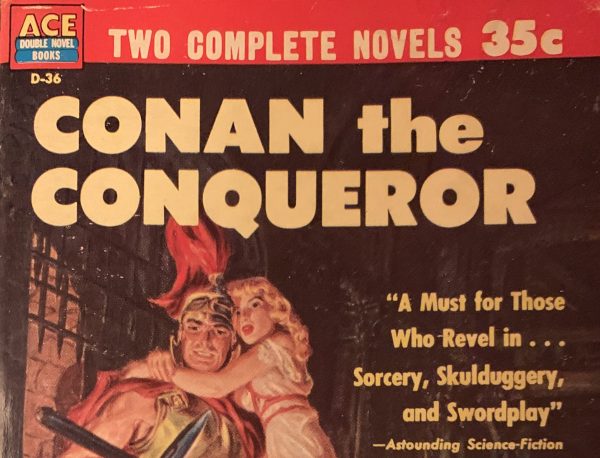
ABOVE: the cover of “Conan the Conqueror” (AKA: The Hour of the Dragon), by Robert E Howard. Art by Norman Saunders from 1953 for an ACE Double Novel.

Get Ready for Cirsova Spring 2025!

My short story, Machine Dreams for Wired People along with many other delicious pulp offerings, are now available for preorder for Amazon Kindle, and Lulu Hardcover. A softcover version will also be made available. The magazine is scheduled for release on March 19th, 2025.

Here’s the blurb for Machine Dreams for Wired People, from Cirsova Magazine: A family infiltration team is hired to break into a cybernetic AI factory to rescue the itinerant daughter of a wealthy benefactor before her mind can be liquified!

Machine Dreams for Wired People is my first serious dip into Cyberpunk. I had a lot of fun writing this one, I think it manages to find a way to be both horrific and humous. Like most futuristic horror, it’s absurd, and its supposed to be.

If you like the story, please be sure to leave a review, even a short one can really help!

Shoot the Devil

My short story, Gloryhound, is now available on Amazon Kindle as part of the anthology, Shoot the Devil Militia of Martyrs! Get it here.

Gloryhound: A beast stalks the woods of France, devouring men, women, and children with the cold, cruel efficiency of a man. Hundreds have hunted the Beast of the Gévaudan, but none are quite like Jean Chastel. He follows the Beast’s trail and prays for an end to the carnage. When a mysterious girl arrives, knowing things only the dead could know, Jean soon realizes that his prayers have been answered. But the hunt has only just begun, and the end is in the sacrifice.

Check this anthology out and leave a review on amazon!

I have other weird tales to share, you can find them here! 

You can also follow me on Twitter/X!

ABOVE: detail of the bottom section of Saint Michael; Master of Belmonte, Spanish, (Aragon). 1460–1490. Tempera and oil on wood. Housed at the Met Cloisters, New York, New York.

Review: To Sleep in a Sea of Stars, Christopher Paolini

Christopher Paolini and I go way back. Growing up I loved the Inheritance Cycle—or rather, I loved the first two books. Eagon was a fun ride for what it was although it took me a second reading really to appreciate Eldest. Unfortunately, by the time I reached high school I had, for the most part, moved on.

I eventually did finish Brisingr, but it left nothing to me. I barely have any memory of actually reading it. When Inheritance came out, I simply ignored it and seldom, if ever, thought of Paolini again.

A few months ago, a coworker told me about To Sleep in a Sea of Stars, a sci-fi offering from a now very grown-up Christopher Paolini.

I thought, great, maybe this will ignite my love of his works? He’s an adult now, he has experience, gravitas. I’ll give this a read.

To start off this review, I want to say that I don’t regret reading Stars. It was fun, a solid reading experience. But the book left me with a sense of missed opportunity, of near-incompleteness.

There’s a lot of good ideas in this book and each one is sort of picked up, given a cursory examination, and gently set back down again as we move onto the next item of interest. After finishing the novel, I just couldn’t shake the sense that Paolini told the wrong story—that he missed out on the far more interesting tales going on it the background.

Part of what makes the background seem so much more interesting is the absolute bore of a character that is Kira, our POV main protagonist.

Kira has the flavor a passive observer. Things happen to Kira.

Some of this passivity is a product of the universe she inhabits—one that takes orders. Kira is a scientist for a major corporation, she takes orders or she doesn’t get paid; the government is a military dictatorship and she does what they say because she’s a good citizen.

When Kira does finally muscle up some agency, its too little to late. Her character is one that allows things to happen to her, why the sudden shift in attitude?

A story where things happen to an everyman character isn’t necessarily a bad one, but passivity in fiction can be perilous for the writer. There are time where Paolini seems to peek out of the clouds and offer his characters a dues ex machina.

“Wow, that was lucky!” Isn’t really the kind of thing a reader wants to be thinking about how the last story crisis played out. There’s a time and place for that kind of narrative trick, but for Kira, it just reiterates her passivity. She is not calm, cool, collected, or competent. Moments for character growth are unearned—or worse, boring.

Which leads me to my next big issue with Stars. The space travel is boring.

Because of the way Paolini designed FTL space travel, it necessitates that most of the characters go into deep freeze. Kira, immune to the drugs that put people under, spends weeks by herself and Kira simply isn’t interesting enough to make these long periods of narrative fun or stimulating.

Kira’s “progress” made during these FTL trips are a slog to read through, lending to the overall sense of her nonparticipation. Her development feels unearned because the only person she really contends with is herself.

My third, and perhaps my biggest issue with Stars is the direct cause of that sense of incompleteness I mentioned above.

Paolini has created a horrific galaxy filled with technological marvels that stretch the bounds of science and good sense. He’s placed normal people into a place of deep disquiet, but whenever he draws close to pulling out a thread of that existential terror, he draws back and I’m left asking “wait, what? Go back to that, talk about that!”   

At some point, the rebel alien faction mentions that they agreed with the main alien faction’s original plan to invade and conquer human space, they only changed their minds because they felt they needed the help of the humans to defeat a bigger threat.  

This revelation, which is great fodder for storytelling, is barely touched outside a mention here or there.  

But it goes deeper than just missed opportunities.

Like most modern sci-fi, Stars embraces an unquestioning endorsement of Gnosticism. The characters are only their minds, not the flesh that encases them working in tandem with their souls. Despite that many of the characters have become something else, they insist that they have not, that it’s still “them inside.”

But this isn’t true; by the end, Kira becomes something else in the same way Ship Minds are something else.

I think Paolini wants the reader to feel happy for Kira. She has found peace, or at least purpose. But its hard to reconcile what I’m told to feel with the actuality of what he is describing.

Kira is a Lovecraftian nightmare, a color out of dark space. When she returns from her sojourn, when all her friends are long dead and there is nothing left to tie her to the humanity she is no longer a part of, what’s to stop her from becoming the tyrant of the future? She’s already showed signs of it—spying on her friends, passing out all-powerful gifts, making demands of reasonably skeptical government leaders.

And it’s that disquieting, horrific future that I’m far more interested in. Maybe in the sequel, Paolini will deal with these lingering questions? Maybe Stars is the villain’s origin story? Maybe we’ll meet a Ship Mind made a ship’s mind against their will? Maybe someone will stand up to the military dictatorship? I’m not terribly hopeful, but taking a stab as any of those questions would do a lot towards getting me interested in the next book.

Miscellaneous notes

I’ve been telling people that To Sleep in a Sea of Stars reminds me of Mass Effect Andromeda in that I don’t like any of the characters and just when I think it’s going to let me have fun, it doesn’t.

This seems harsh until you learn that I didn’t hate Andromeda. But I didn’t like Andromeda for the reasons that Bioware wanted me like to Andromeda.

Most of the fun in Andromeda came from being deliberately annoying to my shipmates or picking it apart for its questionable plot or finding interesting ways to break it. In other words, Andromeda was fun when I didn’t take it seriously.  

Towards the end of Stars I couldn’t stop laughing. The ending is mostly silly or it’s saccharine to a ridiculous degree. I’m even laughing as I write this because some of the ending is that outlandish.

Stars is also like Mass Effect in the sense that it’s Mass Effect. There’s a lot of similarities right down to the fact that the audiobook is voiced by Jennifer Hale, the voice of Female Shepard. Paolini doesn’t try to hide this fact, he was upfront with Mass Effect’s influence on his work, and it doesn’t really bother me, but it’s there.

Final Thoughts    

Paolini’s capacity for creativity is undiminished. What he lacks is the writing chops to deal with his topics in a charming and stylistically interesting way. To Sleep in a Sea of Stars is competently written, creatively charged, and fast-paced enough to make its hefty page count a relatively easy read. But there’s little to go back to and most of what I’ll recall years from now is what made it entertaining for the wrong reasons.

I don’t regret reading it, but I can’t recommend it.

I write weird tales of my own, you can see them here! Follow me on Twitter/X.

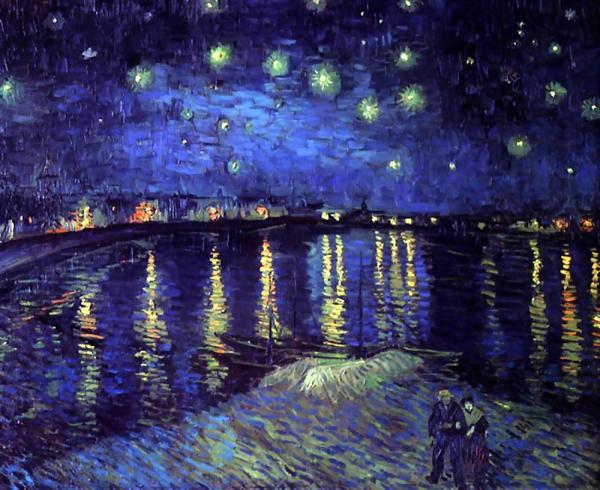
Above: Starry Night Over the Rhône. Oil on Canvas. Vincent van Gogh (1853-1890), Dutch. Currently housed in the Musée d’Orsay in Paris, France.

Blog at WordPress.com.

Up ↑