For this entry in Adventures in Storytelling, I’m doing something a little different. Instead of focusing on myself and my journey, I want to turn our attention onto a less well-known part of Storytelling, namely, publishing.
Richard Wilson is the founder of IronAge Media. Recently, his new magazine ANVIL: An IronAge Magazine was crowdfunded and released in July of 2023. In the interest of full disclosure, I was a backer of issue 1 and, my short story, Afflicted: Nourritures les Ver, will be published in ANVIL issue 2 which will be released this coming October. Although fundraising has ended, you can still purchase copies “on demand” via Indigogo.
The point of this series has always been to share tips, tricks, and struggles in the same way someone might journal a travel diary. Richard is on the bleeding edge of a new era of literary endeavor and I think we can learn a lot from his side of the adventure.
Independent publishing has become the norm and pulp style magazines are seeing a resurgence in online circles. While I’m not sure that the traditional publication industry is entirely down for the count, its certainly exciting to see new blood in the literary world.
I’d like to thank Richard and everyone at IronAge Media for consenting to this interview. Working with this team has been an awesome experience. I’ve learned so much from the interactions I’ve had with Richard.
Let’s get into it.
The Interview
Tell me a little about yourself. Are you a writer, artist, or is Anvil Magazine your first creative endeavor?
Well I’m certainly not a writer, and although I have done plenty of painting and sketching in the past I wouldn’t identify as an artist. Prior to ANVIL I had worked on a couple of personal projects that would qualify as creative endeavors, but all of them were digital and coding focused. A few small video games and mods, some coding projects, and even a metaverse for a bit. However, ANVIL was the first thing I’ve personally made a serious effort to bring to market.
Who are your favorite writers or books? Favorite video games, comics? What type of media inspires you?
That’s a big question. Early in life the Dinotopia books by James Gurney were particularly influential in my love of reading and I believe they hold up as beautiful artistic works as an adult. The original Dune series, The Book of the New Sun, and Zen and the Art of Motorcycle Maintenance were all works that I chewed on in my high school years, in addition to the usual high school assigned reading torment and more casual fun of older scifi.
For readers who might not be familiar, in your own words, what is the Iron Age?
I’ll steal from myself in the first issue of ANVIL: The Iron Age is a decentralized movement of independent creators, across genres and mediums, circumventing traditional producers to create the kinds of entertainment that they want to see.
Do you think there’s a real hunger for original IPs?
I think there’s a hunger for something different. Before mega-corporations started buying up IPs like startup competitors, I think there was a much broader range of ‘taste’ within those legacy franchises and people didn’t feel any need to look around. Now if you want something aside from boardroom, corporate approved mediocrity wearing your childhood franchises like a skinsuit, you really have to look to new, original IPs.
What is the philosophy or guiding principle of IronAge Media?
Become the culture! Pragmatically that means bootstrapping the new media ecosystem as best as I can.
What made you want to start a magazine? Was it a spur of the moment decision or was it something you had always dreamed of? I know you have a talented team working with you, were you friends before IronAge Media, or did you just come together as a group of like-minded people? (i.e. how did this team get assembled?)
It was relatively spur of the moment. I hadn’t considered starting a magazine in January, but I was looking at actionable ways to achieve some broader goals I’d been thinking about. As for the team, Daniel and Jake were people I met early in the process of growing IronAge Media, and it was just a matter of looking at people who I knew I’d work well with and also had the skill sets I needed.
How did you settle on the name, Anvil? Is it symbolic or just cool?
Both. It was the first thing that popped in my mind when I was thinking about the magazine. Symbolically and thematically on brand for the Iron Age. I agonized over a lot of other names when I discovered an old communist rag was called ‘The Anvil’ back a hundred years ago, but I ultimately decided I’d rather go with my instincts and re-appropriate the term.
The first issue of Anvil Magazine far surpassed its original monetary goal, how does that feel? Were you surprised or did you know there was a desire for the kind of stories that Anvil promises?
It was immensely humbling more than anything else. I wasn’t necessarily surprised that people wanted it, I felt confident in the product, but I was surprised that I was able to get enough attention to communicate what it was to people and that those people were willing to trust me to deliver on that message.
What was the hardest part of getting IronAge Media and Anvil magazine off the ground? What was the most fun? And what was the most rewarding?
For me the greatest difficulty of IAM has been articles. I’m not a writer by practice, so writing a review or article for the site is far more time consuming than it should be, which is why I’m so appreciative of people who send in content. As for the most fun I’d definitely say the image prompts. Those were a decision I made on a whim and have proven to be a major part of the community building of IAM, and in many ways lead directly to ANVIL. Regarding ANVIL, by far the most difficult part of it has been fulfillment so far. I know a lot of people see the big number on the campaign and think it translates to big dollars for me, but when it comes to hourly rate, I definitely screwed myself over. The success of ANVIL of course has been an amazing and at times surreal experience that opened up a lot more options for what else I’d like to do. Certainly seeing authors happy to be published and readers excited about the magazine has been a very rewarding.
What are your future hopes for Iron Age Media? Do you have any plans to see IronAge Media branch out beyond Anvil Magazine? Do you see Anvil as a herald of a new age in media?
Expect to see the IAM site rebuilt soon to give users a more modern, slick feel. The overall brand is already moving into some new projects. One which will be public later this year, another that has a much longer timeline.
My goal for ANVIL has always been to create a place for consumers to find enjoyable works by new authors and artists they will love. I find that there’s a lot of (justified) complaining about consumer habits in the indie world, but I hope a brand like ANVIL can work as a stepping stone to draw in new buyers who know they aren’t happy, and just aren’t sure where to find that originality they’ve been missing.
I always end my entries of Adventures in Storytelling with a lesson I learned or a piece of advice I found helpful. Are there any lessons that launching Iron Age Media and ANVIL1 taught you?
Be a rational optimist and, the fastest way to learn if something is viable is to do it. There are a million failed websites and tens of thousands of failed magazines. If I had been negative about this I never would have tried. Instead I took a risk, put in the work, alongside other hard working folks, and now I can say that indie creators have made money and gained fans thanks to the project.
Do you have any advice for writers, artists, publishers?
The potential market for new media is huge. Focus on your work and getting that work in front of buyers. Another person succeeding doesn’t take money out of your pocket, our current, globally networked economy is just too big for that. Doesn’t mean seeing crap succeeding is any less frustrating, but don’t let it drive you to harm your own goals.
Any final thoughts to share? Where can my readers find you?
Thank you for the opportunity to publish Afflicted! My wife and myself both enjoyed the character of Amélia Mitre and the interesting world you’ve placed her in. Your readers can find me at IronAge.Media and follow the links there to my various socials. I stream on Sunday evenings if you’d like to chat with me as I do something relaxing.
Again, I want to offer my heartfelt thanks to Richard and everyone at IronAge Media. Working with IronAge has been a awesome and humbling experience. It’s my hope that we work together in the future.
To sum up Richard’s great advice, remember:
Be a rational optimist. The fastest way to learn if something is possible, is to do it. Drop the negativity, take a risk, put in the work, and surround yourself with a cadre of other hardworking folk.
The potential market is huge, other people succeeding isn’t taking success from you, even if it hurts to see mediocre work rise to the top.
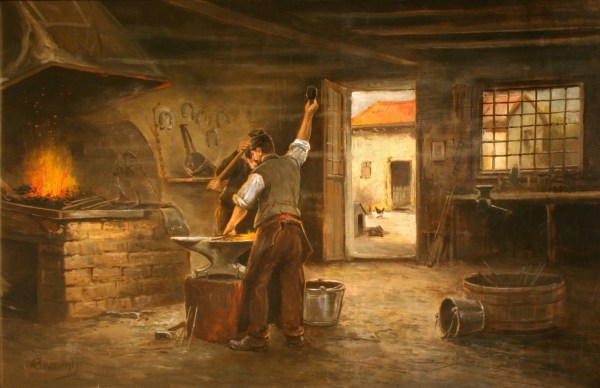
Above: The Blacksmith’s Studio. Albert Brument, French, 1883-1901. Oil on canvas. Housed in a Private Collection.

 The Salon at Elfland