The following contains profanity.
Let me start this off by stating that I have no problem with curse words. I curse—too much, actually—but I’m not interested in shaming anyone. I am interested in the efficacy of profanity as it pertains to writing.
A long time ago I picked up a book on writing prose. I expected it to be a quick read, it promised a step-by-step guide to writing better, more dynamic prose. What I didn’t expect was for the author to immediately call me a bitch and then tell me to put the book down if I don’t like cursing because the author does a lot of it.
Okay, whatever. I said to myself. I got about a chapter in and realized that almost every paragraph had a swear word in it.
I put the book aside and haven’t picked it up since. I began to question if this was someone I wanted to learn prose from. Not because I don’t like cursing—I don’t, to be honest, but it’s habituated in the culture and I’m perfectly guilty of using cuss words so I’m not judging the author for using vulgarity.
I’m judging the author for writing prose so damn onerous it became tedious to read.
I don’t remember where I heard it, but I picked up a piece of advice regarding curse words and writing. The advice went something like this: “save it for when you really mean it.” I took that advice to heart. There is cursing in my writing, I’ve got no problem dropping a “damn” or a “hell.” Sometimes I even exercise my creative liberty with a “damnation” or a “hellfire.” But before I drop anything harder, I think about the impact of that word.
Words are powerful. There is a reason why some phrases, some sentences, some stories stay with us. Words make an impact, for good or ill.
The Harry Potter series is filled with colorful aphorisms: “Merlin’s beard,” “Merlin’s pants,” “galloping gorgons” the offensive “mudblood.” But the most famous, most powerful cuss said in the Harry Potter series is said by the least likely person, an all-caps piece of formatting art:
“NOT MY DAUGHTER, YOU BITCH!”
-Molly Weasley, Harry Potter and the Deathly Hallows
This was absolutely thrilling to my teenage self. It felt very grown up, very earned. Molly Weasley said what we were all thinking. We’d been on this journey with Harry and friends and Bellatrix Lestrange was one of the villains most in need of some violent correction.
There’s a lot of power behind the fact that this is really the only time a true “muggle-world” curse is used in the Harry Potter books. By saving this pejorative until the end, by having it said by a character no one would expect, by using it on someone who unmistakably deserved it, Rowling punches the word home. It does not become trite and tired, it remains forceful, meaningful. Bellatrix Lestrange was a bitch, she died like a bitch, and Mrs. Weasley is a bad bitch.
From my own writing, I wrote a character who was disgraced royalty. This character hid the effect of that shame by acting disgracefully, using curses, blasphemies, and unbecoming language to make it seem that the shame was a choice, not something forced upon them. The character’s business partner never used foul language and often chastised the other character for their uncouth behavior. Character B was well aware of Character A’s past and knew them to better than a common thug.
To get this theme across, I put a lot curse words in A’s mouth and at some point, during the editing process I heard that piece of advice from above. Suddenly all the piled up “fucks” and “shits” started to become repetitive. Annoying even, like clutter. My prose was overburdened with words that began to lose any semblance of meaning.
A word loses its strength with every repetition. Psychology calls this phenomenon semantic satiation, where a word repeated temporarily loses all meaning. After the fifth of sixth curse in as many (or fewer) paragraphs, I found the curses to be like dirty laundry piled up in the corners of a room. Annoying, nagging, in need of a good wash.
So, I took up the task to remove all but the most necessary swears. I found that this exercise was ultimately better for the work. I came up with charming little ejaculations not unlike Rowling’s “Merlin’s beard” that added cultural flavor to the world. Character B still reacted to these phrases with offense, but I peeled away the meaningless white noise that “fuck” had taken on in the story.
As a bonus, when I do whip out the above curse, it was suddenly and powerfully steeped in meaning. The scene is an airing of grievances. Character A accuses B of wanting to “fuck” and it’s meant in all the dirty, grimy, objectification that word entails. Greatly insulted, B turns the phrase around. This is the only time B curses in the story and it shocks A into silence.
All this is said with a big heaping spoon of it’s my opinion. Still, I think “save it for when you really mean it, when it will be most powerful” is pretty good advice. Perhaps if we all took this advice to heart, our interactions with each other would be less cluttered with nonsense expletives turned filler.
Take the advice, or don’t, fuck if I care.
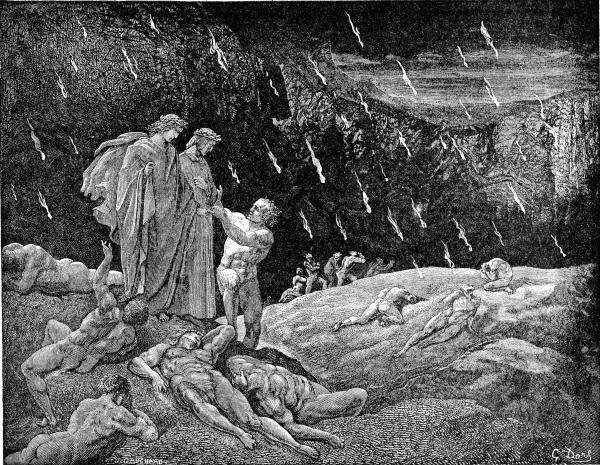
Above: Illustration of Dante Alighieri’s Divine Comedy, the Inferno Canto XV. Gustave Doré (January 1832 – January 1883). French. Engraved Print.
Don’t forget to check out the crowdfunding pages for Anvil Issue 2, where my short story, Afflicted: Nourritures les Ver, will be published! For more info, click here.
 The Salon at Elfland