A Long but Necessary Introduction
From the beginning, my goal for the Archetypes of Scripture series has been to expand my (and my readers) understanding of tropes and archetypes while also exploring the various stories found in Sacred Scripture. While I’m not using this series to evangelize, I know that its impossible to speak about Christ without it coming off that way.
Further baggage is added when I expound upon my denomination. I consider myself ecumenical and I want this series to appeal to a wide variety of readers. So, while I’m not going to stop explaining the tenants of the Christian Faith, I hope that readers are willing to enter into the Scriptures as a story.
Sometimes, I’m not always sure I know what I mean when I say “story,” especially in light of the Bible.
As I’ve said before, the Bible is really a library featuring poetry, history, prophecy, and even primitive creative fiction. But from the Christian position, all the stories, no matter how short and seemingly insignificant, point to a wider, over-arching narrative.
This narrative points upward, towards God and man’s struggle to reach Him. One of the main villains is man himself, who lives in the mucky waters of Original Sin and wrestles with God. The wrestling seems to have no end, until God throws the match and comes down to struggle with us. Standing shoulder-to-shoulder with Creation, He defeats death once and for all.
In that way, all the stories point to Christ. But to make that point, they sometimes point backwards—away from Christ.
When I think about the various linchpin tropes of Sacred Scripture, I think of Adam, Original Sin, and the New Adam.
Original Sin should not be confused with Total Depravity, which, I believe, is what most non-Christians believe all Christian believe. I’ve also seen that a lot of people believe that it has something to do with sex, which is wildly incorrect.
The original sin of Adam was disobedience to God. The Lord forbad Adam from eating the fruit of the tree of Knowledge of Good and Evil.
Worse still, after directly disobeying God, Adam blames Eve for his faults—the first in humanity’s long and proud tradition of blaming each other for our personal short comings.
Its by the disobedience of Adam that sin enters the world and stains all his children [read: the human race]. This sin is the deprivation of the original holiness and justice intended for humanity. Human nature, states the Catechism of the Catholic Church, is “not totally corrupted: it is wounded” with an inclination to do evil. [CCC 405]. This sentiment is clearly stated by Saint Paul in Romans:
I have the desire to do what is good, but I cannot do what is good. 19 For I do not do the good I desire; rather, it is the evil I do not desire that I end up doing. 20 Now if I do what I do not desire, it is no longer I who do it, but sin that dwells in me.
[New Catholic Bible, Romans 7:18-20]
Long after the fall, in another garden, Jesus would ask his Father that the cup depart from him, but not if it meant disobeying his Father’s will. It is the Sin of Adam that brings—into sharp contrast—the Obedience of Jesus.
The sin of our father covered us, until the innocence of another washed it away.
This 500-word preamble, was to introduce us to the trope: the sins of the father.
The Sword will not Depart
Of all the millions of misquotations and misunderstanding between Christian sects, non-Christians, and atheists, the sins of the father is probably high in the running. So, here is the original verse:
I the Lord your God am a jealous God, punishing children for the iniquity of parents, to the third and the fourth generation of those who reject me, 6 but showing steadfast love to the thousandth generation[a] of those who love me and keep my commandments.
[New Revised Standard Version Catholic Edition, NRSV-CE, Exodus 20:5-6]
In this verse, the Lord is speaking about idolatry, which is to love anything more than God. We all worship something—for most of us, that thing is the self.
For David, for one moment, that thing was his lust. David would throw himself at the feet of this idol and in a singular act of worship to it, subject his family to the consequences of sin.
2 It happened, late one afternoon, when David rose from his couch and was walking about on the roof of the king’s house, that he saw from the roof a woman bathing; the woman was very beautiful. 3 David sent someone to inquire about the woman. It was reported, “This is Bathsheba daughter of Eliam, the wife of Uriah the Hittite.” 4 So David sent messengers to get her, and she came to him, and he lay with her. (Now she was purifying herself after her period.) Then she returned to her house. 5 The woman conceived; and she sent and told David, “I am pregnant.”
[NRSV-CE, 2 Samuel 11:2-5]
I don’t need to expound upon the pain and anguish adultery causes in a family, in David’s case, his family won’t feel the effects until later. For Bathsheba and Uriah, the effects are immediate.
We get no word on the willingness or unwillingness of Bathsheba. On my part, I will not brand Bathsheba a temptress, nor will I call David a rapist. But when the king wants you, what are you to say to that? Denying him would insult him, maybe even risk your husband’s life. But to go along defiles you and your marriage vows. Or, perhaps the text is more subtle. Perhaps Bathsheba, having purified herself after her menstrual cycle, believed she would not conceive so soon after it, and went to David to further her husband’s career or even her own standing.
Regardless of Bathsheba’s desires, David is the key figure and he’s on a collision course with evil. David sends for Bathsheba’s husband, Uriah, who is fighting with Joab and David’s other servants, against the Ammonites. Uriah returns to Jerusalem and David tries to convince him to sleep with Bathsheba in order fleece Uriah into thinking the child is his.
But Uriah, following the tenant of the law (1 Samuel 21:4-5), does not sleep with his wife while David’s kingdom is at war. Uriah says:
“The ark and Israel and Judah remain in booths [tents];[a] and my lord Joab and the servants of my lord are camping in the open field; shall I then go to my house, to eat and to drink, and to lie with my wife? As you live, and as your soul lives, I will not do such a thing.”
[NRSV-CE 2 Samuel 11:11]
David then commands Uriah to stay with him another day. David feasts him, getting him drunk, but still, Uriah will not return to his house and sleep with Bathsheba.
Desperate, David compounds one sin with another and orders Joab, his commander, to place Uriah on the front lines and abandoned him, ensuring he is killed in the fighting.
15 In the letter he wrote, “Set Uriah in the forefront of the hardest fighting, and then draw back from him, so that he may be struck down and die.” 16 As Joab was besieging the city, he assigned Uriah to the place where he knew there were valiant warriors. 17 The men of the city came out and fought with Joab; and some of the servants of David among the people fell. Uriah the Hittite was killed as well.
[NRSV-CE 2 Samuel 11:15-17]
Joab, decidedly uncertain about how David will react to the news of Uriah’s death, instructs his messenger to tell David everything about the battle and decern his mood before he tells of Uriah’s death.
In a piece of brilliant, delicious biblical foreshadowing, David tells the messenger:
25 David said to the messenger, “Thus you shall say to Joab, ‘Do not let this matter trouble you, for the sword devours now one and now another; press your attack on the city, and overthrow it.’ And encourage him.”
[NRSV-CE 2 Samuel 11:25]
The sword, indeed, devours. Very soon, that sword will come for David’s house.
Bathsheba mourns her husband’s death and when that customary mourning period is over, David marries her and brings her into his household. But, “the thing David had done displeased the Lord.”
The Lord sends his prophet, Nathan. The Prophet tells David a story:
“There were two men in a certain city, the one rich and the other poor. 2 The rich man had very many flocks and herds; 3 but the poor man had nothing but one little ewe lamb, which he had bought. He brought it up, and it grew up with him and with his children; it used to eat of his meager fare, and drink from his cup, and lie in his bosom, and it was like a daughter to him. 4 Now there came a traveler to the rich man, and he was loath to take one of his own flock or herd to prepare for the wayfarer who had come to him, but he took the poor man’s lamb, and prepared that for the guest who had come to him.”
[NRSV-CE 2 Samuel 12:1-4]
David, a just and honorable king, is understandably horrified that such thievery is going on in his kingdom. He demands to know who has committed such an offense. Nathan, then, drops the mic:
7 Nathan said to David, “You are the man! Thus says the Lord, the God of Israel: I anointed you king over Israel, and I rescued you from the hand of Saul; 8 I gave you your master’s house, and your master’s wives into your bosom, and gave you the house of Israel and of Judah; and if that had been too little, I would have added as much more. 9 Why have you despised the word of the Lord, to do what is evil in his sight? You have struck down Uriah the Hittite with the sword, and have taken his wife to be your wife, and have killed him with the sword of the Ammonites. 10 Now therefore the sword shall never depart from your house, for you have despised me, and have taken the wife of Uriah the Hittite to be your wife.
[NRSV-CE 2 Samuel 12:7-10]
The sins of the father shall be visited upon the children. David has sown chaos in his house and his family will reap this bitter harvest until the Stump of Jesse sprouts again.
To David’s credit, he repents immediately. The Lord puts away his sin, but the wheels of cause and effect are already turning. Evil is a consequence of sin. David sinned, and that insult was against God, but God is hardly the only victim. Uriah, Bathsheba, the unborn child, David’s other children—are all effected by David’s sin.
The sword will not depart, Nathan said, and it doesn’t. Although the marriage to Bathsheba eventually produces Solomon, a wiser, but as equally flawed a king as David, proves that God can bring good out of evil. The real horror of David’s story begins when Amnon, his son by a different wife, rapes his half-sister, Tamar.
Tamar is Absolom’s sister, she is described as beautiful, and a virgin.
2 Amnon was so tormented that he made himself ill because of his sister Tamar, for she was a virgin and it seemed impossible to Amnon to do anything to her.
[NRSV-CE 2 Samuel 13:2]
On the advice of his friend, Amnon uses trickery to bring Tamar close enough to misuse her. He pretends to be ill and asks his father to send Tamar to tend to him. Believing her brother is sick, Tamar makes food for him which Amnon refuses to eat, except from out of Tamar’s hands. He sends all his attendants, except Tamar, out of his chambers. Being a good sister, Tamar comes forward to Amnon’s bed.
11 But when she brought them [the cakes] near him to eat, he took hold of her, and said to her, “Come, lie with me, my sister.” 12 She answered him, “No, my brother, do not force me; for such a thing is not done in Israel; do not do anything so vile! 13 As for me, where could I carry my shame? And as for you, you would be as one of the scoundrels in Israel. Now therefore, I beg you, speak to the king; for he will not withhold me from you.” 14 But he would not listen to her; and being stronger than she, he forced her and lay with her.
[NRSV-CE 2 Samuel 13:11-14]
And so, the sword devours another.
Like every sexual predator, Amnon wasn’t “in love” with Tamar, he was worshiping himself and his lust. Amnon, like David, made an idol of his desires. He took what he wanted for no other reason but he wanted to.
Amnon took Tamar, like an object, and used her. He was even “seized with a very great loathing for her; indeed, his loathing was even greater than the lust he had felt for her” and he throws her out of his house, refusing to make a wife of her after ruining her chances of finding a husband (2 Samuel 13:15).
Absolom, Tamar’s direct brother, brings her into his house. He tells her to keep her peace because Amnon is her brother. This is harsh by our modern sensibilities, but the next verse, I think, explains why Absolom told his sister to keep silent about the rape:
21 When King David heard of all these things, he became very angry, but he would not punish his son Amnon, because he loved him, for he was his firstborn.[d]
[NRSV-CE 2 Samuel 13:21]
I doubt Absolom has confidence in David’s sense of justice. After all, his father wasn’t above destroying Uriah’s family in order to gain Bathsheba. Like father, like son, right?
Here we see the true consequence of David’s sin. He has been rendered ineffective. Absolom doesn’t believe David is a good and just king, and David proves that correct. Despite knowing the wrong that happened in his house, David does nothing against Amnon.
Denied official channels, Absolom takes matters into his own hands. He waits for two years before taking his vengeance. Absolom invites all his brothers to a party in the countryside and he orders his servants to watch Amnon. When Amnon is drunk, Absolom and his servant strike, killing Amnon and causing the other brothers to flee.
Word reaches David that Absolom has killed all his brother (David’s sons). David tears at his garments and weeps until the truth is learned that Amnon alone is dead. Still, Absolom flees to Talmai, in Geshur. He will stay there three years.
Although David misses Absolom, he does not call his son back from Talmai. David is still trying to hold onto that veneer of justice. Bringing his murder son back would show to all Israel that he has lost his way.
Enter Joab, the son of Zeruiah. As a character, he has the flavor of a political upstart and I can’t help imagine him scheming in the backrooms of the palace seeking ways to ingratiate himself into David’s good-graces.
Regardless, Joab perceives that David misses Absolom, so he goes out and finds a wisewoman to petition David:
4 When the woman of Tekoa came to the king, she fell on her face to the ground and did obeisance, and said, “Help, O king!” 5 The king asked her, “What is your trouble?” She answered, “Alas, I am a widow; my husband is dead. 6 Your servant had two sons, and they fought with one another in the field; there was no one to part them, and one struck the other and killed him. 7 Now the whole family has risen against your servant. They say, ‘Give up the man who struck his brother, so that we may kill him for the life of his brother whom he murdered, even if we destroy the heir as well.’ Thus they would quench my one remaining ember, and leave to my husband neither name nor remnant on the face of the earth.”
[NRSV-CE 2 Samuel 14:4-7]
David tells the woman to return to her home, that no harm will come to her, and he will not allow anyone to harm one hair on the head of her son.
Like the story of Nathan above, David, again, convicts himself. The woman says as much:
13 The woman said, “Why then have you planned such a thing against the people of God? For in giving this decision the king convicts himself, inasmuch as the king does not bring his banished one home again. 14 We must all die; we are like water spilled on the ground, which cannot be gathered up. But God will not take away a life; he will devise plans so as not to keep an outcast banished forever from his presence.[a]
[NRSV-CE 2 Samuel 14:13-14]
God forgives, and so David should forgive.
If we’re honest, we can admit that Absolom’s murder of Amnon is justifiable. Amnon’s offense was public knowledge as Amnon ordered his servants “put her [Tamar] out” and “bolt the door after her.” She then covered herself in ashes and went about weeping.
The fault lies with David, who, as a just and righteous king, should have dealt with Amnon accordingly. That failure wrecked his, albiet, not great, relationship with Absolom.
Still trying to hold onto that veneer of justice and impartiality, David commands Joab to bring Absolom back to Jerusalem, but he will not allow Absolom back into his kingly presence. Perhaps, if David had welcomed Absolom back into his bosom, things could have been different.
David is a prefigure of Christ, but he is not the Christ. And this episode proves that simple fact, definitively. The king forgives Absolom, his subject, and lets him come home, but David does not forgive his son and does not let him come home.
A just king, David might be, but a just father? I have my doubts.
I desire to do good, said Saint Paul, but I can’t do good. Like many stories in the Old Testament, I feel that sentiment in the story of David and Absolom. Sin, miscommunication, misunderstandings, and partial forgiveness—all part of the tragedy of Original Sin, the sin of our first father.
Absolom lives in Jerusalem for two years without seeing his father. He sends for Joab, hoping to be let in to see the king, but Joab ignores him. He sends for a second time, and still gets no answer. Fed up, Absolom orders his servants to set Joab’s barley field on fire.
Roused at last, Joab goes to Absolom to ask why he set fire to his land.
32 Absalom answered Joab, “Look, I sent word to you: Come here, that I may send you to the king with the question, ‘Why have I come from Geshur? It would be better for me to be there still.’ Now let me go into the king’s presence; if there is guilt in me, let him kill me!” 33 Then Joab went to the king and told him; and he summoned Absalom. So he came to the king and prostrated himself with his face to the ground before the king; and the king kissed Absalom.
[NRSV-CE 2 Samuel 14:32-33]
Forgiveness, great! We may think, but two years is a long time to build resentment. And, let’s not forget the last time Absolom waited two years.
Back in his father’s good graces, Absolom hires a chariot and 50 servants, and he begins to rise early in the morning in order to stand by the gate and so that when a man came to petition justice from David, he could intercept them.
Absalom would call out and say, “From what city are you?” When the person said, “Your servant is of such and such a tribe in Israel,” 3 Absalom would say, “See, your claims are good and right; but there is no one deputed by the king to hear you.” 4 Absalom said moreover, “If only I were judge in the land! Then all who had a suit or cause might come to me, and I would give them justice.” 5 Whenever people came near to do obeisance to him, he would put out his hand and take hold of them, and kiss them. 6 Thus Absalom did to every Israelite who came to the king for judgment; so Absalom stole the hearts of the people of Israel.
[NRSV-CE 2 Samuel 15:2-6]
Absolom follows that old trope: revenge is a dish best served cold.
After four years of this, Absolom goes to David (who doesn’t appear to have any idea of what’s going on) and begs the King to let him go to Hebron to fulfil a vow he made to the Lord while in Geshur. David, of course, lets him go.
With his father’s permission to depart, Absolom then sends out secret messengers to the Tribes of Israel telling them that “at the sound of trumpets” they should shout “Absolom is king at Hebron” (2 Samuel 15:10).
The conspiracy grew under David’s nose. Until word reaches Jerusalem.
13 A messenger came to David, saying, “The hearts of the Israelites have gone after Absalom.” 14 Then David said to all his officials who were with him at Jerusalem, “Get up! Let us flee, or there will be no escape for us from Absalom. Hurry, or he will soon overtake us, and bring disaster down upon us, and attack the city with the edge of the sword.”
[NRSV-CE 2 Samuel 15:13-14]
David and his household flee Jerusalem. David leaves behind his concubines to look after his house. Confident in the Lord, he intends to return. He’s so confident, in fact, he tells the Levites to leave the Ark of the Covenant in Jerusalem, saying “If find favor in the eyes of the Lord, he will bring me back and let me see both it and the place where it stays” (2 Samuel 15:25).
In the wilderness, at the ascent of the Mount of Olives, David prays to the Lord, asking him to turn the advice of the counselor, Ahithophel, who betrayed him, into foolishness.
David is reeling from this betrayal. The conspiracy is so widespread that David and his supporters are so outnumbered that defending Jerusalem becomes impossible and they must flee and roam the countryside. He sends a spy, Hushai, to Absolom’s court in Jerusalem, but David must ultimately rely on the Lord.
Even while on the road, David is cursed by his subjects. When his servants ask to slay those who speak ill of the king, David utters:
11 David said to Abishai and to all his servants, “My own son seeks my life; how much more now may this Benjaminite! Let him alone, and let him curse; for the Lord has bidden him. 12 It may be that the Lord will look on my distress,[c] and the Lord will repay me with good for this cursing of me today.”
[NRSV-CE 2 Samuel 16:11-12]
While David camps on the banks of the Jordan River, Absolom enters Jerusalem and seeks the guidance of his father’s former advisor, Ahithophel.
20 Then Absalom said to Ahithophel, “Give us your counsel; what shall we do?” 21 Ahithophel said to Absalom, “Go in to your father’s concubines, the ones he has left to look after the house; and all Israel will hear that you have made yourself odious to your father, and the hands of all who are with you will be strengthened.” 22 So they pitched a tent for Absalom upon the roof; and Absalom went in to his father’s concubines in the sight of all Israel. 23 Now in those days the counsel that Ahithophel gave was as if one consulted the oracle[f] of God; so all the counsel of Ahithophel was esteemed, both by David and by Absalom.
[NRSV-CE 2 Samuel 16:20-23]
And there Nathan’s prophecy is fulfilled: “for you did it secretly; but I will do this thing before all Israel, and before the sun.”
This is an absolute humiliation for David. Absolom is basically saying “I’ve replaced you utterly.” He has taken over David’s house, taken his women, used them as David would use them. The line is drawn, Absolom will take all that David has.
Absolom calls for further council and is convinced by Hushai, David’s spy, to pursue David personally. Hushai then sends word to David so that he might escape. David and his supporters cross the Jordan river and at daybreak, Absolom and his army follow.
David appoints commanders, but intends to go out and fight with his men. His commanders disapprove and tell the king that he worth ten-thousands men. Convinced by their words, David takes shelter in a nearby city, but he implores his commanders:
5 The king ordered Joab and Abishai and Ittai, saying, “Deal gently for my sake with the young man Absalom.” And all the people heard when the king gave orders to all the commanders concerning Absalom.
[NRSV-CE 2 Samuel 18:5]
The battle commences, with David’s mighty men slaying the men of Israel.
6 So the army went out into the field against Israel; and the battle was fought in the forest of Ephraim. 7 The men of Israel were defeated there by the servants of David, and the slaughter there was great on that day, twenty thousand men. 8 The battle spread over the face of all the country; and the forest claimed more victims that day than the sword.
[NRSV-CE 2 Samuel 18:6-8]
But the sword David was warned of so long ago comes down again. Despite his pleas, Joab is fed up with the infighting. He sees Absolom, who’s long, beautiful hair has been caught in a tree, he is trapped and helpless.
9 Absalom happened to meet the servants of David. Absalom was riding on his mule, and the mule went under the thick branches of a great oak. His head caught fast in the oak, and he was left hanging[c] between heaven and earth, while the mule that was under him went on. 10 A man saw it, and told Joab, “I saw Absalom hanging in an oak.” 11 Joab said to the man who told him, “What, you saw him! Why then did you not strike him there to the ground? I would have been glad to give you ten pieces of silver and a belt.” 12 But the man said to Joab, “Even if I felt in my hand the weight of a thousand pieces of silver, I would not raise my hand against the king’s son; for in our hearing the king commanded you and Abishai and Ittai, saying: For my sake protect the young man Absalom! 13 On the other hand, if I had dealt treacherously against his life[d] (and there is nothing hidden from the king), then you yourself would have stood aloof.” 14 Joab said, “I will not waste time like this with you.” He took three spears in his hand, and thrust them into the heart of Absalom, while he was still alive in the oak. 15 And ten young men, Joab’s armor-bearers, surrounded Absalom and struck him, and killed him.
[NRSV-CE 2 Samuel 18:9-15]
In a sad, but perhaps fitting, twist of fate, Absolom had no sons. His only achievement was a monument he built, now called Absolom’s Monument. All of his vengeance-seeking was in vain, it left no lasting mark, except for his father’s cry of anguish: my son, my son!
32 The king said to the Cushite, “Is it well with the young man Absalom?” The Cushite answered, “May the enemies of my lord the king, and all who rise up to do you harm, be like that young man.”
33 [g] The king was deeply moved, and went up to the chamber over the gate, and wept; and as he went, he said, “O my son Absalom, my son, my son Absalom! Would I had died instead of you, O Absalom, my son, my son!”
[NRSV-CE 2 Samuel 18:32-33]
There will be more blood and sorrow for David. His old age will be a time of war. The sins of the father are visited upon the son; all that war will make a time of peace and plenty for the reign of his son, Solomon.
Cause and Effect
Throughout this long essay I’ve been using the saying “the sins of the father” but perhaps a more contemporary way to put it is the simple phrase: cause and effect of narrative. Character A does action x, which sets off a reaction in Character B, who does y in return. These actions radiate outward, swallowing up more characters and actions pushing and pulling the story onward.
Conflict is the meat and potatoes of narrative. One may even say that there is no story without conflict.
These episodes in David’s life are sometimes seen as separate events, but I think I’ve made it clear that the story of David and Bathsheba is merely the first act in a three-act story that culminates in Absolom’s usurpation.
It is commonly misunderstood that God punishes the children for the sins of their parents, this blood-curse is misguided. God did not punish Absolom, he punished David. Or rather, David’s actions—which cannot be put away—rippled through his family like a stone into a still pond.
This does not free Absolom from his actions. I understand his resentment, I think we all do, but he could have accepted his father’s forgiveness, however late it came.
Perhaps when we think of our character’s actions, we ought to think how those actions radiate outward and cause conflict and chaos among the other characters. These are the sins of the father, visited upon the sons.
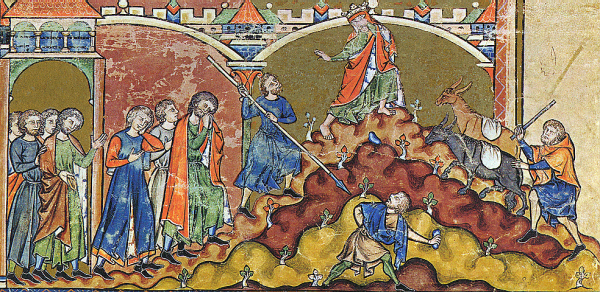
Above: David flees Jerusalem after Absalom’s conspiracy. A scene from the Maciejowski Bible, Leaf 45. Also called the Morgan Bible or Crusader Bible, a picture Bible from 13th Century. It was commissioned by Saint King Louis IX of France. Note the Benjaminite stone-thrower and the use of 13th century clothing. There are 46 surviving folios, 43 folios are housed in the Morgan Museum and Library, New York City, New York; 2 folios are housed in the Bibliothèque Nationale de France, Paris, France; 1 folio at the J. Paul Getty Museum, Los Angeles, California; 2 folios are lost to time.
 The Salon at Elfland