Petals from my Florilegium: C.S. Lewis, letter to Jane Gaskill 09/02/1957

I keep a commonplace book where I collect phrases, proverbs, sentences, or ideas like a haphazard bouquet of wildflowers. I pick them as they come to me, with no curation save what I share on this blog.

In this series, I’ll offer a quote and meditate on why it deserved to be preserved in my Florilegium.


“Aren’t all these economic problems and religious differences too like the politics of our own world? Why go to faeries for what we already have? Surely the wars of faeries should be high, reckless, heroical, and romantic wars—concerned with the possession of a beautiful queen or an enchanted treasure?”

C.S. Lewis, letter to Jane Gaskill 09/02/1957

Modern fiction, particularly fantasy, doesn’t do it for me anymore. There was a time in my life were going to a major bookstore chain—an onerous thirty-minute drive with terrible parking—was an event. I looked forward to visiting the bookstore and would spend hours perusing the shelves, on the hunt for that one perfect volume.

The last time I went to a major bookstore chain, I spent thirty minutes wandering the morass of confusing shelves, games, toys, anime, and Marvel ephemera. It was a dreadful experience punctuated by the reek of unwashed teenagers, bad coffee, and the bumping of Billboard Chart pop.

Worse still was the book selection. It was atrophied; tables awash with the same five writers, all with similar titles: A Blank of Blank and Blank. An entire section was carved out for “cozy” fantasy and the comic book section was expanded into a malignant tumor of plastic toys and uber-expensive special editions. I could barely find the historical section, which of course, had been trimmed down to make room for the toys.   

It was a veritable swamp of similar plots, similar heroines, glossy, minimalist photo-shopped covers, and all stinking of plastic-wrapped corporate greed.

This is starting to sound more like a complaint than an invitation.

Why go to faeries for what we already have?

Growing up, my family was not the kind of family that could afford lavish vacations. Instead, we spent three to four days every summer camping in the California Wilderness punctuated with a day-long trip to the lake.

It was in those woods that I would imagine tales of heroic wolves and foxes as questing knights. Only as an adult do I really appreciate how truly formative the dense, quiet woods of the Sierra-Nevada were for my identity and style as a writer.

Those knightly wolves and foxes were out to rescue a headstrong, tom-boyish queen—the character I most often pretended to be.

For three days, with a new school year looming on the horizon, I got to pretend that the world of fantastical forest animals was in deep, dark peril from a wicked and unnamed evil that stalked the woods at night and ate little girls who wandered too far from the fire.

Fiction, was then, as it is now, my escape from the daily grind.

So, why the hell would I want to read a book about an elf opening a Starbucks? Or about your thinly veiled political hang-ups? Or your trite condemnation of “religion?” Or your edgeless handwringing love-triangle?     

 I want the “high, reckless, heroical, and romantic.” I want the bright banner and the crimson sword, the passionate romance of destined lovers, the tricks of faeries, and the triumphs of brave knights.

Give me edge, give me flesh and blood—take me somewhere else, somewhere that isn’t here.

I wrote this quote down, not to smugly lecture writers on what they should and shouldn’t write, but as a reminder to myself.

I owe myself a good story.

While I’ll never be able to escape my biases, reminding myself that they exist makes it easier to avoid them. I want to be the kind of writer people read because they enjoy what I write, but I can only do that if I try to make myself the kind of writer I want to read.

That means high adventure and even higher truths.    

Above: Fairy Rings and Toadstools. Dated 1875. Richard “Dickie” Doyle (18 September 1824 – 10 December 1883). British Illustrator. Watercolor on paper. Private collection.

Like weird tales? I write my own, you can find them here! You can also follow me on Twitter/X!

Petals from my Florilegium: William Gibson, Virtual Light

I keep a commonplace book where I collect phrases, proverbs, sentences, or ideas like a haphazard bouquet of wildflowers. I pick them as they come to me, with no curation save what I share on this blog.

In this series, I’ll offer a quote and meditate on why it deserved to be preserved in my Florilegium.


Its steel bones, its stranded tendons, were lost within an accretion of dreams; tattoo parlors, gaming arcades, dimly lit stalls stacked with decaying magazines, sellers of fireworks, of cut bait, betting shops, sushi bars, unlicensed pawnbrokers, herbalists, barbers, bars. Dreams of commerce with their locations generally corresponding with the decks that had once carried vehicular traffic; while above them, rising to the very peaks of the cable towers, lifted the intricately suspended barrio, with its unnumbered population and its zones of more private fantasy.    

William Gibson, Virtual Light

William Gibson of Neuromancer fame is one of my favorite writers. His work, Virtual Light, falls into the cyberpunk genre, but in a far more subtle way than the Sprawl Trilogy. There are evil mega-corporations, corrupt governments, mysterious climate disasters, and all the other accoutrements that accompany the genre, but the story revolves around a pair of high-tech glasses and the powerful entities hunting the glasses down.

Sounds bizarre, I know, but the fun of Virtual Light is the unsettling implications behind the high-tech, low-life world that the characters live in.

That said, if you looking for neon-soaked streets, desperate drug addicts, and cyberspace raids, Virtual Light ain’t it. Cyberspace isn’t mentioned once.

Unlike the Sprawl Trilogy where Console Cowboys melt ICE and chat with mystical AI pseudo-gods, Virtual Light revolves around the Bridge.

The Bridge, what we would know as the Golden State Bridge, has in the seedy near-future, become a ghetto. It’s a holdout for the disenfranchised lowlifes of San Francisco. The passage above is the first glimpse the reader gets of the Bridge.

“Its steel bones, its stranded tendons, were lost within an accretion of dreams.” The Bridge is a massive, haphazardly pieced together architectural marvel of busted beams, splintery planks, and rusted platforms. The shops and bars and stalls are all located on the two lower decks where once cars buzzed from San Fran to Oakland. Above, people have built their homes from whatever scrap they can find.

What draws me to this paragraph is not the strange prescience with which it describes the San Francisco of 2024, but the poetry of it.

Gibson is a poet when the mood strikes him, especially when he’s describing places.

This passage begs to be read aloud with emphasis set on the repeated sounds like an alliterative poem.

steel bones, its stranded tendons”

“dimly lit stalls stacked with decaying magazines

“cut bait, betting shops, sushi bars, unlicensed pawnbrokers, herbalists, barbers, bars.”

This passage is awash in sounds and scents, a description that gives you what you need to paint a clear picture without robbing you of the joy of letting your imagination hold the brush. I can hear city traffic humming just below the harsh cries of the vendors. I can smell salt and rust and ramen and rotten fish.

This is the kind of paragraph I long to write—words that stick with a reader, that demand to be read again, and then, read aloud. It’s the perfect balance of rhythm and flavor, sweeping you into something at once familiar and utterly alien.

Gibson is a visionary—not just of the future, but a man who really seems to know his craft. As much as his works tend to horrify me, they enchant me too. Virtual Light doesn’t haunt me the way Neuromancer and Mona Lisa Overdrive still do, but I wrote down this passage because I couldn’t get it out of my head.

I hope it haunts you too, and it convinces you to give Virtual Light a read, if only for gems like this.   

Above: Close up of a Flower. Susanne Nilsson.    

Like weird tales? I write my own, you can find them here! You can also follow me on Twitter/X!
On Keeping a Commonplace Book

I love notebooks—I think every writer loves notebooks. There’s something about a virgin piece of paper and the unbent binding that beckons the writer onto some adventure. It becomes a new companion. A friend, a lover. Someone to whom we pour out a best and silliest ideas. Some of it is useful, some of it is forgotten. The rest is chaff, the nonsense we jot down for kindling in the furnace of the imagination.   

If you’re like me, you rarely—if ever—finish out that notebook. The paper yellows, the spirals bend, the corners crease, and it takes up space in a closet. Half-used, half-remembered. Sometimes I stumble upon an old notebook and thumb through it, grinning at the little spark that become that story or that poem or got reworked into a greater whole.

I collect those bits and add them into a binder or another notebook. The rest, like I said above. Is chaff. I don’t discard it because it was useful when I put it down, but I’ve outgrown the idea. I still respect it.

A few years ago, I came upon the Latin word “Florilegium.” Or, “a gathering of flowers.”  

Medieval Scholars kept a kind of commonplace book, a literal notebook collection of Scripture, Patristic sayings, ideas, etc. for the purpose of writing Sermons. They called these books Florilegium.

This got me thinking.

First, what a wonderful concept—gathering flowers. And gathering flowers, not to destroy a lovely growing thing, but the kind of metaphysical flower we call Wisdom.

Secondly, there are so many kinds of flowers. Why stop at wisdom? Why not pick one because I think it’s pretty? Or because it means something to me? Or because the aesthetic is something so powerful I must collect it with the hope of planting something half that brilliant?

Thirdly, I began to wonder what would happen if I finished one of those notebooks? As in used up all the paper, front to back?

To make sure I actually accomplished this massive feat, I bought a nice notebook. Its leather bound with cream colored lined paper, and personalized with my name and the book’s title: Florilegium, “a gathering of flowers.” I then bought a fountain pen. If I was going to do this, I wanted to do it as ritualistically as possible. I wanted to make it a devotion.

My first entry tells you a little about where I was when I first began gathering flowers.

“…I believe; help my unbelief!”

Mark 9:24

There are parts of this volume (there are two at the time of writing this post) that I can read and feel a wash of memories. There are others that are there because I like them.

Some hold a rich degree of meaning to me:

I am in a sea of wonders. I doubt; I fear; I think strange things which I dare not confess to my own soul. God keep me, if only for the sake of those dear to me!

Bram Stoker, Dracula

Others are for pure aesthetics:

Paul-Muad’Dib remembered that there had been a meal heavy with spice essence.

Frank Herbert, Dune

The more I think on these flowers, the more I see a collage of the writer I want to be.

My handwriting grew sloppier the more I used the book, not because it became a burden, but because I had so much to write down. I dumped the fancy pens and went for whatever pen I had at hand.

This bouquet has become personal to me. The casual reader would find something deeply intimate, and yet come away knowing hardly anything about me. Some of the quotes connect to thoughts, others seem so jarringly out of place that the ideas may appear schizophrenic.

Only I know what Mona Lisa Overdrive has to do with Christ Jesus. Only I know why Chesterton’s work sits next to Frank Herbert’s or why the Spiritual Combat takes up a majority of pages, why I only quote my favorite novel once.

I don’t need anyone to see the pattern—if there even is one. I read what comes to me, what seems fun and profitable as I find it. I collect what I like or what makes me think or what I think sound cool.

And that is why I think a commonplace book is good practice. Not just for writers, but for people. As a purely human exercise.

You don’t even have to read to keep one. Movies, or TV, or friends, have just as much to say to us as anything else. Hell, you don’t even have to keep a book! A blog is just as useful, or just a text sheet on your computer.

The only thing I think you shouldn’t do it make any kind of order of it. Pick flowers as you come upon them. Try it for a year, I think you’ll find that what you thought was a bouquet of cut flowers, is actually a healthy, growing garden.

Here’s where you can read me!

Follow me on Twitter/X.

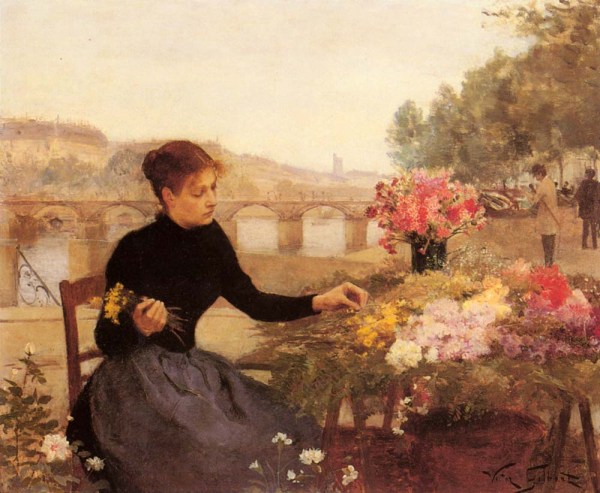
Above: A Parisian Flower Market. Oil on Canvas. Victor Gabriel Gilbert 1847-1933. French.

Blog at WordPress.com.

Up ↑