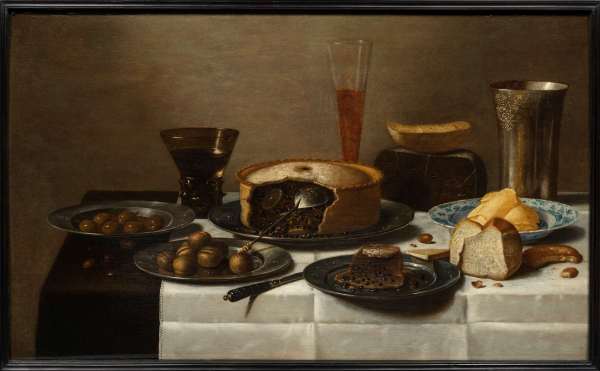
Some time ago, an old friend and I had a discussion set off by a fan fiction she was reading. She sent me a screen shot of something she thought was funny, or horrendous, I can’t remember. What I do remember was seeing the phrase “they stopped near midday and ate a simple meal of bread and cheese.” Immediately, without much context, I knew it was either an alternate history or a fantasy alternative universe (AU) because I’ve seen this deliciously terrible phrase in nearly every fantasy I’ve ever read.
A simple meal of bread and cheese evokes a strange, nostalgic feeling. It has the quality of a really good but utterly normal Christmas dinner. Or better yet, Holiday leftovers. When it’s the middle of the night and you make a cheese sandwich with a dinner roll and some slightly dried cheddar that was left on the appetizer tray.
The phrase itself is unassuming but I can glean some information from it. If your meal is simple, its probably because you come from a high-class background because for a peasant this is just a meal. Simple connotate rustic. Rustic is a polite word for coarse, country, rural, roughing-it. And while its utilitarian enough to evoke these vagaries, the quaint charm leaves me unsatisfied. Like there was a missed opportunity for a slight taste of a wider world.
I find myself asking the writer, what kind of cheese? What kind of bread? Are there nuts in the cheese? What kind of grain is the bread made from? Would it go well with apples?
As Chesterton so elegantly put, the poets have been silent on the subject of cheese and we ought to rectify that.
Personally, I’d rather smear a soft green cheese over a slab of oat-laden bread than place a slice of Kraft on a piece of Wonder Bread. But my tastes aside, a simple meal of bread and cheese is prime real-estate for worldbuilding, whether that world is modern, archaic, or fairytale.
“…hot soup, cold meats, a blackberry tart, new loaves, slabs of butter, and half a ripe cheese: good plain food, as good as the Shire could show…”
The Fellowship of the Ring
While the meal Frodo and his friend have at the Prancing Pony is more than just bread and cheese, the words to describe this simple meal of bread and cheese is marked with Tolkien’s usual narrative color. “Good plain food” he wrote. Because it is. It’s simple fare. Half of a ripe cheese, new loaves. That is, a slightly tangy, older cheese and fresh bread still hot from the oven.
It paints a picture that expands the world a bit. The men of Bree aren’t so different from the hobbits of Hobbiton. It’s this meal that calms Sam who is unused to being around so many tall-folk. For an instant, as readers, we get to enjoy the hobbit’s momentary comfort. We taste a world that is familiar, and yet achingly far away.
Food culture flavors a setting. There is something otherworldly about drinking spice coffee over coffee [Dune]. Something familiar and real about wheels of white cheese and chunks of hardbread [A Song of Ice and Fire]. There are warm comforts in a serving of deeper-than-ever-turnip-and-tater-and beetroot pie next to hotroot soup and nutty soft cheese [Redwall].
A simple meal of bread and cheese tells us much, but a meal of green white cheese and sesame crackers tells the reader a bit more.
It’s these tiny details that give readers a place to latch on. Never pass up a chance to deepen a reader’s journey. Writers don’t need to fill in every blank, that’s tiresome, but take into account the flavor of the universe you’re trying to convey.
If a story takes place in ancient China, no one is eating cheese or bread (as in, typical wheat bread). If your story takes place in medieval England, everyone eats bread and cheese, but class differences dictate the type and quality. A word a caution, never fall into the trap of cultural stereotypes especially when it comes to food. Anyone calling “British food” boring has never had the experience of a blisteringly hot bite of shepherd’s pie. Calling every Indian dish spicy does a disservice to the creamy, sweet, and even sour dishes of India. Making pasta a completely foreign and exotic meal to your adventuring party ignores the fact that some of the first written references to pasta in the West come from the 1st century AD.
When it comes to food and the worldbuilding you do around food, research is your friend. Watch any number of historical cooking shows on YouTube; look up recipes for dishes you’re unfamiliar with and then make it. If a local restaurant serves a specific kind of cuisine, go try it. The best teacher is experience. Take note of the similarities between cultures, appreciate how those similarities are expressed differently.
This small concept—a simple meal of bread and cheese—is the vehicle for a richer experience. We become more potent writers when we make an effort to expand a universe through food. Food is a way for us to come together.
As a writer, bring yourself and your readers to the dinner table. Make them hungry, make them want to come to your works just to taste a fine meal, make them want to come back for more.
Above: A Still-life with Bread, Cheese and a cut Pie. Floris van Schooten, (between 1585 and 1588 – buried 14 November 1656), Dutch Painter. Oil on panel. Housed at Koetser Gallery.
 The Salon at Elfland