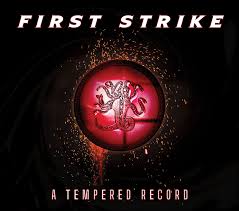
Album Review: First Strike

Am I qualified to talk about music? Probably not, I haven’t read a lick of sheet music since I was in High School; the last instrument I played was for my Junior High String’s band.

That said, I know what I like and I have a deep appreciation for music. It has always been a part of my life, from blasting Alan Jackson and Toby Kieth from the speakers of my Dad’s truck while camping, to sifting through my mom’s collection of rock albums, to my adulthood obsession with collecting every David Bowie CD—my tastes are wide and discerning and I am always hungry to discover new bands.

Last year I decided I wanted to get into heavy metal. That means I sat down and listened to band after band, pushing the YouTube algorithm to its limit in a desperate search for something I could really fall in love with.

Heavy metal is a vast genre, composing so many different quirks and subgenres. I found that I like melody and vastness of sound, epic topics, harmonic singing—what I believe is sometimes called power metal.   

Naturally, I was intrigued when IronAge Media announced an album.

First Strike is probably best described as a compilation album with the talents of Jacob Calta (YouTube/Twitter), Evaleigh (YouTube/Bandcamp), Chillkid (YouTube/Soundcloud), J.V.P. (YouTube/Twitter), and A.C. Pritchard (YouTube/Substack) with Jacob Calta as Producer, Mastering completed by Calta and J.V.P., with Executive Producer, Richard Wilson.

(Disclaimer: I’ve worked with IronAge Media in the past. Whether that makes me biased or not is up to you.)

First things first

I prefer physical media so I tend to buy CDs instead of downloading them as a rule. It may seem silly to discuss a jewel case, but I collect music albums. It’s important to me that the case work as intended and look cool.  

The CD case is smooth cardboard with plastic insert, it includes a song booklet. It’s quality, especially considering the downward spiral most jewel cases have had in the past few years. Is it going to get beat up in the console of my car, are the edges going to get frayed? Yes. But it will hold the CD and the booklet

The album art is pretty slick. I like simplicity in an album cover, especially in something that suggests a wide variety of styles. Also, the symbol of a hydra can’t be overstated—I’m pretty positive that Jacob Calta, the art designer, chose that symbol on purpose. A good choice considering the stated goals of IronAge Media and the Iron Age at large.  

The music

Is First Strike a metal album? Yes. But like I said above, it’s a compilation of talents. There is heavy, pulsing guitar, melodic synth, scream vocals, and most importantly sick guitar solos. Everyone involved has brought their A game.

There are only six songs on the album, so let’s go through them one by one.  

Track 1 – First Strike – Jacob Calta

Track 1 is an instrumental. I found it surprisingly jazzy, with shades of the classic Sonic soundtrack—sort of etheral late 80s, early 90s synth—if that makes sense. There’s a head bobbing urgency to it and a warmth of tone that feels like a classic cape-crusader training montage.

I’ve been getting into synth lately and one of the problems with synth is that, after a while, some of it really starts to sound the same. Juxtaposing a heavy synth instrumental next to a more guitar-heavy rock song is a good call.

This is a great track to start the album off with.  

Track 2 – Power – Evaleigh

Does the Iron Age have an anthem? If not, I nominate Power.

If this song is supposed to be about the little guy, the small-time indie artist, taking on the big corporate music industry, then he’s nailed it. David v. Goliath is a universal tale that is applicable to all kinds of situations, not just the Iron Age.  

“God only knows what I’m doing here tonight” is the kind of lyric I can appreciate. I know that feeling. I still feel it, especially when I burn midnight oil on a Sunday night, hammering out a crappy first draft wondering if anyone will even read what I’ve written or if I’m just wasting time.

The song goes on to suggest that I am not wasting my time, and neither is Evaleigh.

Fantastic little anthem. I love it.  

Tack 3 – the Anvil – Chillkid

I’ve really come to appreciate chillwave synth. Track 3 is very chill, but not a calm chill, an intense chill.

The lyrics are about being “born in fire” and “shaped on the anvil.” I find the irony of a chillwave song about forging by fire and anvil to be deliciously clever. It also has this really cool call-and-response to the lyrics that makes it feel more like a war chant than a typical song.

I think this is a song that grows on you.  

Track 4 – the Wraithsayer – J.V.P.

This instrumental is probably my favorite track. It features a wide variety of synthetic instruments: strings, horns, even an organ, ghost-like chanting. It makes the song feel expansive, like a guitar player with the backing of an orchestra.

The use of organ and bells lends a Victorian eeriness that builds into something epic and heroic. This is the song of a English gentlemen plucking up his courage and taking on the thing that haunts the graveyard.

Weird horror in song. Absolutely love it.

Track 5 – Villainous Wake – A.C. Pritchard

There is not accounting for taste. Unfortunately, I’m not a fan of screaming, gruff, vocals a la Slipknot. That doesn’t mean there aren’t things to like in this song—there are.

The discordant sounding chorus is a very cool effect that matches the lyrics. “I’d rather fly free, than die as a slave. I’ll break from my cage, I’ll rise from the flames. My words are my wings, my shield, my blade, my pleasure, your pain, my villainous wake.” Pritchard casts himself as the villain, and maybe he is? But doesn’t the POV matter?

Not a fan of screamo, but the lyrics are fantastic and J.V.P.’s guitar work is excellent.  

Track 6 – Blow by Blow – Chillkid, A.C. Pritchard, Evaleigh, J.V.P., Jacob Calta

If this album has a B side, then track 6 is it. The weakest of the six tracks, I’m not sure if the problem stems from too many cooks, or if its just the principal that every album must have that one song you can’t vibe with?

Evaleigh and J.V.P.’s guitar work stands out, especially with that plucky guitar work at the 1:40 mark and the solo at the 2:30.

Final thoughts

I honestly had my concerns when I bought this album. I feared that it was going to be like those CDs you buy from the bands who play the bars in Nashville or L.A. But this is a solid album with excellent production and high-quality music.

Even in the song’s I don’t like, I can feel the passion and the care. I believe that these artist like making music and that they want me to like their music too; mutual respect is a part of the titular Iron Age. I feel like I got my money’s worth and that my time wasn’t wasted.

An excellent showing, I recommend it and leave you, appropriately, with lyrics from Track 6:

Flying free into horizons

The moon and stars all fall away

Determination, out instincts guide us

Into a whole new age.   

-Blow by Blow

Don’t forget to check out Anvil Magazine #4, currently available for pre-order!

I write my own weird tales, check them out here and don’t forget to follow me on Twitter/X!

Writer’s Review: Buffy and the Art of Story

When I purchased Buffy and the Art of Story I had a very different notion of what I was ordering verses what I got. It was an impulse buy, I admit. I love Buffy—okay, I love the first three season of Buffy with some select episodes from the other four. The book promises that I’ll be “writing better fiction by watching Buffy.”  

I expected the book to go through the entirety of the Buffy series, break down the character development, plot, motifs, symbolism, etc., all of this towards the goal of enhancing my writing abilities. It wasn’t until the book was in my hands that I realized it said “Season 1.”

When I made my cursory flip-through, I saw that it went through episode by episode. As I began reading, I learned it’s scope was very specific—structure, with some limited commentary of character development and story devices.

The disappointment was my fault. I misunderstood the scope and point of the book. I also got a bit too excited about the gimmick.

Gimmick really is the word here. One of the things that you start seeing with most of the how-to-write books is the reliance on gimmicks.

It makes sense. There are literally thousands of these kinds of books on Amazon alone. If you’re writing one of these books, you have to make yourself stand out.

For example, my own Adventures in Storytelling is, at its core, a how-to-write “book.” It’s gimmick is to share tips, tricks, and advice through the perspective of a personal odyssey.

Buffy and the Art of Story’s gimmick is Joss Whedon’s incredibly successful 1990s horror/comedy/drama television show, Buffy the Vampire Slayer.

Buffy and the Art of Story, Season One by L. M. Lilly

Disclaimer: Per the introduction of Buffy and the Art of Story, the book is a transcript of a podcast by the same name. Because I review how-to-write books and not podcasts, I didn’t listen to it.   

Let’s start with the vampire in the room: this book is extremely niche.

I’ll be the first to admit that I shun fandom. I don’t like the cringy, obsessive, argumentative ways that some fandoms operate (particularly online). So, I’m really not sure if there is much of a modern Buffy fanbase—that is, younger generation fans, not Gen Xers and Millennials like me.

My first taste of Buffy was catching a random re-run some October while I was in high school. I began to borrow the DVDs from my local library, some of which didn’t work properly, so I never ended up finishing the entire series until COVID gave me a chance to sit down and binge.

Although I’m a “new” fan, I’m not really sure how many new fans there are out there. The first episode aired in 1997, I wasn’t even ten! My age bracket is probably the upper limits of someone who would even be familiar (that is, nostalgic) for the cheesy 90s’ and early 00s’.

Buffy and the Art of Story is clearly for established fans of the Vampire Slayer. There are no recaps or synopses at the beginning of each chapter. Lilly simply “dives into the Hellmouth.”

You must already know the basic story and characters of every episode in season 1 in order to get anything out of this book.

The chapters are named by episode, so if you want to skip around and examine specific episodes, you can. Each chapter is arranged the same, starting with some background information about the writers and director; listing the particular story elements the author wants to highlight; a chronological breakdown of the episode catching each one of Lilly’s seven-pointed plot structure; some spoilers and commentary; and finishing up with a list of questions for your writing.  

In the first chapter, Lilly gives us an introduction to her preferred story structure: “Key plot points and turns for your story.”

It’s solid, seven-pointed structure:

  • Opening Conflict, which opens the story and draws the reader in.
  • Story Spark (aka, Inciting Incident), the event that sets off the story at about 10% in.
  • One-Quarter Twist, the first major plot point that “spins the story in a new direction” and typically comes from outside the protagonist.
  • Midpoint, where the protagonist commits to the quest or suffers a major reversal.
  • Three-Quarter Turn, the next major plot point that spins the story in a new direction but usually comes from within the characters. It usually comes in two-thirds through a story.
  • Climax, the “culmination of the main plot.”
  • Falling Action, the end of the story.

As I read the book, I found myself, for the most part, agreeing with Lilly’s use of the structure. However, this book has some serious flaws and it’s for that reason that I cannot recommend it.

I don’t like doing “negative reviews.” The goal of these essays has always been to help other writers find how-to-write books that might expand their horizons. But if that is my stated goal, then I have to be honest. 

Lilly’s seven-pointed structure is a good structure; it’s just not the only one. And it’s especially not the only structure Buffy uses.  

For example, a lot of Buffy’s one-off episodes—the monsters-of-the-week—do not fit neatly into this structure. Some of them use what I would call a “pulp structure.” The episode isn’t really about the characters changing or growing in any profound way, it’s about the characters overcoming obstacles.

This kind of structure is easily seen in any given Conan the Barbarian story. There is a goal and a series of hurdles that the character must overcome in order to achieve said goal. The story is in the lengths a character will go in order to achieve their ends.  

And while Lilly hits the mark for most of the episodes i.e. the two parts 1st and 2nd episodes (Welcome to Hellmouth/the Harvest); episode 7, Angel fits well within her structure; even the one-off I, Robot…You, Jane. She misfires by trying to squeeze every episode into her seven-pointed story structure.

That said, I think the structure is a strong one, it’s should be. It’s the Holy Trinty, the Tripod, better known as the Three Act Structure.

An ocean of ink has been spilled over the vagaries of plot structure and ultimately that’s the thing here. There are better books on plot structure.

But, there are also some problems in her analysis.   

Take her chapter on episode 6, the Pack.

It’s a standalone Xander-centric episode wherein Xander and a gang of obnoxious bullies are possessed by the demonic spirit of a hyena. Here’s a link to a quick summary and analysis if you’re unfamiliar or need a refresher.

The main problem with Lilly’s analysis is that she misplaces story beats because she’s misidentified the active protagonist as Buffy when it’s Xander. This doesn’t mean that Buffy and Willow aren’t active protagonists—they are, but it’s Xander who sets off the story, it’s Xander who commits, and it’s Xander who saves Willow.

Lilly misremembers that Xander is with the Pack when they eat the school mascot and I think this is the critical error in her analysis. This causes her to misplace her midpoint because “from a storytelling perspective [the pack] are not the protagonists.” In a way, she’s right. The four “packmates” aren’t the protagonists, but Xander is. He’s their leader.  

Another issue I have with Lilly’s analysis is episode Eight and I’ll admit that it’s somewhat a nit-pick, she says:

“…in addition to Moloch being this sort of mustache-twirling villain who is just evil for evil’s sake, we also have the people support this kind of demon apparently just for evil’s sake…

…so I know we were told from the beginning that Moloch preys upon the weak of mind. Also he’s the Corruptor, and that he has this way over people. So it’s probably unfair to say they are choosing to follow this demon. But it feels a bit like weak storytelling to me. It is less interesting to have a demon who just has this magic power of making people follow him rather than the followers having some reason. Some deep need the demon is filling, something that makes us understand why they would devote themselves to this demon.”

Buffy and the Art of Story, Pg. 168-169

There are several instances where I think Lilly’s grasp of symbolism and motif is woefully atrophied. And while this episode doesn’t have a great rap, I find it a wealth of almost painfully obvious symbolism.

Moloch is a demon, he preys on the lonely, he’s called the Corruptor, his name is Moloch.

Moloch is traditionally understood to be an ancient Canaanite deity, throughout the Bible the Israelites find themselves falling into idolatrous worship of him. Idolatry is best understood as misplaced love or corrupted love.  

I, Robot…You, Jane is one of those episodes that I feel falls a bit short of the lofty symbolism it’s playing with, in part because the symbolism is clunkily spoon-fed to the audience. Moloch is a symbol of the tension between the characters. Willow’s unrequited love of Xander; Buffy’s crush on Angel; Giles’ utter distrust of technology; Fritz obsession—idolization—of technology.

Lilly’s miss regarding this symbolism was when I truly realized that I couldn’t recommend this book.

Final Thoughts.

Story is more than tight structure, its more than making sure each chapter ends on a hook, its more than twists and turns and reversals.

If Lilly kept strictly to breaking down structure, leaving out any analysis of the characters or plot, it would still be a flawed book, but it would be one with some minor use for novice writers who are also Buffy fans.

As it stands, this book isn’t terrible, it’s just not useful.

Writer’s Review: How to Write a Novel Using the Snowflake Method

If you’re familiar with my Adventures in Storytelling series, you’ll know that I’ve mentioned my preferred method of outlining. I started writing as a hardcore organic or “pantser” type. And while that method worked for me, I’d often find myself quickly losing control of the process and flying off into all sorts of interesting directions. In order to remedy this, I turned to a soft form of outlining I call wish-listing, where I jot down major plot points and connect and collate them as needed.

Naturally, I was intrigued by the premise of the Snowflake Method. The book promises a Goldilocks method, something in between plotter and pantser.

How to Write a Novel Using the Snowflake Method by Randy Ingermanson  

Many how-to-write books have little gimmicks to interest the reader, but I don’t think I’ve ever read a how-to with such a cute one. Mr. Ingermanson writes the book as a book, as in, it has a plot, characters, stakes, conflict, etc.

It’s cute and the charm managed to keep me reading. That said, it’s also short. Any longer than 160 pages and I’m pretty sure I would have gotten tired of it.

The way Mr. Ingermanson relays his information is through the plot and characters of the story.

Goldilocks is our protagonist. She has a dream: to become a best-selling author. The problem is, she doesn’t know where to start when it comes to writing a book. Goldilocks signs up for a series of writer’s workshops, hosted by the Three Bears, the eponymous Papa, Mama, and Baby.

Goldilocks quickly discovers that Papa’s method of plotting is far too rigid; Mama’s organic method is too open; but Baby Bear seems to be onto something with his method, one that splits the difference between his parents.

This method is the Snowflake Method, it is made up of ten steps and its underlining goal appears to be limiting the number of drafts and corrections without dulling the edge of the creative process.

The largest benefit to the rigid outline is its ability to see over the horizon and catch mistakes before they happen. While the biggest benefit to the organic method is the free flow of creative energy that gets words on a page. As someone who struggles with both methods, you can see why I find premise of the Snowflake Method interesting.

To see how it works, I actually took the time to write out a snowflake for a novella I’ve been planning. I won’t be listing any details here, as the snowflake is really designed for the writer, sharing it would give too much away.  

The Method consists of 10 steps:

  1. One sentence summary
  2. One paragraph summary
  3. Write a summary sheet for each character
  4. One page synopsis
  5. Write a character synopsis for each character
  6. Four-page synopsis
  7. Write a character bible
  8. List all the scenes
  9. Write a plan for each scene
  10.  Write your novel

Like most how-to-write guides, Ingermanson’s base is the Three-Act Structure. He also refers to it as the Three-Disaster Structure. His idea is that readers want three things: excitement, decision, and new directions—a disaster. Some might call this a plot point, or a beat. But it’s the incident that forces the character into confrontation with the plot, demanding they answer, and move the story forward.

So, let’s look at these steps.

One Sentence Summary

Fairly self-explanatory. Ingermanson states that it should “give [the reader] a taste of the story in twenty-five words or less.” (pg. 19) I actually call this a “mission statement” and use it as a statement of intent more for myself than anyone else, but I’ve been known to whip it out when a friend or family member asks me what I’m “writing about.” 

It’s a solid idea that I would recommend to the novice and expert alike. You want to be able to tell your friends and family what you’re writing, most importantly you want to be able to tell yourself what you’re writing.

One Paragraph Summary    

Again, another self-explanatory step. Each of Ingermanson’s steps build off the previous the steps, which is very intuitive. For the novice, this semi-solid structure may provide an example of what a writer needs to discern naturally.

The idea of the one paragraph summary is that you take the one sentence summary and expand it into five sentences, paying special attention to characters, setting, the disasters. It should hit all the story beats of each act and include your conclusion. Ingermanson doesn’t want you to bog yourself down with how you get to your conclusion or how characters respond to disaster so much as he wants you to draw the most basic of lines between persons, places, and events.  

Summary Sheet for Characters

For those familiar with my Adventures in Storytelling series, you’ll know that I’ve mentioned a character chart. I typically only make them for major characters and they not absolute, meaning, the character I chart might be completely different in the finished product.

The idea behind the chart is to throw every idea I have for that character down and I then draw lines connecting each piece of personality or backstory to each other. What I like to think I’m doing it making cause-and-effect clear to myself. Why is Character A like this? How did this event effect Character A?

Ingermanson’s character sheet is far from my blasé charts.

While Ingermanson makes it clear that this step isn’t necessary for every character, or that not every step within this step is needed for each character, this is where some of the tedium began to set in for me.

Ingermanson’s right, of course. There’s no need to produce a sheet for every character. As with my charts, it needs to be done for your main characters. You need to know your characters names, their values (“nothing is more important than X…”); their ambition (abstract desire); their goal (achievable); their conflict; their epiphany; a one sentence summary of their story; and a one paragraph summary of their life both in and out of the story.

As I said above, I struggled through this step. I worked out my main characters, wrote down some basic information for my minor characters, and moved on to the next step.

One Page Synopsis  

Unlike the one paragraph summary, the one-page synopsis might be useful for the marketing of a book. Editors and agents are busy people, they need a synopsis to hook them to make sure their time is used wisely.

Ingermanson suggest you take your one paragraph summary and turn each sentence of it into a paragraph.

For me, I found that easier said than done. But I understand Ingermanson’s point. It’s something that probably should be done. That said, I’ve done this only after I’ve finished a work.

I see the point; however, it does take that thin single paragraph and broaden the lines to build a skeleton which can be incarnated in the four-page synopsis.

Character Synopsis     

I’ll be honest, it was about here that I began to think that this method wasn’t really for me. I tried to convince myself that I’m just being averse to hard work, but that’s not being fair to all the hard work I’ve done in writing.

I determined that I would only write a synopsis for my two POV characters. Honestly, my conclusion was that the one paragraph summary I did of my characters in step 3 was all I needed.

Now, this might be because I’ve been brewing this novella for about a year now. It could also be that I don’t intend it to be a full novel. Frankly, this step felt “hand-holdy” if you catch my meaning.

Ingermanson is incredibly clear about how you don’t have to do all the steps of the Snowflake Method, and I appreciate that sentiment because this step isn’t for me. I don’t see its use other than to help you feel like you’re making some kind of progress.

Four Page Synopsis   

I skipped this step. I knew if I forced myself to write a four-page synopsis for my work, it would cause me to resent the Snowflake Method.

But I understand why he suggests it. Ingermanson is taking the rigid outline and hiding it in paragraphs instead of bullet points. He wants the writer to have their story idea locked down so that they know where they start and where they finish.  

Character Bible

Okay, so I was a little harsh on those last two steps. This step is a lot more useful to me. That said, it’s also something I would collapse into the character summaries of step 3.

Ingermanson’s character bible is meant to be the sheet that helps a writer keep track of the nitty-gritty detail of character, i.e., hair and eye color, age, height, DOB, favorite food, the way they take their tea, favorite movie/book, etc…

Not all these details are going to be relevant, although you should always make note of the way certain characters look, especially if they have certain defining features like scars or hair color. A character bible is the place to put that information.   

List all the Scenes

As Ingermanson says, the scene is the basic building block of any story. Each scene ought to play out the three-act structure in miniature, with a conflict and a resolution.

I didn’t do this or step 9. Why? Because I wrote a full page and half outline in step 4. And if I had completed step 6, what purpose would step 8 and 9 serve? I’ve already written the outline.    

In Chapter 8, Goldilocks realizes the crux of the method:

“The Snowflake Method was forcing her to think about things she hadn’t really worked out yet, but she could see that it was filling in the gaps in her story nicely. Every time Baby Bear asked a question, she could easily make up something on the spot to answer it.”

How to write a Novel using the Snowflake Method, Randy Ingermanson Chapter 8, page 69

Final Thoughts

The Snowflake Method is an ordering of the creative process. Its goal is to take the rigid outline and soften it with organic-looking paragraphs; Ingermanson cuts the hard work with fun work, and even gives approximate times you should give yourself to complete a task. He alternates the writer between character development and plot development to keep the writer from going lopsided in any direction.

Ultimately, I believe the Snowflake Method is a training tool. This book is not for people who already know how to write. This is for people who have no idea where to start, what to do, or where to finish. Honestly, I should have figured that out from the beginning. Goldilocks is a complete novice.

This feels like the kind of book a writer can use to get started. But after a while, you should start intuiting some of this process. Writing is an organic endeavor; you should always be getting better. Or as I like to say, where you start isn’t where you finish.

At some point, I think any writer who uses this method will eventually let it fall by the wayside as they develop their own writing tools. This is great for the novice. If you have absolutely no idea where to start, start here.  

Writer’s Review: The Secrets to Creating Character Arcs

Before I began writing these reviews, I had a simple criterion for selecting a how-to-write book: I judged the cover.

The cliché “never judge a book by its cover” is more like an aspiration, sort of like “reach for the stars.” No one is actually going to reach up and grab a star and no one is ever going to not judge a book by its cover.

I admit, it’s not a great method. But, when it comes to reading into a topic where you’re not really sure where to start, it’s a utilitarian method. I mean, how else are you supposed to select a book? Considering the books in this genre are designed for mass-appeal you just have to dive in.

Today’s book is one of those I selected based on the cover. I just like it, its simple and striking.         

The Secrets to Creating Character Arcs: A Fiction Writer’s Guide to Masterful Character Creation (Growing Authors out of Writers) by John S. Warner

I can’t tell you anything about John S. Warner. He has a Facebook and a Goodreads page, but it appears that everything he writes is how-to-write books. I have no problem with this, readers are the best at telling writers what they want to read.

The Secrets to Creating Character Arcs: A Fiction Writer’s Guide to Masterful Character Creation (Growing Authors out of Writers) is made up of ten chapters with an introduction and concluding remarks. It’s a little less than 200 pages, making it a quick and easy read.

Warner starts the book with a quick explanation of what he calls The Holy Trinity: Plot, Structure, and Characters. A good story, he writes, is made of this union. I can agree here, but this isn’t really ground breaking. It took a few more chapters for me to finally feel like I was getting something worthwhile from this book.  

Warner’s next step is to discuss the Trinity in further detail. He starts with plot. He provides some advice.

  • Your plot should provide a smooth flow to the story
  • The focus of your plot should be on the leading characters of your story
  • Your plot should have a clear insight into your protagonist’s psyche
  • The plot should start with a bang
  • Your plot should grab the emotions of your readers, but let go in the end

Again, nothing here that I wouldn’t call intuitive to the practicing writer.

However, once he begins breaking down what he means by plot points, I feel like we’re finally getting into some nitty-gritty. It was about here that I began to enjoy it. You see, this book falls into a category I would classify as a “beginner’s basics” or an “expert’s vindicator.”

What Warner begins to discuss now are the seven plot points.

  • Inciting incident
    • First point
      • First pinch
    • Midpoint
      • Final pinch
    • Second point
  • Resolution

He fleshes out each bullet point and then describes how the arrangement of these points is structure.

I then began to contrast what Warner was writing with my own personal techniques. I saw how they differed and how they overlapped. I realized that I didn’t need to read this book, but I wanted to. Warner’s book was simple enough that it was making me think about my own theories.

Warner calls it plotting—writing down the desired events of your story—I call it wish-listing. When it comes to ordering these points, we both call it structuring. These are just a few examples of our overlapping.

Warner dedicates a good chunk of the book to some quick outlines of various, popular structures like Save the Cat’s Beat Sheet and the Fichtean Curve. This a helpful for someone who is not familiar with these structural modes or for someone who wants a refresher.

Once Warner finishes up his explanations of the first aspects of the trinity, he moves on to the real red meat of the book: characters and characterization.

He begins with the bones of a character—what he calls the three pillars of characterization. They are Physical Characterization, the distinct physical details of your character like a scar, scabby knees, or left-handedness. Psychological characterization, those psychological details that help you build a character’s personality, their fears, biases, secrets. Lastly, social circumstances, your character’s place in a society, their school, profession, etc.

I appreciate that Warner writes on archetypes, but stays away from the traditional Jungian archetypes. He keeps it minimal, focusing on Protagonists, antagonists, mentors, sidekicks, and skeptics.

Warner finishes the book with several chapters on crafting characters. He provides questions, some basic tips, and outlines to help you write. There isn’t really anything here to write home about.

Final Thoughts

As much as I enjoyed Warner’s Creating Character Arcs, I can’t say that there is much here for experienced writers. There were many sections that I found helpful for formulating my own ideas on writing, but I can see how that wouldn’t be useful for every writer.

Certainly, if you’re a beginner looking for a more structured way to craft characters, Warner’s book might be a good starting point.

Skippable, but useful for certain purposes.   

Don’t forget to check out the crowdfunding pages for Anvil Issue 2, where my short story, Afflicted: Nourritures les Ver, will be published! For more info, click here.

Writer’s Review: Writing Tools, 50 Essential Strategies

If you’re a writer and you’ve ever looked up “writing advice” you’ve probably come upon a vast google list of various articles offering tidbits of—well, honestly—things you already know because you’re not an idiot. You then decide the best thing to do is search Amazon, surely Jeff Bezos, with all his wealth and power will have a curated list of “how to write” guides for your convenience. You’ll pick one from a writer you know and then it’s off to the races.

To your horror, you’re met with 20 pages of a spectacularly un-curated wild jungle saturated to the brim with no-names and gimmicks. Some of it isn’t even about writing books, it’s about Amazon marketing or prepping or parenting. Some of these books don’t even appear to be written by anyone at all, but by a faceless corporation. Not only that, while they’re cheap as a Kindle book, if you’re more of a “paper and ink” person, you’ll be shelling out twenty to thirty bucks on a new copy.

That’s where I come in. I’ve read dozens of these kinds of book and some of them have really wasted my time, others have helped build my confidence or given me a useful piece of advice I’d never thought of. 

I’ll be honest I’m not exactly sure how to review a book that offers writing strategies and guidance. I’m not going to judge it based on its technical flair or it’s plot or it’s narrative structure. The only thing left is the level of use I got out of it.

That’s probably the only way to review a book like this—or any “self-help” book out there. In the end, I won’t be rating the book out of 5 or 10 or what have you. Instead, I’ll offer my observations on how useful I think the book is and who I think is best served by reading it.

Writing Tools: 50 Essential Strategies for Every Writer by Roy Peter Clark

I don’t know anything about Roy Peter Clark. The blurb on the back of his book says he’s the VP of the Poynter Institute, a prestigious journalism school. Now, let’s not hold that against him, because Writing Tools is a pretty useful book.

Clark’s book is broken into 4 parts: Nuts and Bolts; Special Effects; Blueprints; and Useful Habits. Each part has a number of chapter that Clark calls “Tools.”

For example, Part One: Nuts and Bolts, features Tool 3: Activate your verbs. Clark uses an example from Ian Fleming’s From Russia with Love in order to show that Fleming took to heart the simple advice given by George Orwell: “Never use the passive where you can use the active.”

This is a great tool for writers of all levels and experience—avoid verb qualifiers. Instead of using “he sort of wanted ice cream,” or “he seemed to want ice cream.” Activate your verbs, “he wanted ice cream” or “he chose chocolate” or “he got ice cream.” Clark then reminds us that you can overstuff a paragraph with activated verbs. When you play with this concept, you can see what he means by the need for temperance. 

This tool has become extremely useful to me, especially when editing. Often, when writing, I’m desperate to get everything out onto the page with the idea that I will prune later. This leaves my writing with a lot of ugly verb qualifiers. I find myself scraping these barnacles away, especially in my action-oriented scenes, where I need swift, clean sentences to keep up forward momentum.

Tool 5 is another excellent gem of advice. Clark charges writers to “watch those adverbs.” He states: “at their best, adverbs spice up a verb or adjective. At their worst, they express a meaning already contained in it.”

To make his point, Clark uses the example “she smiled happily” and “she smiled sadly.” “She smiled happily” is immediately cringe inducing. It’s a bad use of adverbs. “She smiled” already intonates happiness. You don’t need to qualify it. But, “she smiled sadly” is a good use of the adverb “sadly” because it changes the meaning of the smile.

Of course, he does conclude with a disclaimer, stating that J.K. Rowling uses loads of adverbs.

Another tool I found extremely helpful is in Part Two: Special Effects. Tool 16 tells us to Seek original images.

Clark begins with an Orwell quote, “never use a metaphor, simile, or other figure of speech which you are used to seeing in print.” Orwell had no love for clichés and thought of them as a substitute for thinking. Tool 16 taught me this lesson very well.

During a recent rewrite in a novel I’ve been working on, I came upon a cliché that jarred me right out my own narrative. It was a not-so-common Shakespearean euphemism for marital infidelity, but I knew it well enough to know that I didn’t want it there.

I spent a couple hours looking for alternatives online. In the end I was forced to think about the specific culture I had created, the kind of place the characters lived in, and I created my own. The scene was immediately better, it made the setting feel more lifelike.

This tool is useful for all, but I find it particularly necessary for speculative fiction writers. Your high-tech space aliens aren’t going to say “you’re putting the cart before the horse.” And in your medieval fantasy adventure where reading is a luxury, your peasants aren’t “reading between the lines.” Even if it takes hours, sit down and think because Orwell is right, most clichés are a substitute for thinking.

For my last example, I’m pulling from Part 4: Useful Habits. Tool 41 tells us to Turn procrastination into rehearsal.

I work a full-time job, the only real time I have to write is on the weekends and two days can be cruelly short if I’m having difficultly finding my groove. Clark writes: “writers experience procrastination as a vice, not a virtue. During the process of not writing, we doubt ourselves and sacrifice the creative time we could use to build a draft. What would happen if we experiences this period of delay not as something destructive, but as something constructive, or even necessary?…what if we call it rehearsal?…we all rehearse, and that includes writers. Our problem is that we call it procrastination or writer’s block.” 

This is was something that I desperately needed to read. As my work day dragged on and I found I had difficulty writing on the weekends, I began to punish myself with the typical mental abuse we writers hurl at ourselves—you’ll never write anything worthy, you’ll never be published, you’re creatively bankrupt, you’re lazy, etc.

But the drive to write is innate in me. Even as I abused myself, I found myself writing up scenes and ideas in my head. Usually just before bed, during downtime at work, or while in the shower. And when I was unable to get them out onto a page, I continued with my self-abusing. It created a vicious cycle than began to put a real strain on my mental health. 

Clark’s advice, that I allow those periods of none-production to become a time when I rehearse what I’m going to write on the weekend.

When the weekend comes, I have no standards. I write. I throw everything at the page, I get everything out and prune it later. I no longer allow myself to suffer “writer’s block.” I rehearse. If I’m really struggling, I look back at some earlier work and do a little basic editing. I keep a daybook where I write little musings and interesting ideas, snatches of poetry, insight or epiphanies.

Its difficult to reframe the “typical ideal” of the “struggling” author. But once you liberate yourself from that concept, you’ll be free to actually do some writing.

Final Thoughts

Roy Peter Clark’s Writing Tools: 50 Essential Strategies for Every Writer is one of the most useful “how to write” guides I’ve ever read. It has become the standard by which I rate all “how to write” guides.

There is something in here for every type of writer. It has useful tips to ease beginners and concise reminders for the experts.

Absolutely recommended. Buy it, buy some highlighters, take notes.         

Blog at WordPress.com.

Up ↑