Archetypes of Scripture, Fated Meetings at the Well

The trope is called “meet-cute.” I hate the name of this trope. I can’t really tell you why I don’t like the name, maybe it’s because I really just think it’s romance lampshading under a different name? Either way, I prefer the Chinese/Japanese concept of the red string of fate.

However, I’m not going to focus on the many variants of this specific trope. I’m really looking for the barebones, basic, down-to-the-studs archetype. For the purpose of this essay, we’re going to call this plot device the “fated meeting.”  

The highlighted action of this trope, as we’ll see in the readings, is change. The meeting at the well is a vehicle for alteration of state, whether physical, mental, and/or spiritual.  

There are three fated meetings I want to dissect. Two from the Old Testament Book of Genesis, and the final from the New Testament Gospel of John.

Rebecca at the well

We’ll start with Genesis 24, the Marriage of Isaac and Rebecca. Here’s a quick summary of the events leading up to the fated meeting.

Shortly after the death of his wife, Sarah, Abraham calls a servant to his side and commands him to swear an oath that if he [Abraham] should die, the servant will see to it that his son, Isaac, does not marry a foreign woman. Abraham asks the servant to “go to my country and to my kindred and take a wife for my son Isaac.” [Gen 24:4 RSV-2CE]

After some reasonable negotiations, the servant swears to go to the city of Nahor in Mesopotamia. He takes camels laden with gifts for the future bride and her family. When the servant makes it to the city, he finds a well and makes the camels lay down in the evening. Evening is a time when the women of the city come and fetch water for their households.

The servant then prays:

12 O Lord the God of my master Abraham, meet me to day, I beseech thee, and shew kindness to my master Abraham. 13 Behold I stand nigh the spring of water, and the daughters of the inhabitants of this city will come out to draw water.14 Now, therefore, the maid to whom I shall say: Let down thy pitcher that I may drink: and she shall answer, Drink, and I will give thy camels drink also: let it be the same whom thou hast provided for thy servant Isaac: and by this I shall understand, that thou hast shewn kindness to my master. 15 He had not yet ended these words within himself, and behold Rebecca came out, the daughter of Bathuel.

[DRV 24:12-15]

We get a small description of Rebecca, she is “exceedingly comely” and a “beautiful virgin.” She passes the servant and fills up her water jar. On her way back up the road to home, Abraham’s servant runs out to meet her:

17 And the servant ran to meet her, and said: Give me a little water to drink of thy pitcher. 18 And she answered: Drink, my lord. And quickly she let down the pitcher upon her arm, and gave him drink. 19 And when he had drunk, she said: I will draw water for thy camels also, till they all drink. 20 And pouring out the pitcher into the troughs, she ran back to the well to draw water: and having drawn she gave to all the camels.

[DRV 24:17-20]

Hauling water is hard work, what Rebecca is doing here is extremely generous. Now, certainly, Rebecca sees these camels laden with gifts and, being a perceptive woman, would know that helping this man could be to her benefit. It is possible to be both simultaneously generous and shrewd. There are no other women mentioned in this passage, but we should assume them there and all but Rebecca are passing the servant by.   

Fetching water from the well is a social affair. Women go in groups. It’s a time for gossip and giggles. While the other women move on, heading home before it gets dark, Rebecca fills the trough for the camels to drink. She may even be risking her reputation here, it’s not normal for a woman to be alone with a strange man and in ancient societies, it was a sign of infidelity, regardless if sex occurred or not.

21 But he [the servant] musing beheld her with silence, desirous to know whether the Lord had made his journey prosperous or not. 22 And after that the camels had drunk, the man took out golden earrings, weighing two sicles: and as many bracelets of ten sicles weight.23 And he said to her: Whose daughter art thou? tell me: is there any place in thy father’s house to lodge? 24 And she answered: I am the daughter of Bathuel, the son of Melcha, whom she bore to Nachor. 25 And she said moreover to him: We have good store of both straw and hay, and a large place to lodge in.26 The man bowed himself down, and adored the Lord.

[DRV 24:21-26]

The servant muses, watching her, amazed that he might have fulfilled his master’s wishes. Once he knows who she is, he adores the Lord for his good fortune. Rebecca returns to her home and the servant follows. He is brought into the house and offered food and lodging, but the servant will not eat until he has told his story:

45 And whilst I pondered these things secretly with myself, Rebecca appeared coming with a pitcher, which she carried on her shoulder: and she went down to the well and drew water. And I said to her: Give me a little to drink. 46 And she speedily let down the pitcher from her shoulder, and said to me: Both drink thou, and to thy camels I will give drink. I drank, and she watered the camels.

[DRV 24:45-46]

I want to note here that it’s a common structural trope for the Israelites to repeat things. They only repeat things that are very, very important. That’s why we’re getting a repeated play-by-play of the event we just read.

This is for practical reasons. Most people at the time couldn’t read, repeating something in a slightly different way helps them to remember that which is important. There is also a poetic quality to it, after all, Genesis is a work of Hebrew poetry.

Once the servant finishes his tale, he receives his answer:

50 And Laban and Bathuel answered: The word hath proceeded from the Lord, we cannot speak any other thing to thee but his pleasure. 51 Behold Rebecca is before thee, take her and go thy way, and let her be the wife of thy master’s son, as the Lord hath spoken.

[DRV 24:50-51]

Rejoicing, the servant gives out the gifts to Rebecca, clothing her in fine raiment, silver, and jewels. He gives gifts to Rebecca’s brother, Laban, and her mother. He and the men with him eat and drink and celebrate for three days. After three days they ask to return to Abraham in the land of Canaan. There is resistance from Laban and his mother at first, so they ask Rebecca what she wants. Rebecca says: “I will go.”     

61 So Rebecca and her maids, being set upon camels, followed the man: who with speed returned to his master. 62 At the same time Isaac was walking along the way to the well which is called Of the living and the seeing: for he dwelt in the south country. 63 And he was gone forth to meditate in the field, the day being now well spent: and when he had lifted up his eyes, he saw camels coming afar off.

64 Rebecca also, when she saw Isaac, lighted off the camel, 65 And said to the servant: Who is that man who cometh towards us along the field? And he said to her: That man is my master. But she quickly took her cloak, and covered herself.

66 And the servant told Isaac all that he had done.67 Who brought her into the tent of Sara his mother, and took her to wife: and he loved her so much, that it moderated the sorrow which was occasioned by his mother’s death.

[DRV 24:61-67]

One suspects that during their travels and during the three days spent in Nahor, the servant has been telling Rebecca stories about Isaac. Her willingness to go to Canaan after three days suggest that she is already interested in Isaac and once Isaac hears the stories of Rebecca, he takes her as his wife and “loved her.”

There a lots of women in the Bible, not all of them are strong like Deborah, or generous like Rebecca, many of them are misused by the men around them, all of them are sinners. Many are mentioned in genealogies and then never mentioned again.

Rebecca stands above them all, because Rebecca was loved. Even David did not “love” Bathsheba. Jacob did not love Leah the way he loved Rachel. While disorder always makes its way into the story, it seems that this fated meeting works out as the trope intends.

Jacob meets Rachel

The second fated meeting is between Jacob and Rachel. Jacob is the son of Isaac and Rebecca. He has fled his father and brother at the behest of his mother. Jacob is a cheater. He is his mother’s favorite child while his brother Esau is Isaac’s favorite. Using trickery, (his mother’s idea, she is a shrewd woman), Jacob steals a blessing meant for Esau from his aged and blind father.

This isn’t the first time Jacob has pulled something like this. Jacob and Esau are twins, which is a topic for later discussion, just know that their relationship is contentious to the point that Jacob fears the wrath of his brother and runs away from home. This is, of course, a little micro-example of the hero’s journey, but let’s remain focused on the well.

Jacob journeys into the east, where his mother’s kin dwell. He stops at the well where several shepherds are waiting for the rest of the flocks to be gathered so that they can water the sheep. There is a large stone over the well’s mouth, suggesting that the shepherds must wait for the other shepherds in order to move the stone. Jacob asks them if they know his kinsman, Laban:

“Yes,” they replied, “and here is his daughter Rachel, coming with the sheep.” He [Jacob] said, “Look, it is still broad daylight; it is not time for the animals to be gathered together. Water the sheep, and go, pasture them.” But they said, “We cannot until all the flocks are gathered together, and the stone is rolled from the mouth of the well; then we water the sheep.”

[RSV-CE 29:6-8]

I suspect Jacob hopes to move the shepherds along so that he can speak to Rachel alone. In the end, he rolls the stone out of the way. He then waters the sheep under Rachel’s care.

Then Jacob kissed Rachel, and wept aloud. 12 And Jacob told Rachel that he was her father’s kinsman, and that he was Rebekah’s [Rebecca] son; and she ran and told her father.

13 When Laban heard the news about his sister’s son Jacob, he ran to meet him; he embraced him and kissed him, and brought him to his house. Jacob told Laban all these things, 14 and Laban said to him, “Surely you are my bone and my flesh!” And he stayed with him a month.

[RSV-CE 29:11-14]

Laban offers to give Jacob wages for his work.

16 Now Laban had two daughters; the name of the elder was Leah, and the name of the younger was Rachel. 17 Leah’s eyes were lovely,[b] and Rachel was graceful and beautiful. 18 Jacob loved Rachel; so he said, “I will serve you seven years for your younger daughter Rachel.” 19 Laban said, “It is better that I give her to you than that I should give her to any other man; stay with me.” 20 So Jacob served seven years for Rachel, and they seemed to him but a few days because of the love he had for her.

[RSV-CE 29:16-20]

Rachel, like Rebecca, is loved. Jacob works diligently for his Uncle, increasing Laban’s wealth and flocks with the expectation that he will be married to Rachel at the end of seven years.

But something happens. It’s Leah, Rachel’s sister, who Jacob ends up married to. In the morning, when the deception is seen, Jacob is outraged.

And Jacob said to Laban, “What is this you have done to me? Did I not serve with you for Rachel? Why then have you deceived me?” 26 Laban said, “This is not done in our country—giving the younger before the firstborn. 27 Complete the week of this one, and we will give you the other also in return for serving me another seven years.” 28 Jacob did so, and completed her week; then Laban gave him his daughter Rachel as a wife. 29 (Laban gave his maid Bilhah to his daughter Rachel to be her maid.) 30 So Jacob went in to Rachel also, and he loved Rachel more than Leah. He served Laban[c] for another seven years.

[RSV-CE 29:25-30]

What goes around, comes around. But all this trickery is to the determent of the characters involved. Leah is aware of her position in Jacob’s household. Rachel is the favored wife, and there is nothing more painful than knowing that you play the consolation prize in someone else’s love story.

31 When the Lord saw that Leah was unloved, he opened her womb; but Rachel was barren. 32 Leah conceived and bore a son, and she named him Reuben;[d] for she said, “Because the Lord has looked on my affliction; surely now my husband will love me.”

[RSV-CE 29:31-32]

“Surely now my husband will love me.” Meet-cute indeed. Human relationships are messy things. And while the story of Jacob’s immediate family has a happy ending, the rivalry between Leah and Rachel, made possible by Jacob’s clear favoritism, leads to his sons conspiring to murder their brother, Joseph.    

The Samaritan Woman

Our final fated meeting is set in Samaria, near the city of Sichar. Jesus of Nazareth stops at a well dug by Jacob. It’s noon and Jesus is tired and thirsty. There is no one around, he sits by the well, and sees a Samaritan woman, coming, alone in the heat of the day, not the coolness of evening, with the other women.  

A Samaritan woman came to draw water, and Jesus said to her, “Give me a drink.” (His disciples had gone to the city to buy food.) The Samaritan woman said to him, “How is it that you, a Jew, ask a drink of me, a woman of Samaria?”

[RSV-CE John 4:7-9]

Its important to know that Samaritans and Jews do not get along. The Samaritans hold to only the first five books of the Hebrew Bible, the Pentateuch, that is Genesis, Exodus, Leviticus, Numbers, and Deuteronomy and exclude the rest of the Prophets. The Jews held that the Samaritans do not properly worship God and the Samaritans held that the Jews don’t properly worship God. The Jews reverence Mount Zion and the Samaritans reverence Mount Gerizim. The Samaritans are the ancestors of foreign settlers in Israel during the Exilic Period. There is no love between these two people.

By the traditions and biases of his people, Jesus shouldn’t be speaking to this woman, let alone asking her for a drink. But Jesus is the hero par excellence. He is on his hero’s journey and he will not be stopped by archaic rules and prejudices. He speaks to her:  

10 Jesus answered her, “If you knew the gift of God, and who it is that is saying to you, ‘Give me a drink,’ you would have asked him, and he would have given you living water.” 11 The woman said to him, “Sir, you have no bucket, and the well is deep. Where do you get that living water? 12 Are you greater than our ancestor Jacob, who gave us the well, and with his sons and his flocks drank from it?” 13 Jesus said to her, “Everyone who drinks of this water will be thirsty again, 14 but those who drink of the water that I will give them will never be thirsty. The water that I will give will become in them a spring of water gushing up to eternal life.” 15 The woman said to him, “Sir, give me this water, so that I may never be thirsty or have to keep coming here to draw water.”

[RSV-CE John 4:10-15]

This event concludes with Jesus telling the woman to go and get her husband and come back. She tells him that she doesn’t have a husband and Jesus says “You are right in saying, ‘I have no husband’; for you have had five husbands, and the one you have now is not your husband.”

The Samaritan woman came to the well alone. She was alone with a strange man. She’s been living with a man who is not her husband. She is an absolute outcast from her society. And Jesus, being the Messiah, knows this. He speaks to her anyway. A good hero is not moved from his quest, not for anything. At times he may doubt it, he may retreat to the desert for clarity, but he should never step off it—that is the path to villainy.

The woman returns to the city to tell the people what she has been told.

28 Then the woman left her water jar and went back to the city. She said to the people, 29 “Come and see a man who told me everything I have ever done! He cannot be the Messiah,[e] can he?” 30 They left the city and were on their way to him.

[RSV-CE John 4:28-30]

The people see Jesus and listen to him and they believe that he is the long-awaited Messiah. This is in sharp contrast to his own people, who do not believe in him. 

Well, Well, Well

These are three very similar, very different fated meetings. As we view these stories as stories, we see the well as a plot contrivance. Don’t take “plot contrivance” negatively. It’s a device that allows writers to get the plot moving. The well is a meeting place, an ancient singles bar, if you will.

Its no different from a character missing the bus and meeting his future wife at the stop. He’s never late and she’s always late. She’s beautiful, but he can’t stand how she never in a hurry. He’s handsome, but she can’t keep up with his fast-paced lifestyle. For all their disagreements and future conflict, missing that bus was the best thing that ever happened to them.

What makes a plot contrivance effective as a storytelling element is the ultimate symbolism behind the device in use. Let’s continue with the bus metaphor.

Let’s say that the man loves timeliness, he loves to be orderly and well-kept. He is “married” to his work. He’s never missed a day and he’s never been late. But after a hard night of working on his company’s latest project, he fails to properly set his alarm. He lives in a city where having a car is impractical. Missing the bus on the morning of an important work meeting is catastrophic to him.

The woman is laid back and calm. She bounces from job to job because she’s easily bored. She’s currently a waitress so missing the bus isn’t a huge deal, she’s more than happy to move onto the next gig. Missing the bus is just another opportunity for her to roll with the punches. Seeing how uptight the man is, she offers to help him navigate the subway. They get lost instead and it’s the best worst day of the man’s life. There are consequences of course.  

For the man, the bus is a symbol of his fast-pace, highly regimented life. Forgetting to set his alarm shows us how much of his life is consumed in work. In his exhausted state, he fails to set it right. Our leading lady is the catalyst to the disorders that occur with missing such an important work event. She has also become the source of his happiness. The tension between those two symbols—chaos and joy—is the story people want to read.       

So, what’s in a well?   

I don’t think I need to impart the importance of water to a desert people. Men guarded their wells with viciousness—to steal from a tribe’s well was to sign a death warrant. You are literally stealing that tribe’s life, water they need to sustain their flocks and their families. Losing a well in war could destroy a tribe. Cities grew up around wells so that this source of life could be protected by the tribal group.  

Women go together to the well, they share gossip, advice, and jokes. They play matchmaker for each other, discuss their children, their husbands, and family problems. It’s at the well that they go about the natural and normal business of running a household and therefore, civilization.

A well is a place of refreshment, where the tired and thirty rest in the shade and the cool waters. It’s a miniature oasis, a small sip of paradise to come.

Rebecca drew water from the well for the Abraham’s servant. She put aside her family duties to help a stranger, watering his camels and refreshing him. She is generous, but sees the chance to build her own household, increasing the wealth and connections of her family. She is going about the important business of civilization, selflessly providing the sweat of her brow. Before Rebecca was even born, it said to Abraham that God would make a great multitude of him. His descendants would number the stars.

It’s women like Rebecca, who draw out of themselves, the life sustaining water that nourishes a tribe. The well is a plot contrivance, a place to meet, an active symbol of what is occurring in the life of these characters. She’s a girl who goes from her father’s house to work and run her husband’s house. Our man above misses the bus because he’s missing out on life.

Rachel too is going about this important work. She is caring for her father’s flocks and all that entails. Then, Jacob comes and does the same, increasing and caring for Laban’s household and wealth. For his work, he is tricked—but the trick is a direct result of his untrustworthiness. Wells can be deep and even treacherous.

A stone covers the well where Jacob and Rachel met, perhaps to keep people and animals from falling in and drowning? Jacob rolled away the stone only to fall in. Stuck with unhappy, quarrelsome wives, no doubt he felt like he was drowning.

Our man who missed the bus must eventually face the consequences of missing work, marking a massive change in the relationship between the man and the woman. He must count the cost of meeting her.

Then comes Jesus, the Messiah. He knows the depths of every well. He knows a calm surface hides a muddy bottom. The Samaritan woman was alone at the well, she was cast out from society for her sins. He asks her for a drink—breaking all propriety—because she is worth something, even if she doesn’t feel worthy.

The living water he offers her is spiritual. It will clean away everything, even the sins she commits in the future.

Water is a source of life, we drink it, but we bathe in it too. Water makes us clean, it refreshes the hot and tired, when heated it warms the heart. Jesus has come into this woman’s life and given her a taste of that life-giving water; he changes how she sees herself and the world around her.

Our man who missed the bus has a met a wild girl who arouses his love and takes him on an adventure. Work won’t satisfy him ever again.

I said above that I dislike the name “meet-cute.” I still do. But this trope is a powerful one. Meeting in a silly or cute or awkward situation is a plot contrivance, but that is how we get characters to meet. In order to move the plot or get the message across we must get the characters to come together because in meeting they make change.

Tropes are anchors. As readers, we latch on to them, seeking their familiar shapes, but we allow ourselves to be surprised by the colors and the little details that differ with every story. As writers, that is what we must do.

Take a trope, color outside the lines, make it your trope—pretend like no one has ever done this before and own it. We’ve got three radically different meaning out of these Biblical fated meetings, three different changes. Never assume a trope is worthless because it’s been done before. It’s your characters, their personality and circumstances, your details and written style that make the story.

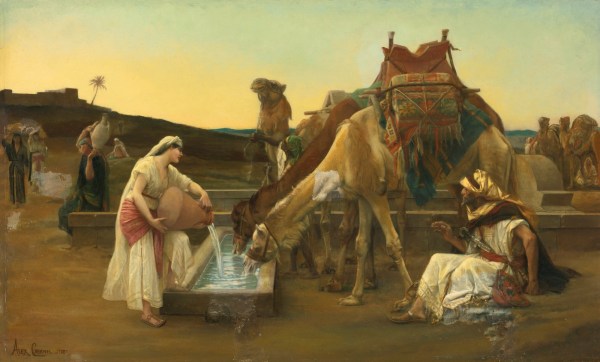
Above: Rebecca et Eliézer. Alexandre Cabanel, 28 September 1823 – 23 January 1889. French Painter. Oil on canvas. In private collection.
Adventures in Storytelling: Interview w/ Richard of IronAge Media

For this entry in Adventures in Storytelling, I’m doing something a little different. Instead of focusing on myself and my journey, I want to turn our attention onto a less well-known part of Storytelling, namely, publishing.

Richard Wilson is the founder of IronAge Media. Recently, his new magazine ANVIL: An IronAge Magazine was crowdfunded and released in July of 2023. In the interest of full disclosure, I was a backer of issue 1 and, my short story, Afflicted: Nourritures les Ver, will be published in ANVIL issue 2 which will be released this coming October. Although fundraising has ended, you can still purchase copies “on demand” via Indigogo.

The point of this series has always been to share tips, tricks, and struggles in the same way someone might journal a travel diary. Richard is on the bleeding edge of a new era of literary endeavor and I think we can learn a lot from his side of the adventure.

Independent publishing has become the norm and pulp style magazines are seeing a resurgence in online circles. While I’m not sure that the traditional publication industry is entirely down for the count, its certainly exciting to see new blood in the literary world.

I’d like to thank Richard and everyone at IronAge Media for consenting to this interview. Working with this team has been an awesome experience. I’ve learned so much from the interactions I’ve had with Richard.    

Let’s get into it.

The Interview

Tell me a little about yourself. Are you a writer, artist, or is Anvil Magazine your first creative endeavor?

Well I’m certainly not a writer, and although I have done plenty of painting and sketching in the past I wouldn’t identify as an artist. Prior to ANVIL I had worked on a couple of personal projects that would qualify as creative endeavors, but all of them were digital and coding focused. A few small video games and mods, some coding projects, and even a metaverse for a bit. However, ANVIL was the first thing I’ve personally made a serious effort to bring to market.


Who are your favorite writers or books? Favorite video games, comics? What type of media inspires you?  

That’s a big question. Early in life the Dinotopia books by James Gurney were particularly influential in my love of reading and I believe they hold up as beautiful artistic works as an adult. The original Dune series, The Book of the New Sun, and Zen and the Art of Motorcycle Maintenance were all works that I chewed on in my high school years, in addition to the usual high school assigned reading torment and more casual fun of older scifi.


For readers who might not be familiar, in your own words, what is the Iron Age? 

I’ll steal from myself in the first issue of ANVIL: The Iron Age is a decentralized movement of independent creators, across genres and mediums, circumventing traditional producers to create the kinds of entertainment that they want to see.


Do you think there’s a real hunger for original IPs?

I think there’s a hunger for something different. Before mega-corporations started buying up IPs like startup competitors, I think there was a much broader range of ‘taste’ within those legacy franchises and people didn’t feel any need to look around. Now if you want something aside from boardroom, corporate approved mediocrity wearing your childhood franchises like a skinsuit, you really have to look to new, original IPs.


What is the philosophy or guiding principle of IronAge Media?

Become the culture! Pragmatically that means bootstrapping the new media ecosystem as best as I can.


What made you want to start a magazine? Was it a spur of the moment decision or was it something you had always dreamed of? I know you have a talented team working with you, were you friends before IronAge Media, or did you just come together as a group of like-minded people? (i.e. how did this team get assembled?)

It was relatively spur of the moment. I hadn’t considered starting a magazine in January, but I was looking at actionable ways to achieve some broader goals I’d been thinking about. As for the team, Daniel and Jake were people I met early in the process of growing IronAge Media, and it was just a matter of looking at people who I knew I’d work well with and also had the skill sets I needed.


How did you settle on the name, Anvil? Is it symbolic or just cool?

Both. It was the first thing that popped in my mind when I was thinking about the magazine. Symbolically and thematically on brand for the Iron Age. I agonized over a lot of other names when I discovered an old communist rag was called ‘The Anvil’ back a hundred years ago, but I ultimately decided I’d rather go with my instincts and re-appropriate the term.


The first issue of Anvil Magazine far surpassed its original monetary goal, how does that feel? Were you surprised or did you know there was a desire for the kind of stories that Anvil promises?

It was immensely humbling more than anything else. I wasn’t necessarily surprised that people wanted it, I felt confident in the product, but I was surprised that I was able to get enough attention to communicate what it was to people and that those people were willing to trust me to deliver on that message.


What was the hardest part of getting IronAge Media and Anvil magazine off the ground? What was the most fun? And what was the most rewarding?

For me the greatest difficulty of IAM has been articles. I’m not a writer by practice, so writing a review or article for the site is far more time consuming than it should be, which is why I’m so appreciative of people who send in content. As for the most fun I’d definitely say the image prompts. Those were a decision I made on a whim and have proven to be a major part of the community building of IAM, and in many ways lead directly to ANVIL. Regarding ANVIL, by far the most difficult part of it has been fulfillment so far. I know a lot of people see the big number on the campaign and think it translates to big dollars for me, but when it comes to hourly rate, I definitely screwed myself over. The success of ANVIL of course has been an amazing and at times surreal experience that opened up a lot more options for what else I’d like to do. Certainly seeing authors happy to be published and readers excited about the magazine has been a very rewarding.


What are your future hopes for Iron Age Media? Do you have any plans to see IronAge Media branch out beyond Anvil Magazine? Do you see Anvil as a herald of a new age in media?

Expect to see the IAM site rebuilt soon to give users a more modern, slick feel. The overall brand is already moving into some new projects. One which will be public later this year, another that has a much longer timeline.

My goal for ANVIL has always been to create a place for consumers to find enjoyable works by new authors and artists they will love. I find that there’s a lot of (justified) complaining about consumer habits in the indie world, but I hope a brand like ANVIL can work as a stepping stone to draw in new buyers who know they aren’t happy, and just aren’t sure where to find that originality they’ve been missing.


I always end my entries of Adventures in Storytelling with a lesson I learned or a piece of advice I found helpful. Are there any lessons that launching Iron Age Media and ANVIL1 taught you?

Be a rational optimist and, the fastest way to learn if something is viable is to do it. There are a million failed websites and tens of thousands of failed magazines. If I had been negative about this I never would have tried. Instead I took a risk, put in the work, alongside other hard working folks, and now I can say that indie creators have made money and gained fans thanks to the project.


Do you have any advice for writers, artists, publishers?  

The potential market for new media is huge. Focus on your work and getting that work in front of buyers. Another person succeeding doesn’t take money out of your pocket, our current, globally networked economy is just too big for that. Doesn’t mean seeing crap succeeding is any less frustrating, but don’t let it drive you to harm your own goals.


Any final thoughts to share? Where can my readers find you?

Thank you for the opportunity to publish Afflicted! My wife and myself both enjoyed the character of Amélia Mitre and the interesting world you’ve placed her in. Your readers can find me at IronAge.Media and follow the links there to my various socials. I stream on Sunday evenings if you’d like to chat with me as I do something relaxing.


Again, I want to offer my heartfelt thanks to Richard and everyone at IronAge Media. Working with IronAge has been a awesome and humbling experience. It’s my hope that we work together in the future.

To sum up Richard’s great advice, remember:

Be a rational optimist. The fastest way to learn if something is possible, is to do it. Drop the negativity, take a risk, put in the work, and surround yourself with a cadre of other hardworking folk.

The potential market is huge, other people succeeding isn’t taking success from you, even if it hurts to see mediocre work rise to the top.

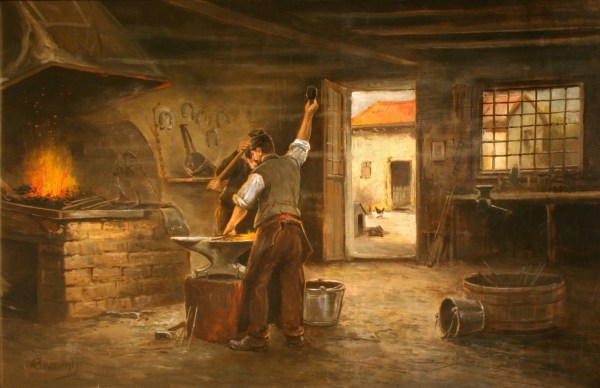
Above: The Blacksmith’s Studio. Albert Brument, French, 1883-1901. Oil on canvas. Housed in a Private Collection.

Writer’s Review: How to Write a Novel Using the Snowflake Method

If you’re familiar with my Adventures in Storytelling series, you’ll know that I’ve mentioned my preferred method of outlining. I started writing as a hardcore organic or “pantser” type. And while that method worked for me, I’d often find myself quickly losing control of the process and flying off into all sorts of interesting directions. In order to remedy this, I turned to a soft form of outlining I call wish-listing, where I jot down major plot points and connect and collate them as needed.

Naturally, I was intrigued by the premise of the Snowflake Method. The book promises a Goldilocks method, something in between plotter and pantser.

How to Write a Novel Using the Snowflake Method by Randy Ingermanson  

Many how-to-write books have little gimmicks to interest the reader, but I don’t think I’ve ever read a how-to with such a cute one. Mr. Ingermanson writes the book as a book, as in, it has a plot, characters, stakes, conflict, etc.

It’s cute and the charm managed to keep me reading. That said, it’s also short. Any longer than 160 pages and I’m pretty sure I would have gotten tired of it.

The way Mr. Ingermanson relays his information is through the plot and characters of the story.

Goldilocks is our protagonist. She has a dream: to become a best-selling author. The problem is, she doesn’t know where to start when it comes to writing a book. Goldilocks signs up for a series of writer’s workshops, hosted by the Three Bears, the eponymous Papa, Mama, and Baby.

Goldilocks quickly discovers that Papa’s method of plotting is far too rigid; Mama’s organic method is too open; but Baby Bear seems to be onto something with his method, one that splits the difference between his parents.

This method is the Snowflake Method, it is made up of ten steps and its underlining goal appears to be limiting the number of drafts and corrections without dulling the edge of the creative process.

The largest benefit to the rigid outline is its ability to see over the horizon and catch mistakes before they happen. While the biggest benefit to the organic method is the free flow of creative energy that gets words on a page. As someone who struggles with both methods, you can see why I find premise of the Snowflake Method interesting.

To see how it works, I actually took the time to write out a snowflake for a novella I’ve been planning. I won’t be listing any details here, as the snowflake is really designed for the writer, sharing it would give too much away.  

The Method consists of 10 steps:

  1. One sentence summary
  2. One paragraph summary
  3. Write a summary sheet for each character
  4. One page synopsis
  5. Write a character synopsis for each character
  6. Four-page synopsis
  7. Write a character bible
  8. List all the scenes
  9. Write a plan for each scene
  10.  Write your novel

Like most how-to-write guides, Ingermanson’s base is the Three-Act Structure. He also refers to it as the Three-Disaster Structure. His idea is that readers want three things: excitement, decision, and new directions—a disaster. Some might call this a plot point, or a beat. But it’s the incident that forces the character into confrontation with the plot, demanding they answer, and move the story forward.

So, let’s look at these steps.

One Sentence Summary

Fairly self-explanatory. Ingermanson states that it should “give [the reader] a taste of the story in twenty-five words or less.” (pg. 19) I actually call this a “mission statement” and use it as a statement of intent more for myself than anyone else, but I’ve been known to whip it out when a friend or family member asks me what I’m “writing about.” 

It’s a solid idea that I would recommend to the novice and expert alike. You want to be able to tell your friends and family what you’re writing, most importantly you want to be able to tell yourself what you’re writing.

One Paragraph Summary    

Again, another self-explanatory step. Each of Ingermanson’s steps build off the previous the steps, which is very intuitive. For the novice, this semi-solid structure may provide an example of what a writer needs to discern naturally.

The idea of the one paragraph summary is that you take the one sentence summary and expand it into five sentences, paying special attention to characters, setting, the disasters. It should hit all the story beats of each act and include your conclusion. Ingermanson doesn’t want you to bog yourself down with how you get to your conclusion or how characters respond to disaster so much as he wants you to draw the most basic of lines between persons, places, and events.  

Summary Sheet for Characters

For those familiar with my Adventures in Storytelling series, you’ll know that I’ve mentioned a character chart. I typically only make them for major characters and they not absolute, meaning, the character I chart might be completely different in the finished product.

The idea behind the chart is to throw every idea I have for that character down and I then draw lines connecting each piece of personality or backstory to each other. What I like to think I’m doing it making cause-and-effect clear to myself. Why is Character A like this? How did this event effect Character A?

Ingermanson’s character sheet is far from my blasé charts.

While Ingermanson makes it clear that this step isn’t necessary for every character, or that not every step within this step is needed for each character, this is where some of the tedium began to set in for me.

Ingermanson’s right, of course. There’s no need to produce a sheet for every character. As with my charts, it needs to be done for your main characters. You need to know your characters names, their values (“nothing is more important than X…”); their ambition (abstract desire); their goal (achievable); their conflict; their epiphany; a one sentence summary of their story; and a one paragraph summary of their life both in and out of the story.

As I said above, I struggled through this step. I worked out my main characters, wrote down some basic information for my minor characters, and moved on to the next step.

One Page Synopsis  

Unlike the one paragraph summary, the one-page synopsis might be useful for the marketing of a book. Editors and agents are busy people, they need a synopsis to hook them to make sure their time is used wisely.

Ingermanson suggest you take your one paragraph summary and turn each sentence of it into a paragraph.

For me, I found that easier said than done. But I understand Ingermanson’s point. It’s something that probably should be done. That said, I’ve done this only after I’ve finished a work.

I see the point; however, it does take that thin single paragraph and broaden the lines to build a skeleton which can be incarnated in the four-page synopsis.

Character Synopsis     

I’ll be honest, it was about here that I began to think that this method wasn’t really for me. I tried to convince myself that I’m just being averse to hard work, but that’s not being fair to all the hard work I’ve done in writing.

I determined that I would only write a synopsis for my two POV characters. Honestly, my conclusion was that the one paragraph summary I did of my characters in step 3 was all I needed.

Now, this might be because I’ve been brewing this novella for about a year now. It could also be that I don’t intend it to be a full novel. Frankly, this step felt “hand-holdy” if you catch my meaning.

Ingermanson is incredibly clear about how you don’t have to do all the steps of the Snowflake Method, and I appreciate that sentiment because this step isn’t for me. I don’t see its use other than to help you feel like you’re making some kind of progress.

Four Page Synopsis   

I skipped this step. I knew if I forced myself to write a four-page synopsis for my work, it would cause me to resent the Snowflake Method.

But I understand why he suggests it. Ingermanson is taking the rigid outline and hiding it in paragraphs instead of bullet points. He wants the writer to have their story idea locked down so that they know where they start and where they finish.  

Character Bible

Okay, so I was a little harsh on those last two steps. This step is a lot more useful to me. That said, it’s also something I would collapse into the character summaries of step 3.

Ingermanson’s character bible is meant to be the sheet that helps a writer keep track of the nitty-gritty detail of character, i.e., hair and eye color, age, height, DOB, favorite food, the way they take their tea, favorite movie/book, etc…

Not all these details are going to be relevant, although you should always make note of the way certain characters look, especially if they have certain defining features like scars or hair color. A character bible is the place to put that information.   

List all the Scenes

As Ingermanson says, the scene is the basic building block of any story. Each scene ought to play out the three-act structure in miniature, with a conflict and a resolution.

I didn’t do this or step 9. Why? Because I wrote a full page and half outline in step 4. And if I had completed step 6, what purpose would step 8 and 9 serve? I’ve already written the outline.    

In Chapter 8, Goldilocks realizes the crux of the method:

“The Snowflake Method was forcing her to think about things she hadn’t really worked out yet, but she could see that it was filling in the gaps in her story nicely. Every time Baby Bear asked a question, she could easily make up something on the spot to answer it.”

How to write a Novel using the Snowflake Method, Randy Ingermanson Chapter 8, page 69

Final Thoughts

The Snowflake Method is an ordering of the creative process. Its goal is to take the rigid outline and soften it with organic-looking paragraphs; Ingermanson cuts the hard work with fun work, and even gives approximate times you should give yourself to complete a task. He alternates the writer between character development and plot development to keep the writer from going lopsided in any direction.

Ultimately, I believe the Snowflake Method is a training tool. This book is not for people who already know how to write. This is for people who have no idea where to start, what to do, or where to finish. Honestly, I should have figured that out from the beginning. Goldilocks is a complete novice.

This feels like the kind of book a writer can use to get started. But after a while, you should start intuiting some of this process. Writing is an organic endeavor; you should always be getting better. Or as I like to say, where you start isn’t where you finish.

At some point, I think any writer who uses this method will eventually let it fall by the wayside as they develop their own writing tools. This is great for the novice. If you have absolutely no idea where to start, start here.  

Adventures in Storytelling 4

Entry 4, Carpe editorem, occide…continued.   

In my last entry I outlined four points that needed addressing in P1. I left off in the middle of my second round of editing and highlighted that I use my own tools to help identify my strengths and weaknesses. I made a list and focused on the nuts and bolts, things like -ly words and passive voice.

I want highlight one of the other two issues identified: lore/worldbuilding mistakes and inconsistencies; and, there are some things I simply don’t like.

I’m going to start with the first—lore/worldbuilding—because it’s easier to answer.

There is no end to the discourse regarding “worldbuilding.” There are endless books and articles on the topic, various charts and step-by-step guides on how to “build unique and imaginative places.” And that’s great, sometimes people need a guide.

Once you’ve come to understand the need for worldbuilding and mastered the concepts, your next step is to debate endlessly about when and where to use it, what qualifies as worldbuilding, and when its really just an infodump?

I’m not going to bore you with a lengthy discourse. I believe thoroughly that if you are writing, you are worldbuilding. Every sentence is an opportunity to build and deepen the unique flavor and culture of a world. It should be done in every kind of story, regardless if the setting is New York City or some far-flung elfland.

The danger with worldbuilding lies in the fact that sometimes it is an infodump.

In P1, I found that I didn’t really have a problem with infodumping. I killed that problem in one of my first drafts, working and reworking paragraphs and conversations to move information in a smoother way. I classified lore and worldbuilding information into two categories: absolutely necessary, and trivia.

Lore that is absolutely necessary is lore that is needed in order for the plot and the character’s actions to make sense. It is necessary to suspend a reader’s belief. For example, P1’s co-protagonist, R, has a background before meeting protagonist E. R’s background includes connections to an organization with an extensive history. That history must be told for R’s actions to make sense. Without that lore, R’s movements and thoughts become schizophrenic—unmoored from the reality of the story.

Lore classified as trivia is the nice little accoutrements that make a story unique, pretty, realistic. It’s the way someone styles hair or takes their tea. It’s how the road shunts to the left or how the flowers were blooming late in the mild spring. Fine details, those little things whose inclusion adds color but absence results in no serious loss to the central action of the story.

The issue was just how much lore I had.

If you recall from Adventures in Storytelling 1, I started P1 because a sense of overwhelming vastness that plagued my first abortive attempts at putting Project Paisley on paper. I knew I had something; I just wasn’t sure where to go with it. P1 was started to help me congeal—so to speak—my world.

In that, I would say I was successful. I believe the world I’ve created is colorful and realistic. Is it perfect? Of course not! But I think I have a world that is interesting and engaging. It’s made up of several counties, each with their own unique cultures.

That said, I didn’t start out that way. While writing, I spent a lot of time thinking about P1’s setting.

The main setting of P1 is an island-bound city, at the risk of oversharing, when thinking about this city I had two real cities in mind—London and Paris. I wanted to capture the things I liked about both cities. I thought deeply about how the ocean effects a city, it’s culture, government, etc. What considerations does an island-bound nation have to make regarding security? How does the sea change their food culture? What kind of jobs would their poor city-folk work? What of the prosperous?

In the end, I found myself asking, what would Paris be like if was actually on the coast of Normandy? What about London without the Thames?

My first draft was missing many of the key elements that I feel make this setting (as it’s written now) interesting. While I muddled through various technical problems, I found myself filling in the blank corners. Ordinary English idioms were rewritten to better relay the culture of a seafaring people, food became fish heavy, the peasantry became laborers and fishermen. I began to add these little details.

And that was just a single city. The religion of this world was terribly atrophied. I used a placeholder name for the main deity until a better name struck me in the middle of a slow work day. That bit of inspiration was just pure luck, the rest I had to force myself to sit down and think about.

When I began writing P1, I already had a small booklet that I jotted ideas in. It was in no way comprehensive, but it was helpful and allowed me to keep track of my thoughts.  

I’d written several notes about the religion of a particular civilization that acts as the “national antagonist” if that makes sense. This nation is in a strained relationship with the other nations. They’re less an actual threat and more a looming, invisible darkness that hangs over the characters like a Sword of Damocles.

With them, I had to ask myself, how weird am I willing to be? How strange and foreign do I go? I wanted to create a religion that would repulse all modern sensibilities. Something in the way of a mystery cult with elements of ancient fertility cults. I confided in some friends and the answer I got back is the same advice I would give to any writer. Be weird. Write what you want. Weird is where the fun is.

There is only one way to solve lore and worldbuilding inconsistencies. If its trivial, you can drop it. If it’s necessary, you alter it. Its perfectly possible for you to like the mistake more than the original idea. I’ve changed things to better match up with the mistake I made.

But, the more you have, the higher the chance for error. As I read through my second or third draft, I realized that my timeline was, well, fucked. I couldn’t keep my pacing tight. Things were moving either too quickly to be believable, or too slowly. Fixing this is easier said than done. I haven’t completely fixed it.

Before my most recent draft I sat down and did two things.

First, I worked out a primitive timeline. I went event by event and found that a perceptive reader would quickly take note of the awkwardness of the pacing. Conflict was happening so frequently that despite my clear delineation of day and night, it didn’t feel like there was enough time between problem and resolution.

Now, of course, piling catastrophe on catastrophe is part of being a writer. The action happens in between conflict and resolution. Because my story has a high element of political chaos, it was necessary for the conflicts to coalesce, or the solution to become a problem later in the plot. But I couldn’t make the pacing feel natural. I had to sit down and write it out, event by event, piece by piece, until I understood exactly what I was looking at.

I remain uncomfortable with my current timeline; I am working on fixing the pacing.

The second thing I did was go through each chapter and take out everything I could find that was lore related. I placed it all in a master document. This list has become an augmentation to my original booklet. I refer to it as needed. Now, anything inconsistent or repeated is glaringly obvious. By listing each piece of lore/worldbuilding with the chapter it was found in, I am now able to refer and correct.

You’ll note that these aren’t really solutions. They’re more like guides. The tasks I’ve made for myself are monumental and they cannot be solved in a few short sessions. As I write this entry, I’m actively in the middle of these corrections. I’m not foolish enough to think that I can work a perfect draft. Eventually, I will have to give in and let the story escape.

It’s hard to pinpoint a lesson when you’re actively attempting to fix something. The only thing I could offer my past self is this:

Writing is work, but a good story deserves your attention. Even if you can only work small pieces at a time, keep chipping away. Every correction, every setback, every mistake makes you a better writer.

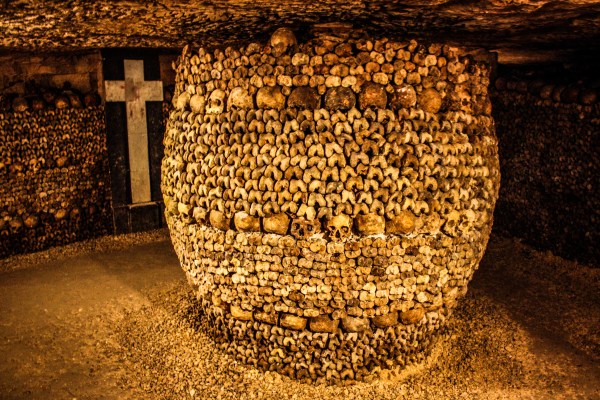
Above: a view from the Paris Catacombs. Consecrated in 1786, the Catacombs are the final resting place of countless Parisian dead. May the souls of the faithfully departed, through the mercy of God, rest in peace.

Four Letter Words

The following contains profanity.

Let me start this off by stating that I have no problem with curse words. I curse—too much, actually—but I’m not interested in shaming anyone. I am interested in the efficacy of profanity as it pertains to writing.

A long time ago I picked up a book on writing prose. I expected it to be a quick read, it promised a step-by-step guide to writing better, more dynamic prose. What I didn’t expect was for the author to immediately call me a bitch and then tell me to put the book down if I don’t like cursing because the author does a lot of it.

Okay, whatever. I said to myself. I got about a chapter in and realized that almost every paragraph had a swear word in it.

I put the book aside and haven’t picked it up since. I began to question if this was someone I wanted to learn prose from. Not because I don’t like cursing—I don’t, to be honest, but it’s habituated in the culture and I’m perfectly guilty of using cuss words so I’m not judging the author for using vulgarity.

I’m judging the author for writing prose so damn onerous it became tedious to read.

I don’t remember where I heard it, but I picked up a piece of advice regarding curse words and writing. The advice went something like this: “save it for when you really mean it.” I took that advice to heart. There is cursing in my writing, I’ve got no problem dropping a “damn” or a “hell.” Sometimes I even exercise my creative liberty with a “damnation” or a “hellfire.” But before I drop anything harder, I think about the impact of that word.

Words are powerful. There is a reason why some phrases, some sentences, some stories stay with us. Words make an impact, for good or ill.

The Harry Potter series is filled with colorful aphorisms: “Merlin’s beard,” “Merlin’s pants,” “galloping gorgons” the offensive “mudblood.” But the most famous, most powerful cuss said in the Harry Potter series is said by the least likely person, an all-caps piece of formatting art:

“NOT MY DAUGHTER, YOU BITCH!”

-Molly Weasley, Harry Potter and the Deathly Hallows

This was absolutely thrilling to my teenage self. It felt very grown up, very earned. Molly Weasley said what we were all thinking. We’d been on this journey with Harry and friends and Bellatrix Lestrange was one of the villains most in need of some violent correction.

There’s a lot of power behind the fact that this is really the only time a true “muggle-world” curse is used in the Harry Potter books. By saving this pejorative until the end, by having it said by a character no one would expect, by using it on someone who unmistakably deserved it, Rowling punches the word home. It does not become trite and tired, it remains forceful, meaningful. Bellatrix Lestrange was a bitch, she died like a bitch, and Mrs. Weasley is a bad bitch.

From my own writing, I wrote a character who was disgraced royalty. This character hid the effect of that shame by acting disgracefully, using curses, blasphemies, and unbecoming language to make it seem that the shame was a choice, not something forced upon them. The character’s business partner never used foul language and often chastised the other character for their uncouth behavior. Character B was well aware of Character A’s past and knew them to better than a common thug.

To get this theme across, I put a lot curse words in A’s mouth and at some point, during the editing process I heard that piece of advice from above. Suddenly all the piled up “fucks” and “shits” started to become repetitive. Annoying even, like clutter. My prose was overburdened with words that began to lose any semblance of meaning.  

A word loses its strength with every repetition. Psychology calls this phenomenon semantic satiation, where a word repeated temporarily loses all meaning. After the fifth of sixth curse in as many (or fewer) paragraphs, I found the curses to be like dirty laundry piled up in the corners of a room. Annoying, nagging, in need of a good wash.  

So, I took up the task to remove all but the most necessary swears. I found that this exercise was ultimately better for the work. I came up with charming little ejaculations not unlike Rowling’s “Merlin’s beard” that added cultural flavor to the world. Character B still reacted to these phrases with offense, but I peeled away the meaningless white noise that “fuck” had taken on in the story.

As a bonus, when I do whip out the above curse, it was suddenly and powerfully steeped in meaning. The scene is an airing of grievances. Character A accuses B of wanting to “fuck” and it’s meant in all the dirty, grimy, objectification that word entails. Greatly insulted, B turns the phrase around. This is the only time B curses in the story and it shocks A into silence.

All this is said with a big heaping spoon of it’s my opinion. Still, I think “save it for when you really mean it, when it will be most powerful” is pretty good advice. Perhaps if we all took this advice to heart, our interactions with each other would be less cluttered with nonsense expletives turned filler.  

Take the advice, or don’t, fuck if I care.     

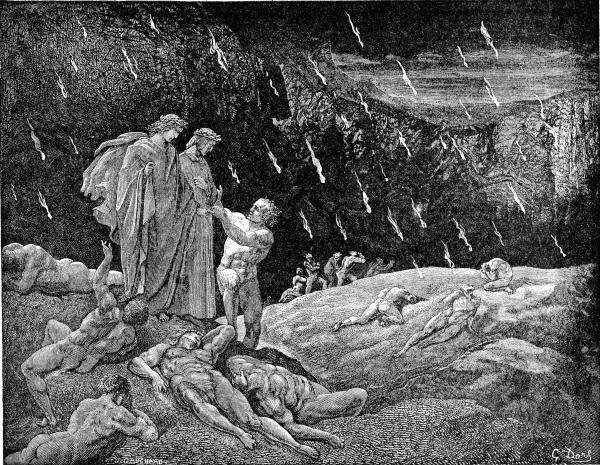
Above: Illustration of Dante Alighieri’s Divine Comedy, the Inferno Canto XV. Gustave Doré (January 1832 – January 1883). French. Engraved Print.

Don’t forget to check out the crowdfunding pages for Anvil Issue 2, where my short story, Afflicted: Nourritures les Ver, will be published! For more info, click here.

Blog at WordPress.com.

Up ↑