Writer’s Review: Buffy and the Art of Story

When I purchased Buffy and the Art of Story I had a very different notion of what I was ordering verses what I got. It was an impulse buy, I admit. I love Buffy—okay, I love the first three season of Buffy with some select episodes from the other four. The book promises that I’ll be “writing better fiction by watching Buffy.”  

I expected the book to go through the entirety of the Buffy series, break down the character development, plot, motifs, symbolism, etc., all of this towards the goal of enhancing my writing abilities. It wasn’t until the book was in my hands that I realized it said “Season 1.”

When I made my cursory flip-through, I saw that it went through episode by episode. As I began reading, I learned it’s scope was very specific—structure, with some limited commentary of character development and story devices.

The disappointment was my fault. I misunderstood the scope and point of the book. I also got a bit too excited about the gimmick.

Gimmick really is the word here. One of the things that you start seeing with most of the how-to-write books is the reliance on gimmicks.

It makes sense. There are literally thousands of these kinds of books on Amazon alone. If you’re writing one of these books, you have to make yourself stand out.

For example, my own Adventures in Storytelling is, at its core, a how-to-write “book.” It’s gimmick is to share tips, tricks, and advice through the perspective of a personal odyssey.

Buffy and the Art of Story’s gimmick is Joss Whedon’s incredibly successful 1990s horror/comedy/drama television show, Buffy the Vampire Slayer.

Buffy and the Art of Story, Season One by L. M. Lilly

Disclaimer: Per the introduction of Buffy and the Art of Story, the book is a transcript of a podcast by the same name. Because I review how-to-write books and not podcasts, I didn’t listen to it.   

Let’s start with the vampire in the room: this book is extremely niche.

I’ll be the first to admit that I shun fandom. I don’t like the cringy, obsessive, argumentative ways that some fandoms operate (particularly online). So, I’m really not sure if there is much of a modern Buffy fanbase—that is, younger generation fans, not Gen Xers and Millennials like me.

My first taste of Buffy was catching a random re-run some October while I was in high school. I began to borrow the DVDs from my local library, some of which didn’t work properly, so I never ended up finishing the entire series until COVID gave me a chance to sit down and binge.

Although I’m a “new” fan, I’m not really sure how many new fans there are out there. The first episode aired in 1997, I wasn’t even ten! My age bracket is probably the upper limits of someone who would even be familiar (that is, nostalgic) for the cheesy 90s’ and early 00s’.

Buffy and the Art of Story is clearly for established fans of the Vampire Slayer. There are no recaps or synopses at the beginning of each chapter. Lilly simply “dives into the Hellmouth.”

You must already know the basic story and characters of every episode in season 1 in order to get anything out of this book.

The chapters are named by episode, so if you want to skip around and examine specific episodes, you can. Each chapter is arranged the same, starting with some background information about the writers and director; listing the particular story elements the author wants to highlight; a chronological breakdown of the episode catching each one of Lilly’s seven-pointed plot structure; some spoilers and commentary; and finishing up with a list of questions for your writing.  

In the first chapter, Lilly gives us an introduction to her preferred story structure: “Key plot points and turns for your story.”

It’s solid, seven-pointed structure:

  • Opening Conflict, which opens the story and draws the reader in.
  • Story Spark (aka, Inciting Incident), the event that sets off the story at about 10% in.
  • One-Quarter Twist, the first major plot point that “spins the story in a new direction” and typically comes from outside the protagonist.
  • Midpoint, where the protagonist commits to the quest or suffers a major reversal.
  • Three-Quarter Turn, the next major plot point that spins the story in a new direction but usually comes from within the characters. It usually comes in two-thirds through a story.
  • Climax, the “culmination of the main plot.”
  • Falling Action, the end of the story.

As I read the book, I found myself, for the most part, agreeing with Lilly’s use of the structure. However, this book has some serious flaws and it’s for that reason that I cannot recommend it.

I don’t like doing “negative reviews.” The goal of these essays has always been to help other writers find how-to-write books that might expand their horizons. But if that is my stated goal, then I have to be honest. 

Lilly’s seven-pointed structure is a good structure; it’s just not the only one. And it’s especially not the only structure Buffy uses.  

For example, a lot of Buffy’s one-off episodes—the monsters-of-the-week—do not fit neatly into this structure. Some of them use what I would call a “pulp structure.” The episode isn’t really about the characters changing or growing in any profound way, it’s about the characters overcoming obstacles.

This kind of structure is easily seen in any given Conan the Barbarian story. There is a goal and a series of hurdles that the character must overcome in order to achieve said goal. The story is in the lengths a character will go in order to achieve their ends.  

And while Lilly hits the mark for most of the episodes i.e. the two parts 1st and 2nd episodes (Welcome to Hellmouth/the Harvest); episode 7, Angel fits well within her structure; even the one-off I, Robot…You, Jane. She misfires by trying to squeeze every episode into her seven-pointed story structure.

That said, I think the structure is a strong one, it’s should be. It’s the Holy Trinty, the Tripod, better known as the Three Act Structure.

An ocean of ink has been spilled over the vagaries of plot structure and ultimately that’s the thing here. There are better books on plot structure.

But, there are also some problems in her analysis.   

Take her chapter on episode 6, the Pack.

It’s a standalone Xander-centric episode wherein Xander and a gang of obnoxious bullies are possessed by the demonic spirit of a hyena. Here’s a link to a quick summary and analysis if you’re unfamiliar or need a refresher.

The main problem with Lilly’s analysis is that she misplaces story beats because she’s misidentified the active protagonist as Buffy when it’s Xander. This doesn’t mean that Buffy and Willow aren’t active protagonists—they are, but it’s Xander who sets off the story, it’s Xander who commits, and it’s Xander who saves Willow.

Lilly misremembers that Xander is with the Pack when they eat the school mascot and I think this is the critical error in her analysis. This causes her to misplace her midpoint because “from a storytelling perspective [the pack] are not the protagonists.” In a way, she’s right. The four “packmates” aren’t the protagonists, but Xander is. He’s their leader.  

Another issue I have with Lilly’s analysis is episode Eight and I’ll admit that it’s somewhat a nit-pick, she says:

“…in addition to Moloch being this sort of mustache-twirling villain who is just evil for evil’s sake, we also have the people support this kind of demon apparently just for evil’s sake…

…so I know we were told from the beginning that Moloch preys upon the weak of mind. Also he’s the Corruptor, and that he has this way over people. So it’s probably unfair to say they are choosing to follow this demon. But it feels a bit like weak storytelling to me. It is less interesting to have a demon who just has this magic power of making people follow him rather than the followers having some reason. Some deep need the demon is filling, something that makes us understand why they would devote themselves to this demon.”

Buffy and the Art of Story, Pg. 168-169

There are several instances where I think Lilly’s grasp of symbolism and motif is woefully atrophied. And while this episode doesn’t have a great rap, I find it a wealth of almost painfully obvious symbolism.

Moloch is a demon, he preys on the lonely, he’s called the Corruptor, his name is Moloch.

Moloch is traditionally understood to be an ancient Canaanite deity, throughout the Bible the Israelites find themselves falling into idolatrous worship of him. Idolatry is best understood as misplaced love or corrupted love.  

I, Robot…You, Jane is one of those episodes that I feel falls a bit short of the lofty symbolism it’s playing with, in part because the symbolism is clunkily spoon-fed to the audience. Moloch is a symbol of the tension between the characters. Willow’s unrequited love of Xander; Buffy’s crush on Angel; Giles’ utter distrust of technology; Fritz obsession—idolization—of technology.

Lilly’s miss regarding this symbolism was when I truly realized that I couldn’t recommend this book.

Final Thoughts.

Story is more than tight structure, its more than making sure each chapter ends on a hook, its more than twists and turns and reversals.

If Lilly kept strictly to breaking down structure, leaving out any analysis of the characters or plot, it would still be a flawed book, but it would be one with some minor use for novice writers who are also Buffy fans.

As it stands, this book isn’t terrible, it’s just not useful.

The Archetypes of Scripture: The Sword Shall Not Depart

A Long but Necessary Introduction

From the beginning, my goal for the Archetypes of Scripture series has been to expand my (and my readers) understanding of tropes and archetypes while also exploring the various stories found in Sacred Scripture. While I’m not using this series to evangelize, I know that its impossible to speak about Christ without it coming off that way.

Further baggage is added when I expound upon my denomination. I consider myself ecumenical and I want this series to appeal to a wide variety of readers. So, while I’m not going to stop explaining the tenants of the Christian Faith, I hope that readers are willing to enter into the Scriptures as a story.      

Sometimes, I’m not always sure I know what I mean when I say “story,” especially in light of the Bible.

As I’ve said before, the Bible is really a library featuring poetry, history, prophecy, and even primitive creative fiction. But from the Christian position, all the stories, no matter how short and seemingly insignificant, point to a wider, over-arching narrative.

This narrative points upward, towards God and man’s struggle to reach Him. One of the main villains is man himself, who lives in the mucky waters of Original Sin and wrestles with God. The wrestling seems to have no end, until God throws the match and comes down to struggle with us. Standing shoulder-to-shoulder with Creation, He defeats death once and for all.

In that way, all the stories point to Christ. But to make that point, they sometimes point backwards—away from Christ.

When I think about the various linchpin tropes of Sacred Scripture, I think of Adam, Original Sin, and the New Adam.

Original Sin should not be confused with Total Depravity, which, I believe, is what most non-Christians believe all Christian believe. I’ve also seen that a lot of people believe that it has something to do with sex, which is wildly incorrect.

The original sin of Adam was disobedience to God. The Lord forbad Adam from eating the fruit of the tree of Knowledge of Good and Evil.

Worse still, after directly disobeying God, Adam blames Eve for his faults—the first in humanity’s long and proud tradition of blaming each other for our personal short comings.

Its by the disobedience of Adam that sin enters the world and stains all his children [read: the human race]. This sin is the deprivation of the original holiness and justice intended for humanity. Human nature, states the Catechism of the Catholic Church, is “not totally corrupted: it is wounded” with an inclination to do evil. [CCC 405]. This sentiment is clearly stated by Saint Paul in Romans:

I have the desire to do what is good, but I cannot do what is good. 19 For I do not do the good I desire; rather, it is the evil I do not desire that I end up doing. 20 Now if I do what I do not desire, it is no longer I who do it, but sin that dwells in me.

[New Catholic Bible, Romans 7:18-20]

Long after the fall, in another garden, Jesus would ask his Father that the cup depart from him, but not if it meant disobeying his Father’s will. It is the Sin of Adam that brings—into sharp contrast—the Obedience of Jesus.

The sin of our father covered us, until the innocence of another washed it away. 

This 500-word preamble, was to introduce us to the trope: the sins of the father.

The Sword will not Depart

Of all the millions of misquotations and misunderstanding between Christian sects, non-Christians, and atheists, the sins of the father is probably high in the running. So, here is the original verse:

I the Lord your God am a jealous God, punishing children for the iniquity of parents, to the third and the fourth generation of those who reject me, but showing steadfast love to the thousandth generation[a] of those who love me and keep my commandments.

[New Revised Standard Version Catholic Edition, NRSV-CE, Exodus 20:5-6]

In this verse, the Lord is speaking about idolatry, which is to love anything more than God. We all worship something—for most of us, that thing is the self.

For David, for one moment, that thing was his lust. David would throw himself at the feet of this idol and in a singular act of worship to it, subject his family to the consequences of sin.

It happened, late one afternoon, when David rose from his couch and was walking about on the roof of the king’s house, that he saw from the roof a woman bathing; the woman was very beautiful. David sent someone to inquire about the woman. It was reported, “This is Bathsheba daughter of Eliam, the wife of Uriah the Hittite.” So David sent messengers to get her, and she came to him, and he lay with her. (Now she was purifying herself after her period.) Then she returned to her house. The woman conceived; and she sent and told David, “I am pregnant.”

[NRSV-CE, 2 Samuel 11:2-5]

I don’t need to expound upon the pain and anguish adultery causes in a family, in David’s case, his family won’t feel the effects until later. For Bathsheba and Uriah, the effects are immediate.

We get no word on the willingness or unwillingness of Bathsheba. On my part, I will not brand Bathsheba a temptress, nor will I call David a rapist. But when the king wants you, what are you to say to that? Denying him would insult him, maybe even risk your husband’s life. But to go along defiles you and your marriage vows. Or, perhaps the text is more subtle. Perhaps Bathsheba, having purified herself after her menstrual cycle, believed she would not conceive so soon after it, and went to David to further her husband’s career or even her own standing.

Regardless of Bathsheba’s desires, David is the key figure and he’s on a collision course with evil. David sends for Bathsheba’s husband, Uriah, who is fighting with Joab and David’s other servants, against the Ammonites. Uriah returns to Jerusalem and David tries to convince him to sleep with Bathsheba in order fleece Uriah into thinking the child is his.

But Uriah, following the tenant of the law (1 Samuel 21:4-5), does not sleep with his wife while David’s kingdom is at war. Uriah says:

“The ark and Israel and Judah remain in booths [tents];[a] and my lord Joab and the servants of my lord are camping in the open field; shall I then go to my house, to eat and to drink, and to lie with my wife? As you live, and as your soul lives, I will not do such a thing.”

[NRSV-CE 2 Samuel 11:11]    

David then commands Uriah to stay with him another day. David feasts him, getting him drunk, but still, Uriah will not return to his house and sleep with Bathsheba.

Desperate, David compounds one sin with another and orders Joab, his commander, to place Uriah on the front lines and abandoned him, ensuring he is killed in the fighting.

15 In the letter he wrote, “Set Uriah in the forefront of the hardest fighting, and then draw back from him, so that he may be struck down and die.” 16 As Joab was besieging the city, he assigned Uriah to the place where he knew there were valiant warriors. 17 The men of the city came out and fought with Joab; and some of the servants of David among the people fell. Uriah the Hittite was killed as well.

[NRSV-CE 2 Samuel 11:15-17]

Joab, decidedly uncertain about how David will react to the news of Uriah’s death, instructs his messenger to tell David everything about the battle and decern his mood before he tells of Uriah’s death.

In a piece of brilliant, delicious biblical foreshadowing, David tells the messenger: 

25 David said to the messenger, “Thus you shall say to Joab, ‘Do not let this matter trouble you, for the sword devours now one and now another; press your attack on the city, and overthrow it.’ And encourage him.”

[NRSV-CE 2 Samuel 11:25]

The sword, indeed, devours. Very soon, that sword will come for David’s house.

Bathsheba mourns her husband’s death and when that customary mourning period is over, David marries her and brings her into his household. But, “the thing David had done displeased the Lord.”

The Lord sends his prophet, Nathan. The Prophet tells David a story:

 “There were two men in a certain city, the one rich and the other poor. The rich man had very many flocks and herds; but the poor man had nothing but one little ewe lamb, which he had bought. He brought it up, and it grew up with him and with his children; it used to eat of his meager fare, and drink from his cup, and lie in his bosom, and it was like a daughter to him. Now there came a traveler to the rich man, and he was loath to take one of his own flock or herd to prepare for the wayfarer who had come to him, but he took the poor man’s lamb, and prepared that for the guest who had come to him.”

[NRSV-CE 2 Samuel 12:1-4]

David, a just and honorable king, is understandably horrified that such thievery is going on in his kingdom. He demands to know who has committed such an offense. Nathan, then, drops the mic: 

Nathan said to David, “You are the man! Thus says the Lord, the God of Israel: I anointed you king over Israel, and I rescued you from the hand of Saul; I gave you your master’s house, and your master’s wives into your bosom, and gave you the house of Israel and of Judah; and if that had been too little, I would have added as much more. Why have you despised the word of the Lord, to do what is evil in his sight? You have struck down Uriah the Hittite with the sword, and have taken his wife to be your wife, and have killed him with the sword of the Ammonites. 10 Now therefore the sword shall never depart from your house, for you have despised me, and have taken the wife of Uriah the Hittite to be your wife. 

[NRSV-CE 2 Samuel 12:7-10]

The sins of the father shall be visited upon the children. David has sown chaos in his house and his family will reap this bitter harvest until the Stump of Jesse sprouts again.

To David’s credit, he repents immediately. The Lord puts away his sin, but the wheels of cause and effect are already turning. Evil is a consequence of sin. David sinned, and that insult was against God, but God is hardly the only victim. Uriah, Bathsheba, the unborn child, David’s other children—are all effected by David’s sin. 

The sword will not depart, Nathan said, and it doesn’t. Although the marriage to Bathsheba eventually produces Solomon, a wiser, but as equally flawed a king as David, proves that God can bring good out of evil. The real horror of David’s story begins when Amnon, his son by a different wife, rapes his half-sister, Tamar.

Tamar is Absolom’s sister, she is described as beautiful, and a virgin.

Amnon was so tormented that he made himself ill because of his sister Tamar, for she was a virgin and it seemed impossible to Amnon to do anything to her. 

[NRSV-CE 2 Samuel 13:2]

On the advice of his friend, Amnon uses trickery to bring Tamar close enough to misuse her. He pretends to be ill and asks his father to send Tamar to tend to him. Believing her brother is sick, Tamar makes food for him which Amnon refuses to eat, except from out of Tamar’s hands. He sends all his attendants, except Tamar, out of his chambers. Being a good sister, Tamar comes forward to Amnon’s bed.  

11 But when she brought them [the cakes] near him to eat, he took hold of her, and said to her, “Come, lie with me, my sister.” 12 She answered him, “No, my brother, do not force me; for such a thing is not done in Israel; do not do anything so vile! 13 As for me, where could I carry my shame? And as for you, you would be as one of the scoundrels in Israel. Now therefore, I beg you, speak to the king; for he will not withhold me from you.” 14 But he would not listen to her; and being stronger than she, he forced her and lay with her.

[NRSV-CE 2 Samuel 13:11-14]

And so, the sword devours another.

Like every sexual predator, Amnon wasn’t “in love” with Tamar, he was worshiping himself and his lust. Amnon, like David, made an idol of his desires. He took what he wanted for no other reason but he wanted to.

Amnon took Tamar, like an object, and used her. He was even “seized with a very great loathing for her; indeed, his loathing was even greater than the lust he had felt for her” and he throws her out of his house, refusing to make a wife of her after ruining her chances of finding a husband (2 Samuel 13:15).

Absolom, Tamar’s direct brother, brings her into his house. He tells her to keep her peace because Amnon is her brother. This is harsh by our modern sensibilities, but the next verse, I think, explains why Absolom told his sister to keep silent about the rape:

 21 When King David heard of all these things, he became very angry, but he would not punish his son Amnon, because he loved him, for he was his firstborn.[d] 

[NRSV-CE 2 Samuel 13:21]

I doubt Absolom has confidence in David’s sense of justice. After all, his father wasn’t above destroying Uriah’s family in order to gain Bathsheba. Like father, like son, right? 

Here we see the true consequence of David’s sin. He has been rendered ineffective. Absolom doesn’t believe David is a good and just king, and David proves that correct. Despite knowing the wrong that happened in his house, David does nothing against Amnon.

Denied official channels, Absolom takes matters into his own hands. He waits for two years before taking his vengeance. Absolom invites all his brothers to a party in the countryside and he orders his servants to watch Amnon. When Amnon is drunk, Absolom and his servant strike, killing Amnon and causing the other brothers to flee.

Word reaches David that Absolom has killed all his brother (David’s sons). David tears at his garments and weeps until the truth is learned that Amnon alone is dead. Still, Absolom flees to Talmai, in Geshur. He will stay there three years.

Although David misses Absolom, he does not call his son back from Talmai. David is still trying to hold onto that veneer of justice. Bringing his murder son back would show to all Israel that he has lost his way.

Enter Joab, the son of Zeruiah. As a character, he has the flavor of a political upstart and I can’t help imagine him scheming in the backrooms of the palace seeking ways to ingratiate himself into David’s good-graces.

Regardless, Joab perceives that David misses Absolom, so he goes out and finds a wisewoman to petition David:

When the woman of Tekoa came to the king, she fell on her face to the ground and did obeisance, and said, “Help, O king!” The king asked her, “What is your trouble?” She answered, “Alas, I am a widow; my husband is dead. Your servant had two sons, and they fought with one another in the field; there was no one to part them, and one struck the other and killed him. Now the whole family has risen against your servant. They say, ‘Give up the man who struck his brother, so that we may kill him for the life of his brother whom he murdered, even if we destroy the heir as well.’ Thus they would quench my one remaining ember, and leave to my husband neither name nor remnant on the face of the earth.”

[NRSV-CE 2 Samuel 14:4-7]

David tells the woman to return to her home, that no harm will come to her, and he will not allow anyone to harm one hair on the head of her son.

Like the story of Nathan above, David, again, convicts himself. The woman says as much:

13 The woman said, “Why then have you planned such a thing against the people of God? For in giving this decision the king convicts himself, inasmuch as the king does not bring his banished one home again. 14 We must all die; we are like water spilled on the ground, which cannot be gathered up. But God will not take away a life; he will devise plans so as not to keep an outcast banished forever from his presence.[a] 

[NRSV-CE 2 Samuel 14:13-14]

God forgives, and so David should forgive.

If we’re honest, we can admit that Absolom’s murder of Amnon is justifiable. Amnon’s offense was public knowledge as Amnon ordered his servants “put her [Tamar] out” and “bolt the door after her.” She then covered herself in ashes and went about weeping.

The fault lies with David, who, as a just and righteous king, should have dealt with Amnon accordingly. That failure wrecked his, albiet, not great, relationship with Absolom. 

Still trying to hold onto that veneer of justice and impartiality, David commands Joab to bring Absolom back to Jerusalem, but he will not allow Absolom back into his kingly presence. Perhaps, if David had welcomed Absolom back into his bosom, things could have been different.

David is a prefigure of Christ, but he is not the Christ. And this episode proves that simple fact, definitively. The king forgives Absolom, his subject, and lets him come home, but David does not forgive his son and does not let him come home.

A just king, David might be, but a just father? I have my doubts.

I desire to do good, said Saint Paul, but I can’t do good. Like many stories in the Old Testament, I feel that sentiment in the story of David and Absolom. Sin, miscommunication, misunderstandings, and partial forgiveness—all part of the tragedy of Original Sin, the sin of our first father.

Absolom lives in Jerusalem for two years without seeing his father. He sends for Joab, hoping to be let in to see the king, but Joab ignores him. He sends for a second time, and still gets no answer. Fed up, Absolom orders his servants to set Joab’s barley field on fire.

Roused at last, Joab goes to Absolom to ask why he set fire to his land.

32 Absalom answered Joab, “Look, I sent word to you: Come here, that I may send you to the king with the question, ‘Why have I come from Geshur? It would be better for me to be there still.’ Now let me go into the king’s presence; if there is guilt in me, let him kill me!” 33 Then Joab went to the king and told him; and he summoned Absalom. So he came to the king and prostrated himself with his face to the ground before the king; and the king kissed Absalom.

[NRSV-CE 2 Samuel 14:32-33]

Forgiveness, great! We may think, but two years is a long time to build resentment. And, let’s not forget the last time Absolom waited two years.

Back in his father’s good graces, Absolom hires a chariot and 50 servants, and he begins to rise early in the morning in order to stand by the gate and so that when a man came to petition justice from David, he could intercept them.

Absalom would call out and say, “From what city are you?” When the person said, “Your servant is of such and such a tribe in Israel,” Absalom would say, “See, your claims are good and right; but there is no one deputed by the king to hear you.” Absalom said moreover, “If only I were judge in the land! Then all who had a suit or cause might come to me, and I would give them justice.” Whenever people came near to do obeisance to him, he would put out his hand and take hold of them, and kiss them. Thus Absalom did to every Israelite who came to the king for judgment; so Absalom stole the hearts of the people of Israel.

[NRSV-CE 2 Samuel 15:2-6]

Absolom follows that old trope: revenge is a dish best served cold.

After four years of this, Absolom goes to David (who doesn’t appear to have any idea of what’s going on) and begs the King to let him go to Hebron to fulfil a vow he made to the Lord while in Geshur. David, of course, lets him go.

With his father’s permission to depart, Absolom then sends out secret messengers to the Tribes of Israel telling them that “at the sound of trumpets” they should shout “Absolom is king at Hebron” (2 Samuel 15:10).

The conspiracy grew under David’s nose. Until word reaches Jerusalem.

13 A messenger came to David, saying, “The hearts of the Israelites have gone after Absalom.” 14 Then David said to all his officials who were with him at Jerusalem, “Get up! Let us flee, or there will be no escape for us from Absalom. Hurry, or he will soon overtake us, and bring disaster down upon us, and attack the city with the edge of the sword.”

[NRSV-CE 2 Samuel 15:13-14]

David and his household flee Jerusalem. David leaves behind his concubines to look after his house. Confident in the Lord, he intends to return. He’s so confident, in fact, he tells the Levites to leave the Ark of the Covenant in Jerusalem, saying “If find favor in the eyes of the Lord, he will bring me back and let me see both it and the place where it stays” (2 Samuel 15:25).

In the wilderness, at the ascent of the Mount of Olives, David prays to the Lord, asking him to turn the advice of the counselor, Ahithophel, who betrayed him, into foolishness.

David is reeling from this betrayal. The conspiracy is so widespread that David and his supporters are so outnumbered that defending Jerusalem becomes impossible and they must flee and roam the countryside. He sends a spy, Hushai, to Absolom’s court in Jerusalem, but David must ultimately rely on the Lord.

Even while on the road, David is cursed by his subjects. When his servants ask to slay those who speak ill of the king, David utters:

11 David said to Abishai and to all his servants, “My own son seeks my life; how much more now may this Benjaminite! Let him alone, and let him curse; for the Lord has bidden him. 12 It may be that the Lord will look on my distress,[c] and the Lord will repay me with good for this cursing of me today.”

[NRSV-CE 2 Samuel 16:11-12]

While David camps on the banks of the Jordan River, Absolom enters Jerusalem and seeks the guidance of his father’s former advisor, Ahithophel. 

20 Then Absalom said to Ahithophel, “Give us your counsel; what shall we do?” 21 Ahithophel said to Absalom, “Go in to your father’s concubines, the ones he has left to look after the house; and all Israel will hear that you have made yourself odious to your father, and the hands of all who are with you will be strengthened.” 22 So they pitched a tent for Absalom upon the roof; and Absalom went in to his father’s concubines in the sight of all Israel. 23 Now in those days the counsel that Ahithophel gave was as if one consulted the oracle[f] of God; so all the counsel of Ahithophel was esteemed, both by David and by Absalom.

[NRSV-CE 2 Samuel 16:20-23]

And there Nathan’s prophecy is fulfilled: “for you did it secretly; but I will do this thing before all Israel, and before the sun.”

This is an absolute humiliation for David. Absolom is basically saying “I’ve replaced you utterly.” He has taken over David’s house, taken his women, used them as David would use them. The line is drawn, Absolom will take all that David has.

Absolom calls for further council and is convinced by Hushai, David’s spy, to pursue David personally. Hushai then sends word to David so that he might escape. David and his supporters cross the Jordan river and at daybreak, Absolom and his army follow.

David appoints commanders, but intends to go out and fight with his men. His commanders disapprove and tell the king that he worth ten-thousands men. Convinced by their words, David takes shelter in a nearby city, but he implores his commanders:

The king ordered Joab and Abishai and Ittai, saying, “Deal gently for my sake with the young man Absalom.” And all the people heard when the king gave orders to all the commanders concerning Absalom.

[NRSV-CE 2 Samuel 18:5]

The battle commences, with David’s mighty men slaying the men of Israel.

So the army went out into the field against Israel; and the battle was fought in the forest of Ephraim. The men of Israel were defeated there by the servants of David, and the slaughter there was great on that day, twenty thousand men. The battle spread over the face of all the country; and the forest claimed more victims that day than the sword.

[NRSV-CE 2 Samuel 18:6-8]

But the sword David was warned of so long ago comes down again. Despite his pleas, Joab is fed up with the infighting. He sees Absolom, who’s long, beautiful hair has been caught in a tree, he is trapped and helpless.

Absalom happened to meet the servants of David. Absalom was riding on his mule, and the mule went under the thick branches of a great oak. His head caught fast in the oak, and he was left hanging[c] between heaven and earth, while the mule that was under him went on. 10 A man saw it, and told Joab, “I saw Absalom hanging in an oak.” 11 Joab said to the man who told him, “What, you saw him! Why then did you not strike him there to the ground? I would have been glad to give you ten pieces of silver and a belt.” 12 But the man said to Joab, “Even if I felt in my hand the weight of a thousand pieces of silver, I would not raise my hand against the king’s son; for in our hearing the king commanded you and Abishai and Ittai, saying: For my sake protect the young man Absalom! 13 On the other hand, if I had dealt treacherously against his life[d] (and there is nothing hidden from the king), then you yourself would have stood aloof.” 14 Joab said, “I will not waste time like this with you.” He took three spears in his hand, and thrust them into the heart of Absalom, while he was still alive in the oak. 15 And ten young men, Joab’s armor-bearers, surrounded Absalom and struck him, and killed him.

[NRSV-CE 2 Samuel 18:9-15]

In a sad, but perhaps fitting, twist of fate, Absolom had no sons. His only achievement was a monument he built, now called Absolom’s Monument. All of his vengeance-seeking was in vain, it left no lasting mark, except for his father’s cry of anguish: my son, my son!

32 The king said to the Cushite, “Is it well with the young man Absalom?” The Cushite answered, “May the enemies of my lord the king, and all who rise up to do you harm, be like that young man.”

33 [g] The king was deeply moved, and went up to the chamber over the gate, and wept; and as he went, he said, “O my son Absalom, my son, my son Absalom! Would I had died instead of you, O Absalom, my son, my son!”

[NRSV-CE 2 Samuel 18:32-33]

There will be more blood and sorrow for David. His old age will be a time of war. The sins of the father are visited upon the son; all that war will make a time of peace and plenty for the reign of his son, Solomon.

Cause and Effect

Throughout this long essay I’ve been using the saying “the sins of the father” but perhaps a more contemporary way to put it is the simple phrase: cause and effect of narrative. Character A does action x, which sets off a reaction in Character B, who does y in return. These actions radiate outward, swallowing up more characters and actions pushing and pulling the story onward.

Conflict is the meat and potatoes of narrative. One may even say that there is no story without conflict.  

These episodes in David’s life are sometimes seen as separate events, but I think I’ve made it clear that the story of David and Bathsheba is merely the first act in a three-act story that culminates in Absolom’s usurpation.

It is commonly misunderstood that God punishes the children for the sins of their parents, this blood-curse is misguided. God did not punish Absolom, he punished David. Or rather, David’s actions—which cannot be put away—rippled through his family like a stone into a still pond.

This does not free Absolom from his actions. I understand his resentment, I think we all do, but he could have accepted his father’s forgiveness, however late it came.

Perhaps when we think of our character’s actions, we ought to think how those actions radiate outward and cause conflict and chaos among the other characters. These are the sins of the father, visited upon the sons.    

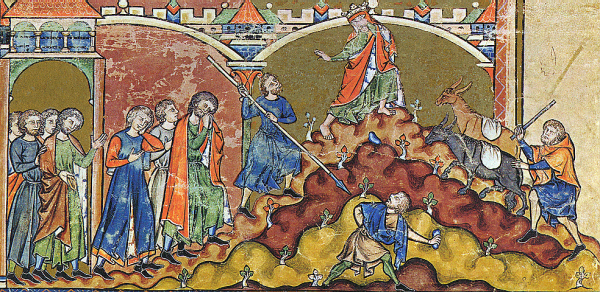
Above: David flees Jerusalem after Absalom’s conspiracy. A scene from the Maciejowski Bible, Leaf 45. Also called the Morgan Bible or Crusader Bible, a picture Bible from 13th Century. It was commissioned by Saint King Louis IX of France. Note the Benjaminite stone-thrower and the use of 13th century clothing. There are 46 surviving folios, 43 folios are housed in the Morgan Museum and Library, New York City, New York; 2 folios are housed in the Bibliothèque Nationale de France, Paris, France; 1 folio at the J. Paul Getty Museum, Los Angeles, California; 2 folios are lost to time.

Fantastic School Staff

My short story, Extra Credit, is available for purchase on Amazon. Fantastic School Staff features many great authors and is edited by Christopher G. Nuttall and L. Jagi Lamplighter.

Here’s the pitch:

Only enchanted treasure could drag a pair of master thieves back to school. Hired on as teachers, Pricilla and Chase must once again navigate the halls of Washington Academy, dodging teachers and students alike in order to steal Vivienne’s Locket. It’ll take all their skills, plus some extra credit, to pull off this heist.

If you pick up a copy, please leave a review!

I’ve learned a lot while working on this project. I wrote Extra Credit back in March of 2023, I was sick as a dog while finishing it and I didn’t have a whole lot of hope for it’s publication. Needless to say, I was pleasantly surprised! I hope you enjoy it!

I can’t thank the team at Fantastic Schools enough, working with them has been a real treat.

Adventures in Storytelling 5

Entry 4, Carpe editorem, occide, part 3.  

Now that I’ve confirmed what we already know, that writing is work worth doing; every correction, setback, and mistake makes you a better writer. We can talk about the tricky subject of taste.

I don’t like this is a delicate situation every writer will inevitably come up against. The way it’s handled can make or break a writer’s morale. Whether it comes from a friend, a random reader, or the worst critic of all—the self. Not liking something you’ve written can be disastrous.

I began editing P1 while embarking on a new career path. Unfortunately, I would abandon this career about a year and a half later, but during this period of my life I went through long stretches when I didn’t really do any editing or any serious work on P1. I worked on short stories at this time, although I also worked on Project Paisley’s second work, P2.

A stretch of alienation, as previously mentioned in entry 3, can put a lot of distance between the work and the writer. When I finally went back to P1 I found there was more to love than I had thought.

What I also learned is that there were plenty of things I didn’t like too.

This caused an…interesting crisis.

On one hand, P1 was almost exactly what I want in a fantasy epic. Political intrigue, sword fights, romance, an interesting magic system, etcetera. The problem was that all the cool stuff was tied up with a subpar b-plot that drifted into multiple directions and needed cutting or immediate tie-in.

I wish I could explain what this crisis looked like, but the only word that comes close is despair. I was extremely sad that I failed to bring this crucial plot material into the fold. It stuck out like a loose thread. Pulling it out unraveled parts of the story I wasn’t ready to give up. Leaving it there was a testament to my poor abilities.

After another month of wallowing, I eventually worked up the courage to take a look at my draft. It was still not great. But, this time around I noticed something. Attentive to the dislike I had for certain sections, I read them as a reader would and found myself thinking; “I would have done this” or “it makes more sense this way.”

I remember that it was a Saturday, sometime in Spring, during the COVID lockdowns when I could go outside during my at-home work day and get some sun. I resolved to fix what I didn’t like.

Armed with a blue pen and sheet of white computer paper, I made myself think about my work and how to make it better. I wrote notes, I crossed things out, I made sarcastic remarks to myself. I worked.

It was about this time when I began to see the value of planning. While my “pantsing” managed to hammer out an initial draft, I realized that it was that out-of-control creative process that tangled up the good ideas with the bad ideas. Somewhere between pantsing and planning, there is a happy middle.

When I write, I find that there is a gestational period between the initial idea and the beginning of the execution of that idea. It’s been as short as one evening and as long as several years. During this gestational period, I took up a practice I call wish-listing.

Over the next several days after that initial sit down, I added more ideas to my list. It’s only now that I understand what I was doing there. I was wish-listing.  

As far as those needed edits go, I eventually settled on a plan and began to put it into action. I’ve completed the first section requiring some massive rewrites. The rest will involve re-arrangements, cuts, and most likely, rewrites.

No one wants to rewrite thousands of words, but ultimately to solve the problem I created, I had to rewrite it. In order to work on these rewrites, I set aside other works in order to focus my energy on P1.

It’s been increasingly difficult to “get in the mood” so to speak. Working a full-time job can really put a damper on the creative flow. The same happens when I spend long stretches away from my work. I have to spend a little time getting back into the characters. To get back in the groove I use a tactic similar to pre-editing (entry 3) that I call previewing.

During preview I jump back to sections before the area I want to work on. Sometimes, I read things out loud. I try to capture the rhythm and voice of the character I intend to write. Jumping ahead can also help the process. Sometimes I takes an entire Saturday to recapture the voice I want. Other times, it’s easy. Since I can only find time to write on the weekends, this gives me a very short window in which to work.

This was a source of extreme anxiety for me. I began to feel like I was giving up without the dignity of throwing in the towel. My life was consumed by my 8-5. When most people use the weekend to unwind from their work week, I felt like I was starting my work—the real work, the work I love. This made me miss out on relaxation, on the unwinding required for a healthy work-life balance.

Worse, when I did relax, I felt guilty. I felt like I was procrastinating, shirking my responsibilities.

Suddenly, spending an hour reading a novel felt like I was wasting time not working on mine. Hanging out with friends had to be cut short because I had to go home and get something out on a page. I didn’t go hiking or take a walk or do any of the things I loved doing before my full-time.

I taxed my mental health and my physical health. Sleeping issues that I had dealt with in the past suddenly reared up, worrying me more. Something was going to break, and that something was me.

To make a long story short, the break didn’t involve my writing. There are personal factors that went into the long and dark winter that was 2021. Writing was my haven, the place I could control. The only thing in the world that made sense to me. I muddled through 2021, fought my way through the spring of 2022.

It was at the height of this breakdown that I finally gave in. I had toyed with Catholicism for years by then. In April, just a few days after Easter, I caved too the only force that could soften my stubborn heart. Christ struck tinder in the ash heap of my soul and for the first time in a long time I stopped worrying.

Am I going to tell you that I no longer complete an elaborate night-time ritual in order to fend off the Sunday Scaries? No, because that would be a lie. Am I going to tell you that I’m not anxious about my writing, or work, my personal life, politics—no, because that would be a lie. But I don’t let them control me anymore. Not even my writing gets to rule my life. I have a different King now and he wants me to write because he likes stories and wants me to like them too.

During 2022, while I worked through my personal problems, I let myself enjoy writing again. I set the P1 rewrites aside and worked on a couple short stories. When I went back to P1 I fell in love with the story and found a deeper appreciation for the work that I put into P1.

I finished the largest chunk of those rewrites back in August of 2022. There’s still more work to do. But I’m taking a break from P1. This isn’t the last entry regarding P1 and Project Paisley. But it is for now.   

Ultimately, what I hope you pick up here, dear reader, is that writing is hard. It’s hard work. Don’t let anyone tell you that it’s not. The effort and preparation that goes into writing is enormous. Editing is just as effortful and time consuming as writing itself—sometimes even more so. The emotional exertion can be just as detrimental to your heart, mind, and body as the physical toll of working that shitty retail job you hate.

But just like that job you hate; you have to do the work. The key to staying even-keeled is remembering the job you love is supposed to be done because you love it. You were asked to pick up this cross because the Man we nailed to it knows you can carry it.

Writing demands work, but it should bring joy.     

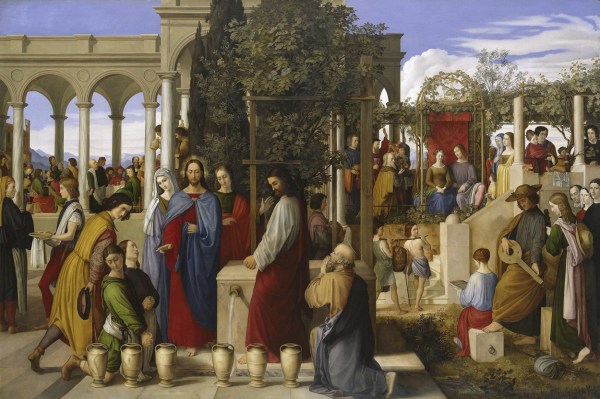
Above: The Marriage at Cana. Julius Schnorr von Carolsfeld (March 1794 – May 1872). German. Oil on Canvas. House at Hamburger Kunsthalle.

Writers Must Read…the Prince

Niccolò Machiavelli’s the Prince

Someone once told me that Machiavelli’s little treatise, the Prince, was “baby’s first political theory.” It was a lame attempt to convince me not to read it, in leu of what, I never found out. Ultimately, I’m glad I disregarded such ignorant advice.

The Prince is probably one of the most useful, practical handbooks for vicious politicians who want to get things done. That quality alone makes it worthy of a writer’s attention. 

Niccolò Machiavelli is the man of our times, and if that sounds scary to you, its because you don’t know much about Machiavelli. That’s not your fault. Cultural references to Niccolò paint him as the mastermind of tyranny. He is the eminent philosopher on cruelty; a wicked, unscrupulous, conniving historical villain whose writings helped spawn the likes of Robespierre, Stalin, and Hitler.

The English nickname for the devil, “Old Nick” is thought to derive from Niccolò. Even now, the word, Machiavellian is used to describe those who excel in the use of calculating, unprincipled tactics whether in the Boardroom, on the House Floor, or in the office. A Machiavellian man is a crafty social climber, sophisticated only so far as it helps him achieve his ambitions, maybe he’s even sociopathic?

Niccolò Machiavelli has been painted with the same broad brush that we’ve come to expect when we hear the adjective bearing his name.

But the truth is far more complicated and far more interesting. The Prince is just one small piece of the fascinating life of Niccolò Machiavelli’s life.

Niccolò, as Aristotle said of all men, was a political animal. Politics was his bread and butter, literally, it was how he paid his bills, which were always growing larger as his income grew smaller. The Prince was written as a last-ditch effort to reenter the universe of politics that he loved so much.

This effort failed so catastrophically that this stalwart defender of republican liberty became synonymous with tyranny and realpolitik.   

Born in Florence in 1469 during one of the most tumultuous eras in Western history, Machiavelli, like most of his fellow Florentines, almost seemed destined to collide with greatness. He was born during a short period (1494 to 1512) when the Medici Family were deposed and the republic re-established.   

Our history books tend to refer to the Renaissance as one enormous event making it seem as if it occurred simultaneously across all of Europe. The truth is, it began in Florence generations before it ever reached France and England, or even her nearby neighbors of Venice and Milan.

The world seemed to revolve around Florence in the 15th Century; for example, the Florin was the most trustworthy currency in Europe at the time and saw wide acceptance and commercial use.  

But most importantly, Florence was a bastion of liberty. Florence was a republic and had been a republic since the 12th century. She wasn’t perfect, because no nation is perfect, and a citizen of modernity would have much to complain about regarding her Signoria, councils, and guilds.

Not all denizens of Florence were citizens, but the chosen few who were citizens, were granted unparalleled rights and responsibilities. In Modernity we tend to believe that liberty is do what you want. In Florence, a citizen was meant to do as they ought.

I won’t bog you down with anymore 15th Century Florentine politics, but by the time Machiavelli was born, twilight was upon the Republic of Florence and its political machine was an elaborate dance of payoffs, patronage, and surrogacy.

The Medici were expelled from Florence when, Piero, the son of Lorenzo de’ Medici the Magnificent, squandered all his father’s hard work by making a bad deal with the French. The Medici were forced to flee Florence. Florence resumed its tradition of republican government.

Machiavelli held many posts during this short period of the reassembled republic. He was a diplomat, a messenger, and even started a proper citizen-lead militia for the defense of Florence which, under his command, recaptured the rebellious city of Pisa.     

But, in 1512, the Medici returned at the head of a Papal-Spanish Army and Florence crumpled. The republic was dissolved by the victors and Machiavelli was deprived of office and exiled.

A year later, Machiavelli was accused of plotting against the Medici rulers. He was seized by the government and tortured. Despite the government’s best efforts to force his arms out of their sockets in a torture method known as corda, Machiavelli never broke. If he knew who was part of the conspiracy, or even if he himself was a conspirator, he refused to say and was released a few weeks later.

He returned to his exile, and it’s hard not to assume he was a different man after that. The man who once wrote bawdy plays, Discourses on Livy (the republican version of The Prince), and corny, lewd poetry, retired to the countryside and wrote The Prince.       

“Men who are anxious to win the favor of a Prince nearly always follow the custom of presenting themselves with the possessions they value most, or with things they know especially please him; so we often see princes given horses, weapons, cloth of gold, precious stones, and similar ornaments worthy of their high position.”

[The Prince, Niccolò Machiavelli, letter from Machiavelli to Lorenzo de’ Medici]

The Prince was written to help revitalize Machiavelli’s career and help him reenter the political realm.

To an urbane Florentine like Machiavelli, exile was the worse than death. It’s very difficult to categorize exile to a modern mind. Part of what makes it so terrible is the danger that the “out there” represented to people before the invention of modern firearms, inexpensive maps, and waterproof matches.

While Machiavelli spent his exile in the genteel countryside, it was far from the wild, debauched nights he’d spent with the friends of his youth and even further from the palace intrigue of Florentine politics.   

He dedicated the Prince to Giuliano di Lorenzo de’ Medici, the third son of Lorenzo de’ Medici the Magnificent, in hopes of gaining entry to the old, but newly reestablished, halls of power.

The book would go unpublished and, presumably, unread, until after Machiavelli’s death.

During the Middle Ages and Renaissance, humanist writers were obsessed with writing books and philosophizing on “what makes a good prince.” The question became a genre of itself, known as “Mirrors for Princes” and usually focused on how a prince ought to be educated, what virtues make for a good leader, etcetera.  

Machiavelli simply took that idea to its natural conclusion, asking instead, “how does one become a prince” and “how does a prince keep his power?”

While his contemporaries wrote treatises on the best Christian virtues and behaviors to instill in a young king-in-waiting, Machiavelli’s work can be summed up easily as: be a lion, unless you must be a fox.

“So, as a prince is forced to know how to act like a beast, he must learn from the fox and the lion; because the lion is defenseless against traps and a fox is defenseless against wolves. Therefore, one must be a fox in order to recognize traps, and a lion to frighten off the wolves. Those who simply act like lions are stupid.”

[The Prince, Niccolò Machiavelli, Chapter XVIII: How princes should keep their word]

“Those who simply act like lions are stupid.” A lot of writers would do well to heed this line.

One of my least favorite tropes is the over-the-top tyrannical king who rules his people with a bloody iron fist.

Part of my problem with trope of the Tyrannical King is that it is often misused. The writer makes their Tyrant King viciously murder friend and foe alike, they surround him with sycophants and bootlicks, and never consider (beyond the needs of their protagonists and plot) how these actions might affect the ruling ability of a king.

Machiavelli has an entire chapter about those who win their power by crime. He uses an example from antiquity, Agathocles, a man who through treachery and crime, rose to become the ruler of Syracuse. Of this tyrannical king, Machiavelli said this:

“It cannot be called virtue to kill one’s fellow-citizens, betray one’s friends, be without faith, without pity, and without religion; by these methods one may indeed gain power, but not glory. For if the virtues of Agathocles in braving and overcoming perils, and his greatness of soul in supporting and surmounting obstacles be considered, one sees no reason for holding him inferior to any of the most renowned captains. Nevertheless his barbarous cruelty and inhumanity, together with his countless atrocities, do not permit of his being named among the most famous men. We cannot attribute to fortune or virtue that which he achieved without either.”

[The Prince, Niccolò Machiavelli, Chapter VIII: Those who come to power by crime]

The limp, ill-used Tyrant King is a villain, he does villainous things. He tortures little girls for fun and kicks puppies when he’s bored, his life is debauched with wine, women, and blood. He is evil, he is a tyrant and that is the extent of his character. His wickedness stems from the writer’s need to contrast the goodness of their hero with the malfeasance of their villain.  

But one moment of thought and a writer may realize that a king who lets his troops slaughter villages, rape townspeople, and burn farms will soon find his army starving. Starving solider soon turn on that king. This idiot lion, this misused trope, has the potential to be interesting, but much like the tyrant’s strategy, the story is not sustainable and it’s not interesting.

Instead, writers should heed what Machiavelli says next:

“Some may wonder how it came about that Agathocles, and others like him, could, after infinite treachery and cruelty, live secure for many years in their country and defend themselves from external enemies without being conspired against by their subjects…

I believe this arises from the cruelties being exploited well or badly. Well committed may be called those (if it is permissible to use the word well of evil) which are perpetrated once for the need of securing one’s self, and which afterwards are not persisted in, but are exchanged for measures as useful to the subjects as possible. Cruelties ill committed are those which, although at first few, increase rather than diminish with time.”

[The Prince, Niccolò Machiavelli, Chapter VIII: Those who come to power by crime]

Well-committed cruelty—what a concept! Imagine a villain who wins loyalty and love like a hero. Now there’s a story I’d love to read.

“It is to be noted, that in taking a state the conqueror must arrange to commit all his cruelties at once, so as not to have to recur to them every day, and as to be able, by not making fresh changes, to reassure people and win them over by benefiting them.”  

[The Prince, Niccolò Machiavelli, Chapter VIII: Those who come to power by crime]

The chapter concludes, warning would-be tyrants that those who fail to act decisively and craftily (like a lion or fox), should be prepared to always keep a knife in their hands at the ready, because someone will always be trying to shove one into their back.

“…a prince must live with his subjects in such a way that no accident of good or evil fortune can deflect him from his course…”

[The Prince, Niccolò Machiavelli, Chapter VIII: Those who come to power by crime]

Eyes on the prize. Don’t let innate cruelty get in the way of the goal. If you want to write a believable, canny, terrifying Tyrant King, I suggest you take Machiavelli’s advice.

Most of the Prince is like this, salacious advice for how to be cruel without being too cruel. But that’s the easy was to read it. There are some historians and philosophers, like Erica Benner in her book Be Like the Fox, who believes that Machiavelli’s intentions with the Prince were far more noble and far more underhanded than we think.

What if Machiavelli was writing a book to tell the liberty-minded what to expect and how to treat tyrants? What if Machiavelli’s Prince is actually a handbook for heroes?

I’ll admit that the evidence is found more in the life and other writing of Machiavelli, but within the Prince there are some interesting passages regarding republican government and how an elected Prince can hold onto the power given him by the people.

“A man who becomes prince by favor of the people find himself standing alone, and he has near him either no one or very few not prepared to take orders…

The people are more honest in their intentions than the nobles are, because the latter want to oppress the people, whereas they only want not to be oppressed…

…it is necessary for a prince to have the friendship of the people; otherwise he has no remedy in times of adversity.”     

[The Prince, Niccolò Machiavelli, Chapter IX: The constitutional principality]

Later on, Machiavelli goes on to encourage princes to start citizen-militias! Common wisdom states that a tyrant who arms his civilians will soon find those arms used against him.

Why would a man believed to be as evil as Machiavelli, a supporter of cruel tyrants, advise those tyrants that you can’t have good laws without good arms and that with good arms, good laws follow?

Whether you’re writing heroes or villains, Machiavelli’s little book on Princedom is excellent primer on practical politics. Your tyrants will become savvy, cruel, and clever. Your heroes will be wise, cunning, and vicious. You’ll write lions who easily transform into foxes.

Niccolò Machiavelli’s the Prince is an absolute must read for writers. It’s short, it’s punchy, and its one of my favorite books by one of my favorite historical figures.

I like the Penguin Classics version, translated by George Bull. It’s very readable, dispenses with some of the clunky phrasing, and includes historical notes in the back. However, it is also available from the University of Baltimore for free here. I used both translations for the quotes above.

[More Writers Must Read]

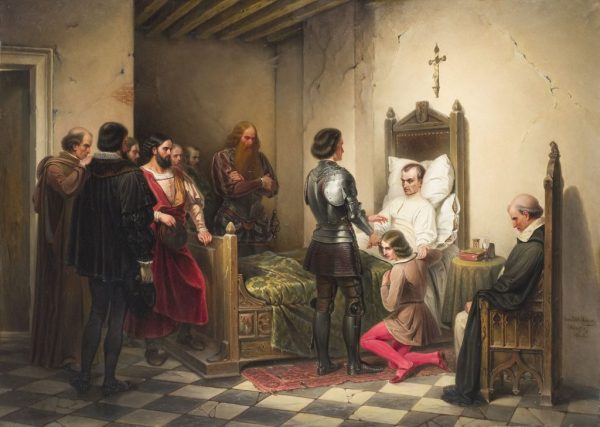
Above: Morte di Niccolò Machiavelli. Cesare Felice Giorgio Dell’Acqua (22 July 1821 – 16 February 1905), Italian Painter. Oil on canvas. Housed at the Revoltella Museum, Trieste, Italy.

Blog at WordPress.com.

Up ↑