Album Review: First Strike

Am I qualified to talk about music? Probably not, I haven’t read a lick of sheet music since I was in High School; the last instrument I played was for my Junior High String’s band.

That said, I know what I like and I have a deep appreciation for music. It has always been a part of my life, from blasting Alan Jackson and Toby Kieth from the speakers of my Dad’s truck while camping, to sifting through my mom’s collection of rock albums, to my adulthood obsession with collecting every David Bowie CD—my tastes are wide and discerning and I am always hungry to discover new bands.

Last year I decided I wanted to get into heavy metal. That means I sat down and listened to band after band, pushing the YouTube algorithm to its limit in a desperate search for something I could really fall in love with.

Heavy metal is a vast genre, composing so many different quirks and subgenres. I found that I like melody and vastness of sound, epic topics, harmonic singing—what I believe is sometimes called power metal.   

Naturally, I was intrigued when IronAge Media announced an album.

First Strike is probably best described as a compilation album with the talents of Jacob Calta (YouTube/Twitter), Evaleigh (YouTube/Bandcamp), Chillkid (YouTube/Soundcloud), J.V.P. (YouTube/Twitter), and A.C. Pritchard (YouTube/Substack) with Jacob Calta as Producer, Mastering completed by Calta and J.V.P., with Executive Producer, Richard Wilson.

(Disclaimer: I’ve worked with IronAge Media in the past. Whether that makes me biased or not is up to you.)

First things first

I prefer physical media so I tend to buy CDs instead of downloading them as a rule. It may seem silly to discuss a jewel case, but I collect music albums. It’s important to me that the case work as intended and look cool.  

The CD case is smooth cardboard with plastic insert, it includes a song booklet. It’s quality, especially considering the downward spiral most jewel cases have had in the past few years. Is it going to get beat up in the console of my car, are the edges going to get frayed? Yes. But it will hold the CD and the booklet

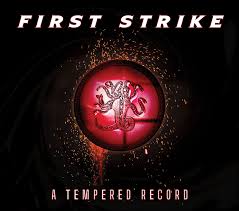
The album art is pretty slick. I like simplicity in an album cover, especially in something that suggests a wide variety of styles. Also, the symbol of a hydra can’t be overstated—I’m pretty positive that Jacob Calta, the art designer, chose that symbol on purpose. A good choice considering the stated goals of IronAge Media and the Iron Age at large.  

The music

Is First Strike a metal album? Yes. But like I said above, it’s a compilation of talents. There is heavy, pulsing guitar, melodic synth, scream vocals, and most importantly sick guitar solos. Everyone involved has brought their A game.

There are only six songs on the album, so let’s go through them one by one.  

Track 1 – First Strike – Jacob Calta

Track 1 is an instrumental. I found it surprisingly jazzy, with shades of the classic Sonic soundtrack—sort of etheral late 80s, early 90s synth—if that makes sense. There’s a head bobbing urgency to it and a warmth of tone that feels like a classic cape-crusader training montage.

I’ve been getting into synth lately and one of the problems with synth is that, after a while, some of it really starts to sound the same. Juxtaposing a heavy synth instrumental next to a more guitar-heavy rock song is a good call.

This is a great track to start the album off with.  

Track 2 – Power – Evaleigh

Does the Iron Age have an anthem? If not, I nominate Power.

If this song is supposed to be about the little guy, the small-time indie artist, taking on the big corporate music industry, then he’s nailed it. David v. Goliath is a universal tale that is applicable to all kinds of situations, not just the Iron Age.  

“God only knows what I’m doing here tonight” is the kind of lyric I can appreciate. I know that feeling. I still feel it, especially when I burn midnight oil on a Sunday night, hammering out a crappy first draft wondering if anyone will even read what I’ve written or if I’m just wasting time.

The song goes on to suggest that I am not wasting my time, and neither is Evaleigh.

Fantastic little anthem. I love it.  

Tack 3 – the Anvil – Chillkid

I’ve really come to appreciate chillwave synth. Track 3 is very chill, but not a calm chill, an intense chill.

The lyrics are about being “born in fire” and “shaped on the anvil.” I find the irony of a chillwave song about forging by fire and anvil to be deliciously clever. It also has this really cool call-and-response to the lyrics that makes it feel more like a war chant than a typical song.

I think this is a song that grows on you.  

Track 4 – the Wraithsayer – J.V.P.

This instrumental is probably my favorite track. It features a wide variety of synthetic instruments: strings, horns, even an organ, ghost-like chanting. It makes the song feel expansive, like a guitar player with the backing of an orchestra.

The use of organ and bells lends a Victorian eeriness that builds into something epic and heroic. This is the song of a English gentlemen plucking up his courage and taking on the thing that haunts the graveyard.

Weird horror in song. Absolutely love it.

Track 5 – Villainous Wake – A.C. Pritchard

There is not accounting for taste. Unfortunately, I’m not a fan of screaming, gruff, vocals a la Slipknot. That doesn’t mean there aren’t things to like in this song—there are.

The discordant sounding chorus is a very cool effect that matches the lyrics. “I’d rather fly free, than die as a slave. I’ll break from my cage, I’ll rise from the flames. My words are my wings, my shield, my blade, my pleasure, your pain, my villainous wake.” Pritchard casts himself as the villain, and maybe he is? But doesn’t the POV matter?

Not a fan of screamo, but the lyrics are fantastic and J.V.P.’s guitar work is excellent.  

Track 6 – Blow by Blow – Chillkid, A.C. Pritchard, Evaleigh, J.V.P., Jacob Calta

If this album has a B side, then track 6 is it. The weakest of the six tracks, I’m not sure if the problem stems from too many cooks, or if its just the principal that every album must have that one song you can’t vibe with?

Evaleigh and J.V.P.’s guitar work stands out, especially with that plucky guitar work at the 1:40 mark and the solo at the 2:30.

Final thoughts

I honestly had my concerns when I bought this album. I feared that it was going to be like those CDs you buy from the bands who play the bars in Nashville or L.A. But this is a solid album with excellent production and high-quality music.

Even in the song’s I don’t like, I can feel the passion and the care. I believe that these artist like making music and that they want me to like their music too; mutual respect is a part of the titular Iron Age. I feel like I got my money’s worth and that my time wasn’t wasted.

An excellent showing, I recommend it and leave you, appropriately, with lyrics from Track 6:

Flying free into horizons

The moon and stars all fall away

Determination, out instincts guide us

Into a whole new age.   

-Blow by Blow

Don’t forget to check out Anvil Magazine #4, currently available for pre-order!

I write my own weird tales, check them out here and don’t forget to follow me on Twitter/X!

Tripping over Easter Eggs

It probably started with the Marvel movies. Not references themselves, but the relentless, in your face, Easter eggs that constitute a meaningless dog whistling. “Hey fellow nerds,” this little pop culture reference seems to say, “remember this cool thing? Only serious fans remember this obscure piece of ephemera!”

With Disney’s permission via example, pop culture easter eggs suddenly became something I started tripping over, especially in the fiction of the last decade or so. Not just in movies and tv, but in books.

For the first few years, I appreciated having my nerdy ego stroked. I liked that I was more familiar with Hawkeye than my friends, I liked that I could smugly explain the significance of a clunky piece of written dialogue, I liked that I could state “that’s from Dungeons and Dragons.”

But, as I got older, the charm wore off.

The clumsy, often non-sequitur references felt less like a wink and a nod and more like a slap to the face. Not someone hinting at me that they enjoy the things I enjoy, but more like a corporate apparatchik with no interest in the thing I’m interested in trying to convince me that they don’t hold me and very reference itself in contempt.  

I can’t take a reference and by extension the writer who makes it, seriously anymore.

Take, for example, the Wilhem Scream of cinema fame. What started out as a piece of cost-saving sound design, Star Wars turned it into a “pop culture icon,” and now has become so ubiquitous it’s in approximately 400 films. As an inside joke, it’s bereft of any meaning. It breaks tension, it breaks the cohesion—it calls attention to itself.

Whenever I hear the Wilhem Scream, I think “oh yeah, that’s right. I’m watching a movie.”

When you’re writing a story, this breaking of immersion can be disastrous.

The willing suspension of disbelief is an unspoken contract between the reader and the writer. In exchange for a good yarn, the reader willingly suspends their skepticism. They simply accept faster-than-light travel, magical talking swords, or healing crystals, despite that logic and reason dictate those things as impossible. A good story doesn’t have to be realistic, but the logic of your constructed world must be internally consistent.  

Constructed being the operative word—all written stories are, by the nature of story, contrived.

A written story must follow certain laws. The laws of grammar, spelling, and language, the rules regarding structure, character typology, typeface, cultural mores, etcetera.

When a reader opens a book and escapes into the world that a writer has created, the last thing the writer wants is to slam on the brakes and make the reader remember “oh yeah, that’s right. I’m reading a book.”

Do not call attention to your grammar. Do not call attention to your clever typeface. Do no call attention to a piece of media they might very well rather be enjoying than your story.

When I read a book, I don’t want to be taken out of your story, not even to laugh, not even to feel smug. I’m giving you my attention, respect my time and give me a good story.

Regarding Video Games

The term Easter Egg comes from the world of programming. It’s tempting the call them a “tradition.” I would be the first to admit that I enjoy the occasional references that I’ve found in my favorite games.

Most of the time, the references must be hunted down, hence “Easter egg.” The player can choose to actively look for them or not. Engagement is optional. That doesn’t mean I’ve never stumbled upon an obvious reference and had to look it up in order to understand it, but it does mean that I can choose not to participate in the hunt itself.

Unlike video games, books are wholistic. By reading, I must engage with the totality of the work, references, grammar, structure, and all. A cringy, out-of-place pop culture reference takes up precious space, both in the reader’s imagination and in the physical work.

Easter eggs can be stumbling blocks, or worse—an assault on the good tastes of a reader, who, out of the all the stories in the world, picked yours. Respect their good taste and don’t remind them they’re reading a book. Instead, let them escape into your world and grieve when they must put it down.

Above: The Renaissance Easter Egg, a Fabergé Egg, part of the Easter Series. Mikhail Perkhin 1860-1903, Russian. Materials: Gold, rose-cut diamonds, agate, rubies. Housed in the Blue Room of the Fabergé Museum, St. Petersburg, Russia.

You can find my written works here. Follow me on X/Twitter.

Anvil #4 – Pre-orders are Live!

Read me in Anvil Issue #4

I’ve hammered out another short story for Anvil. Pre-orders for issue 4 are currently live on IronAgeMedia. The guys at IronAgeMedia are always great to work with and I can’t wait for you guys to get your hands on this issue! More details to come.

While you’re checking out that pre-order, and if you haven’t already picked one up, don’t miss Issue #2, in print and digital. Anvil #2 features my my short story Afflicted: Nourritures les Ver. Here’s the blurb:

Amélia Mitre is Afflicted. Cursed by a pact of her own making, she is made to follow the Weird Way of Scealfe, God of Death of Decay. Summoned to the industrializing city of Beauanne, the Cursed Doctor finds herself investigating a disturbing disease that defies the laws of nature and therefore, the laws of her dark patron. She must discover the origins of the plague and punish anyone foolish enough to pretend rivalry with the God of Death.  

Follow me on X (formerly Twitter)

Check out my other written works here.

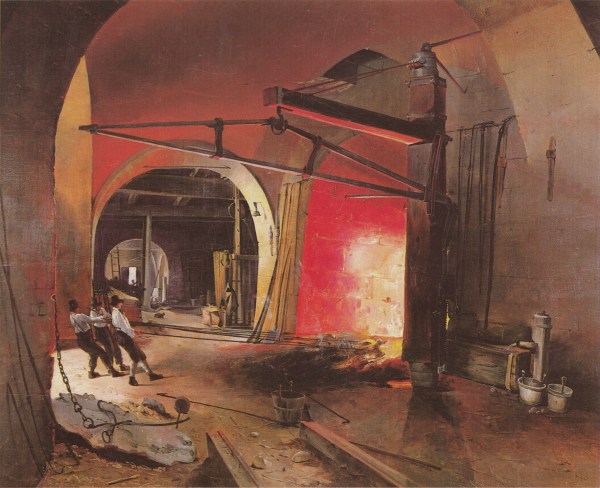
Above: Three Workers in the Iron Works. Oil on panel. Carl Geyling, Austrian (1814–1880), founder of Carl Geyling’s Erben a stained glass company.

Adventures in Storytelling 6

Entry 6, gathering brushwood.

There was a time in my life when I didn’t write short stories. And by that, I mean that I had this youthful, naïve belief that I was a “novelist” and would never write a short story. It was really just an excuse for the simple fact that I didn’t know how to write one.

In school we read tons of short stories—I even liked some of them—although none of them covered genres I read for pleasure. As a reader I’ve always gravitated towards fantasy. I like stories with swords and sorcery, something with an evil to overcome, heroes I can click with, and an adventure I can get lost in. 

Needless to say, the “great American short story” was not something I read unless a class made me. I don’t like Virgina Woolfe, I loathe Mark Twain, I don’t have the life experiences of Ernest Hemmingway or Edgar Allen Poe.

Short stories always felt like opaque little pieces of highbrow literature. High art, rich in irony, drama, and meaning, with messages or morals I usually disagreed with or a muddy, bleak modernist outlook I definitely disagreed with. They were the kinds of work I was expected to read and write essays about. All of them far from the kitschy, heartfelt fantasy I love.

When I finished high school and was able to distance myself from the drudgery of school work and look at short stories as a piece of fiction and not as an assignment, I bent a little. I discovered H.P. Lovecraft, Robert Howard, gained a deeper appreciation for Edgar Allen Poe, read Hemmingway and fell in love with him.

I still don’t like Virginia Woolfe, and I’ll never enjoy Mark Twain. But I found Flanery O’Connor and the short works of Leo Tolstoy. While F. Scott FitzGerald has become one of my favorite authors.  

But before any of that, I over-corrected and spent the first few years out if high school reading nothing but absolute junk food. I flew through every shallow, vapid, horrendous teen-fic fantasy I could get my young adult hands on.

I knew I was reading dreck, and yet I still imbibed. I was happy to drink up any piece of romance-laden, hand-wringing melodrama. I could slurp them up within a couple of days; the characters, setting, and story promptly forgotten as soon as I picked up the next terrible piece of mass produced, corporate trash.

And so my stubborn, arrogant “I’m a novelist” attitude metastasized. I wanted to be like these YA authors, you know, but better.   

But one day, I woke up and couldn’t stand the idea of picking up another novel.

Every book I’d read from high school until about 2015 was exactly the same. A plucky heroine who isn’t like other girls meets about 2.5 boys who needlessly squabble over her while the overtly masculine villain schemes and makes sexist comments until the heroine discovers her inner warrior and defeats the poorly contrived symbol of the patriarchy.

After that I found myself only reading non-fiction. Medieval history, specifically.

As I exhausted my local library’s poorly stocked history section, I turned to medieval literature. I read Dante’s Divine Comedy and Boccacio’s Decameron, various Arthurian tales, poems, etc.

I fell in love with Dante. His entry into my life spurred me into a frenzied trajectory that would alter the way I viewed the world. I’ll have more to say about my patron, later. Just know that it was through his work and my desire to understand it that lead me to reading Aristotle, Virgil, Plato, Homer, Plutarch, Machiavelli, Gottfried, Thomas Aquanis, Cretien de Toyes—

About the time the COVID lockdowns began, I started to really miss fiction. I wanted to escape, I wanted to be anywhere but in America circa 2020.

I was mentally exhausted by the drama going on in my real life, I was working full time, trying to write on the weekends. I watched as my future plans evaporated under the corrupting heat of COVID. I couldn’t focus on history the way I had been.

I tried to hop back into fiction; picking up some paperbacks from my local used book store.

I couldn’t read them. I didn’t have the patience or, rather, the tolerance for modern fiction anymore. I’d been feasting at the table of the Greats for so long, a mass market paperback seemed like thin gruel.

I mentioned in the last entry that COVID was a turning point for me. I had committed years of my life working on a novel that was too long to be published by an unknown author. I couldn’t abandon it; I won’t abandon it. But it was clear that I needed a different strategy.

As my life took a dark turn, I began to pull apart the things that bothered me about modern fiction—the pandering, the limp prose, the lame moralizing, the overwrought, needlessly complicated plots masquerading as “subversion”, the tiresome deconstructed heroes.

I knew I wasn’t the only one getting sick of the same-old-same-old, I just needed to find an in. An “in,” by the way, that I’m still searching for.  

Regardless of my chances of success I knew I could either quit entirely or make myself a better writer.

Dante loomed large in the back of my thoughts during this time, pushing me onward. He demanded excellence of himself, trusted that he possessed the tools to reach the absolute heights of his craft. Could I do no less?

What I began to understand was that I needed to learn how to write short.

Looking back, it felt like a monumental task.

The first thing I needed to do was relearn to enjoy fiction.

The Lord of the Rings has eluded me my entire life. This fact is highly embarrassing to me, but there is it. I could never make it past Tom Bombadil. I just couldn’t fall in love with the books like it seemed everyone else could. I knew tons about the books and about Tolkien but the prose never sang to me the way it seemed to sing to others.

I was aware of their Anglo-Saxon/Germanic heritage. I knew that Tolkien wrote the Hobbit specifically to be read aloud to children. I was also highly familiar with Norse, Anglo-Saxon, and Germanic storytelling and poetry because every medievalist, amateur or not, eventually realizes that they have to read Beowulf and the Norse Sagas in order better understand the cultural context of the history they’re studying.

These people did not write things down. Beowulf isn’t meant to be read; it’s meant to be heard.

I made the logical conclusion that I should listen to the Lord of the Rings. I bought an Audible subscription and started to relearn how to enjoy fiction.

It worked. Not only did I finally fall under the spell of LoTR, I rekindled a passion for fiction.

I began to listen to books at work, before bed, while I brushed my teeth, while I did the dishes, while I went for a walk. I even listened and enjoyed books I’d written off as unreadable while in high school.

Never in my life had I thought I would stay up until 2am listening to Pride and Prejudice. But I did that. More so, a book I once disliked became a book I enjoyed.

While I listened to the more time-intensive works, I started reading shorter ones. I was already a fan of H.P. Lovecraft, so I went looking for others like him.

I found myself getting really into horror, I picked up a lot of classic ghost stories. I learned about Weird Tales and met Robert Howard. I fell in love with his Conan the Cimmerian.

It was Howard that really woke me up to the possibilities of short fiction.

Conan is a fantasy hero; he gets by with a canny mix of cleverness and brute strength. He fights monsters, he steals treasure, he saves maidens, he even becomes a king.

All of Conan’s stories are self-contained and short (usually under 50,000). You can read Tower of the Elephant, or the Jewels of Gwahlur, skip Red Nail (you shouldn’t), and still get to know Conan and lose yourself in the Hyperborean Age.

Once I worked my way through every completed Conan tale, I knew that fire was kindled again. My stubborn unwillingness to learn was broken down, the debris removed as brushwood for the firepit.

While I was still adventuring with Conan, I took a chance and penned an old-school sci-fi short story and submitted it to Cirsova Magazine. It was my first, published in Spring 2023. I’m going to break that one open in the next entry.

For now, let me leave you with what writing this entry has taught me. I refuse to give up. Writing has the flavor of a Vocation. I am called to it.

Even if the fire goes out, as it did with me especially during that depression spiral of 2020-2022, you can start another fire, relearn, reframe.

Humble yourself and commit. Gather brushwood to burn, you’ll be surprised at what happens when you pledge yourself to becoming a better writer. It takes just one spark to set everything ablaze.  

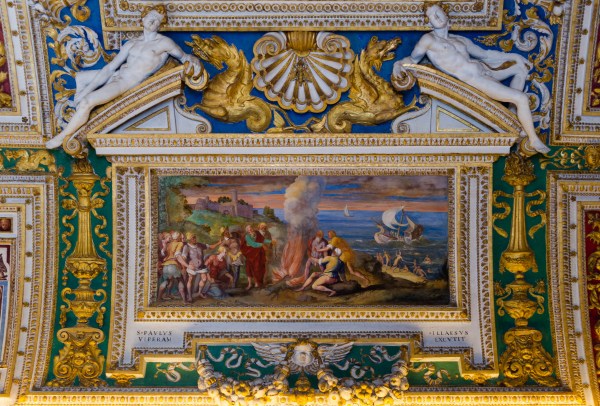
Above: Saint Paul bitten by a viper in Malta. Ceiling of the Gallery of Geographical Maps in Vatican City.

I made a Twitter/X

I’ll probably regret it.

The New Year is always a fascinating time. The few short, almost ethereal days between Christmas and New Years always demands a moment of introspection. I have a lot to be grateful for. This is the first year I published anything, now to have three works under my belt…I’ve achieved a lot this year, particularly in writing.

But achievement means nothing if it isn’t accompanied by a drive to do more. This year, I have a lot of plans. I want to eat healthier, exercise more, and continue my writing journey. I also want to keep working on this blog, build connections with fellow writers, work on a novel, continue my forward momentum as a short story writer.

I’m old enough to know that goals aren’t achieved without stepping out of your comfort zone. I want to make connections with the amazing writers I’ve found my writing sandwiched between. I also want to find a way to get direct feedback from my readers. About a month ago I realized that meant I needed to expand my social media bubble.

I loathe social media and for the most part I’ve done an excellent job of keeping it out of my life. That’s probably why I dragged my feet on making a Twitter/X account. But it’s clear, that’s the easiest way to engage with people.

So I did it. I created a Twitter/X account. You can follow me there @ElflandSalon .

Hopefully, I’ll get over my fear of online social interactions and actually use the bloody thing. We’ll see, I’ve never been particularly good at keeping New Years resolutions.

Blog at WordPress.com.

Up ↑