Adventures in Storytelling 4

Entry 4, Carpe editorem, occide…continued.   

In my last entry I outlined four points that needed addressing in P1. I left off in the middle of my second round of editing and highlighted that I use my own tools to help identify my strengths and weaknesses. I made a list and focused on the nuts and bolts, things like -ly words and passive voice.

I want highlight one of the other two issues identified: lore/worldbuilding mistakes and inconsistencies; and, there are some things I simply don’t like.

I’m going to start with the first—lore/worldbuilding—because it’s easier to answer.

There is no end to the discourse regarding “worldbuilding.” There are endless books and articles on the topic, various charts and step-by-step guides on how to “build unique and imaginative places.” And that’s great, sometimes people need a guide.

Once you’ve come to understand the need for worldbuilding and mastered the concepts, your next step is to debate endlessly about when and where to use it, what qualifies as worldbuilding, and when its really just an infodump?

I’m not going to bore you with a lengthy discourse. I believe thoroughly that if you are writing, you are worldbuilding. Every sentence is an opportunity to build and deepen the unique flavor and culture of a world. It should be done in every kind of story, regardless if the setting is New York City or some far-flung elfland.

The danger with worldbuilding lies in the fact that sometimes it is an infodump.

In P1, I found that I didn’t really have a problem with infodumping. I killed that problem in one of my first drafts, working and reworking paragraphs and conversations to move information in a smoother way. I classified lore and worldbuilding information into two categories: absolutely necessary, and trivia.

Lore that is absolutely necessary is lore that is needed in order for the plot and the character’s actions to make sense. It is necessary to suspend a reader’s belief. For example, P1’s co-protagonist, R, has a background before meeting protagonist E. R’s background includes connections to an organization with an extensive history. That history must be told for R’s actions to make sense. Without that lore, R’s movements and thoughts become schizophrenic—unmoored from the reality of the story.

Lore classified as trivia is the nice little accoutrements that make a story unique, pretty, realistic. It’s the way someone styles hair or takes their tea. It’s how the road shunts to the left or how the flowers were blooming late in the mild spring. Fine details, those little things whose inclusion adds color but absence results in no serious loss to the central action of the story.

The issue was just how much lore I had.

If you recall from Adventures in Storytelling 1, I started P1 because a sense of overwhelming vastness that plagued my first abortive attempts at putting Project Paisley on paper. I knew I had something; I just wasn’t sure where to go with it. P1 was started to help me congeal—so to speak—my world.

In that, I would say I was successful. I believe the world I’ve created is colorful and realistic. Is it perfect? Of course not! But I think I have a world that is interesting and engaging. It’s made up of several counties, each with their own unique cultures.

That said, I didn’t start out that way. While writing, I spent a lot of time thinking about P1’s setting.

The main setting of P1 is an island-bound city, at the risk of oversharing, when thinking about this city I had two real cities in mind—London and Paris. I wanted to capture the things I liked about both cities. I thought deeply about how the ocean effects a city, it’s culture, government, etc. What considerations does an island-bound nation have to make regarding security? How does the sea change their food culture? What kind of jobs would their poor city-folk work? What of the prosperous?

In the end, I found myself asking, what would Paris be like if was actually on the coast of Normandy? What about London without the Thames?

My first draft was missing many of the key elements that I feel make this setting (as it’s written now) interesting. While I muddled through various technical problems, I found myself filling in the blank corners. Ordinary English idioms were rewritten to better relay the culture of a seafaring people, food became fish heavy, the peasantry became laborers and fishermen. I began to add these little details.

And that was just a single city. The religion of this world was terribly atrophied. I used a placeholder name for the main deity until a better name struck me in the middle of a slow work day. That bit of inspiration was just pure luck, the rest I had to force myself to sit down and think about.

When I began writing P1, I already had a small booklet that I jotted ideas in. It was in no way comprehensive, but it was helpful and allowed me to keep track of my thoughts.  

I’d written several notes about the religion of a particular civilization that acts as the “national antagonist” if that makes sense. This nation is in a strained relationship with the other nations. They’re less an actual threat and more a looming, invisible darkness that hangs over the characters like a Sword of Damocles.

With them, I had to ask myself, how weird am I willing to be? How strange and foreign do I go? I wanted to create a religion that would repulse all modern sensibilities. Something in the way of a mystery cult with elements of ancient fertility cults. I confided in some friends and the answer I got back is the same advice I would give to any writer. Be weird. Write what you want. Weird is where the fun is.

There is only one way to solve lore and worldbuilding inconsistencies. If its trivial, you can drop it. If it’s necessary, you alter it. Its perfectly possible for you to like the mistake more than the original idea. I’ve changed things to better match up with the mistake I made.

But, the more you have, the higher the chance for error. As I read through my second or third draft, I realized that my timeline was, well, fucked. I couldn’t keep my pacing tight. Things were moving either too quickly to be believable, or too slowly. Fixing this is easier said than done. I haven’t completely fixed it.

Before my most recent draft I sat down and did two things.

First, I worked out a primitive timeline. I went event by event and found that a perceptive reader would quickly take note of the awkwardness of the pacing. Conflict was happening so frequently that despite my clear delineation of day and night, it didn’t feel like there was enough time between problem and resolution.

Now, of course, piling catastrophe on catastrophe is part of being a writer. The action happens in between conflict and resolution. Because my story has a high element of political chaos, it was necessary for the conflicts to coalesce, or the solution to become a problem later in the plot. But I couldn’t make the pacing feel natural. I had to sit down and write it out, event by event, piece by piece, until I understood exactly what I was looking at.

I remain uncomfortable with my current timeline; I am working on fixing the pacing.

The second thing I did was go through each chapter and take out everything I could find that was lore related. I placed it all in a master document. This list has become an augmentation to my original booklet. I refer to it as needed. Now, anything inconsistent or repeated is glaringly obvious. By listing each piece of lore/worldbuilding with the chapter it was found in, I am now able to refer and correct.

You’ll note that these aren’t really solutions. They’re more like guides. The tasks I’ve made for myself are monumental and they cannot be solved in a few short sessions. As I write this entry, I’m actively in the middle of these corrections. I’m not foolish enough to think that I can work a perfect draft. Eventually, I will have to give in and let the story escape.

It’s hard to pinpoint a lesson when you’re actively attempting to fix something. The only thing I could offer my past self is this:

Writing is work, but a good story deserves your attention. Even if you can only work small pieces at a time, keep chipping away. Every correction, every setback, every mistake makes you a better writer.

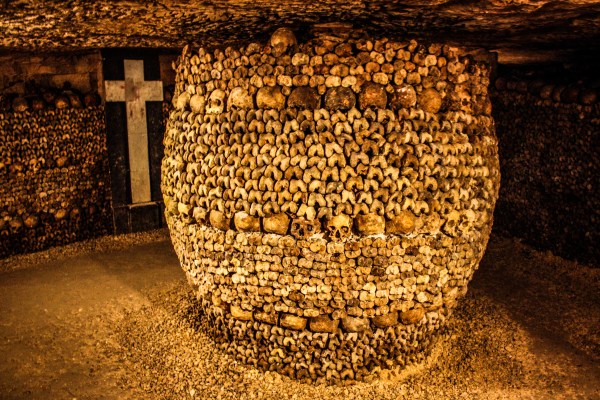
Above: a view from the Paris Catacombs. Consecrated in 1786, the Catacombs are the final resting place of countless Parisian dead. May the souls of the faithfully departed, through the mercy of God, rest in peace.

Adventures in Storytelling 3

Entry 3, Carpe editorem, occide. 

As I stated in the last entry, I learned it was okay to trust my instincts. But when it came to editing, I didn’t really know where to start. I read a couple books on editing, some more useful than others, and sort of just decided to start from the beginning. {read Storytelling 2, here}

I wrote Project Paisley’s P1 into three parts. As a finished draft, P1 was massive, as in, this-is-never-getting-published massive. It was a problem I was aware of while writing it. The seed had grown into a wild forest and was in need of serious cultivation if I was going to make anything of it.

While writing P1 I made heavy use of a tactic I call pre-editing (some call it backtracking). Pre-editing is when I go back to former chapters/sections in order to reread them. Sometimes this is done in order to refresh my memory, double check lore, or simply because I can’t do anything else. Often, if I see a mistake or I decided to rewrite something, I fix it. There are people who believe this is terrible for your writing, but I find helpful. Sometimes, I’ve gone back and read something really good and it’s inspired me or reminded me that I’m not utterly useless as a writer.

While working on part three I had some difficulty getting to my end. I took some time at the local library to print out the first part of P1. I learned from one of the aforementioned editing books that seeing your work in print instead of on a screen can help you distance yourself from it. I also learned that changing the font from your standard use font (like Times New Roman) to something less familiar (like Bahnschrift) provides further alienation.        

This technique, which I call alienation, works for me and I still use it. Placing distance between yourself and your work is like taking a break in a very torrid relationship. It can be incredibly difficult. You’ve spent hours, days, months, years with a particular project. Cutting yourself off from the creative process that held you in thrall for so long is like clipping off pieces of your own soul.

But you must cool that fire before you can really edit. Pre-editing, for all the use I got out of it, wasn’t helping me edit. It was creating a longer and more unwieldy draft. I spent so much time with part one that I had difficulty pulling away from it in order to finish part three. I ended up adding an entirely new section to part two, while I believe this worked out for the best, when I finally got around to finishing part three, I was dealing with a draft so large I knew that no company would publish it as a first novel.

Still, I persevered. I sent the draft to a printer in order to have the monstrosity printed and mailed to me. Note: don’t ever do this. It is cheaper to buy your own ink and paper, print from home in batches and store in a three-ring binder.

In 2019, I started a new fulltime job. Circumstances required me to shelve P1 for months.

Then, Covid happened, and I dusted P1 off. 2020 was a hard year for most of us, but opportunity lies in even the worst elements of chaos and hardship. Never pass up an opportunity to exercise your passion.  

Distance granted me clarity. But not crystal-clear clarity. More like, cold light of day, icy shower clarity.

That’s a little harsh, but you catch my meaning. There were things about my writing that shocked me. The overuse of -ly words, the abundance of had and so, the rambling sentences, the ones that ended randomly unfinished.

And that was just the technical stuff. There were lore errors, inconsistent naming, naming conventions I suddenly found that I hated…

But, as I went further and further into my first draft edit, I came to realize something. For all my mistakes, I enjoyed reading it. Sure, it was messy and unfinished, I had a hundred little things that needed fixing, plot threads that needed tying up (or cutting entirely), but it was good. Or, at least, it was good to me. It hit me as something I would like to read.             

Writing is an organic endeavor. Where you start shouldn’t be where you finish. This became abundantly clear when I took P1 off the shelf and began my first few rounds of editing. My ending was better than my beginning.

My skills as a writer improved dramatically from the first sentence to the last sentence. Both still needed work but the last sentence was in a much better state than the first.

I came away from my first draft feeling better than I expected. I wrote an end-of-edit letter to myself and stuck it in my binder to act as a rubric for my next move. In it, I outlined several things I needed to work on:

  1. My voice is passive, I need to own my words.
  2. If you see had or so, delete immediately/rewrite the sentence.
  3. Various lore and worldbuilding mistakes and inconsistencies.
  4. There are somethings here that I simply don’t like.  

By itemizing the issues in P1, I felt more confident and put it back on the shelf for another month.

I needed a break, editing is hard work, in many ways harder than writing. Editing engages our creative drive, but it also demands our reason. There were times where I found myself arguing over if I should delete a certain word or rework a sentence. More than once I crossed out a word only to mark it with a simple “ok” only to cross that out.   I started the next month, rested and ready. I used my end-of-edit letter to focus my second pass on the nuts and bolts of my writing. My voice was there, but it was buried under mountains of passive verbs and extraneous adverbs. Not to mention that I used the words had and so like crutches.

99% of the time, had and so are unnecessary and they take away from the active action of the characters turning them into passive meat puppets and robbing your voice of it’s confidence. “She had become tired” should be “she was tired.” “So she changed her plans” needs to be “she changed her plans.”

This paragraph: “She ran quickly, speeding down the hall and roughly turning the corner. She threw herself into the next room. Slammed the door and waited silently for the danger to pass.”

Became: “She ran. Her pace picked up speed, slowing as she rounded the corner. There! She spotted the first open door and threw herself into the room. She pressed against the door. Waited. Sweat slipped down her temple. She heard steps—stilled.”     

You’ll note that the second paragraph became longer and the sentence length became more varied. By removing the crutch of adverbs, I was forced to think more about the scene. How do you add tension without an -ly guiding the reader?

Variation is the spice of writing. Vary your sentence length. Vary your grammatical structure. Vary your verbs, nouns, etc. There is no reason sentences in fiction can’t be one word. Or twelve. I also vary my punctuation and my diction.

Note: I don’t want to make it seem as if this all happened between my first and second draft. Writing doesn’t work that way. One day I simply began to notice these changes in my writing. That being said, I’ve gone through four drafts of P1 and I’m currently rewriting most of it. I’ll address the last two issues in the next entry.    

These are my tools, pre-editing, alienation, end-of-edit letter, and variation. They go by different names, some people don’t like them, some don’t find them useful. And that’s okay. Writing is not carpentry. We craft our own tools and use them as we intend them; if it doesn’t work, we toss it out even if it works for someone else.   

Own the tools of your craft. Use them to help you identify your crutches and build the confidence to yank them out.  

Adventures in Storytelling 2

Entry 2, it’s turtles all the way down.

Where last I left off, I explained how Project Paisley had a faulty start. The idea behind the project was burning brightly, but I lacked the fuel to keep the fire going. The solution I came to was easier said than done: don’t surrender an idea just because it’s become difficult to navigate. Pull back, regroup, assess the situation, and start preparing for the second try. {read Storytelling 1, here}

I set the original start of Project Paisley aside and let it rest while I prepared for my college graduation. I had a lot on my plate back then, but I distinctly remember a conversation I had with a friend. I told her that with distance from Paisley, I felt as if the world I wanted to explore was too large, too empty, too colorless. I specifically recall using the phrase “it’s too big, I think I need to think smaller.”

That was my problem. And it was a big problem. Like Matryoshka dolls, further issues nested within the larger problem.

The world felt monochrome with no distinct cultures, flavors, or religions. Without a world to shape them, my characters were the generic adventuring party seen the world over. And because my characters were generic and boring, I wasn’t interested in them. Interest for the author is paramount. If you’re bored, so is every one else. [Note, this isn’t strictly true. Not everyone is as interested in 15th century Florentine politics like me.]

With this revelation finally admitted I was able to address it.

My first order of business was to figure out what kind of world I wanted to build. From there I could mold my characters around the cultures they came from.

I spent my last semester in college reading dozens upon dozens of medieval history books. When I had exhausted my public library, I delved into the poetry and narratives of the same period. I made a laborious study of the Divine Comedy which has endowed me with a deep reverence and appreciation for Dante and his works. As I learned more about the man himself, things started pulling themselves together.

Stupidly, I never dated my notes, but as I graduated and settled in to life outside of school, I wrote my first set of notes that would become the background and backbone of P1.

P1 was never my intention. Or, I should say, P1 was meant to be a short foray into a small, condensed version of the world I originally intended for my failed prototype. For this short story, I had two things in mind; the quasi-erotic, spiritually rich relationship between Dante Alighieri and Beatrice; and the doomed, overtly sexual relationship of Tristan and Isolde.

What I ended up producing was a courtly romance with the symbology of Tristan and the philosophy of Dante.

But that was a future realization because the first thing I worked on was written on a piece of plain white printer paper. On it, I wrote two cities, London and Paris. From those two cities, I made notes about the things I liked about them. I liked the idea of an ancient city with multiple former masters out to make it on its own, I recycled a name from an unfinished D&D campaign. That in and of itself was a lesson in keeping notes. Even failed ideas are great fertilizer. I keep what I’ve previously written, even if its terrible.

The way I tell this story makes it seem as if these thoughts happened independently of each other or in sequence, but all of these thoughts and ideas were cooking at the same time. As I thought about the city, I thought about what kind of people would live in it.

I began the first part of P1 in the summer of 2017, nothing serious, just some scenarios. I didn’t yet have an actual plot. Mostly, I wanted to get a feel for the world. I still had blanks to fill in, the major deity didn’t have name, none of the counties really had names, I wasn’t certain what shape religious worship took, or how it would affect the daily life of people living in the world.

To this day, when I begin a project, I draft certain scenes or events I want to occur. It’s usually a climatic or tense moment. I find that the scenes are typically dialogue heavy or action oriented, either way, it’s a pressure scene. By placing the characters under immediate pressure, I find that I get a feel for their basic stress reactions. I’m able to determine personalities from there.

I conceived two characters for P1, E and R. The more I learned about E the more I understood about R. I’m not going to sugar coat anything and play the will-they-won’t-they card here. E and R were made for each other. I lampshade this almost immediately.

As I said in my last entry, when I conceived this idea, I was a virulent anti-plotter. I never worked out a true timeline or plotted the events as I would inevitably do in the future. But I did try some new things.

I drew something like a flow chart. I wrote E at the top of the page and drew lines connecting thoughts, wishes, and ideas to various traits or backstory events. Not everything I wrote on the chart made it into the story, per se, but it helped me set certain personality expectations. I was able to use this chart and come to basic conclusions about how E would respond to different scenarios.

Writing is an organic process. Inevitably, what you start with is not what you finish with.

Again, what was meant to be a short story turned into a multipart fantasy with a wide variety of characters and stakes that seemed to rise with each passing chapter. I worked on P1 from mid-2017 through 2018 and finished the first draft in August of 2019.

At P1’s completion I came upon a new set of issues. It was enormously long and it had a narrative thread that, while it was cohesive, meandered in some places. But I had done it. I had written a full-length novel. It wasn’t my first (I completed one in high school for National Novel Writing Month), but it was—to date—my best.

However, finishing a novel brings a lot of things to light. Now I had to shift focus, I needed to swap my writing hat for my editor’s cap. That was a tall order for someone who, up to that point, hadn’t done any serious editing outside of term papers.

At this time in my life I started a new job, I met a boy, and I was dabbling in philosophy that would soon point me to Holy Mother Church. It was a time for change. I was older, more mature. I wasn’t afraid to ask for help. So, for the first time in my life I picked up a book that was supposed to help me become a better writer by teaching me to edit.

I took its advice and shelved P1 for a while to gain some distance. I turned my attention to actual short stories, which is a different topic entirely.

Now that I’m able to properly look back on that part of my life, I see more clearly the lesson learned. P1 was a massive detour and it was going to take some time to fit it into my original intentions for Project Paisley. But it was worth it. I returned from that trip as a better writer. I still lacked discipline, I still needed to pick up a new set of skills, but I had climbed the first mountain in this range of madness.

From this experience I learned:

Trust your instincts. Just because the solution presented is contrary to the writer’s intentions, doesn’t mean that it should be ignored. Following that string might lead to something greater.

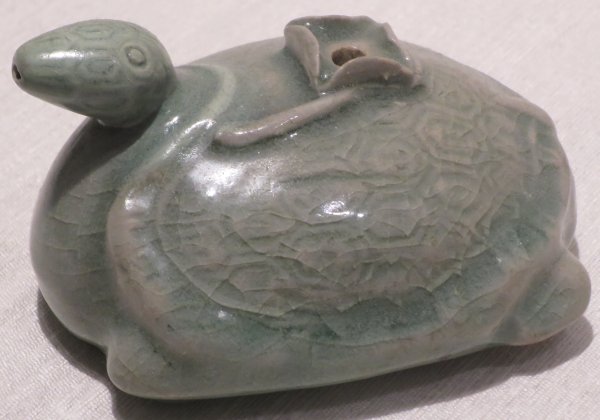
Above: Korean water dropper in shape of a turtle, Koryo dynasty, 12th-13th century, porcelain with molded and incised design under celadon glaze, Dayton Art Institute.

Adventures in Storytelling 1

Entry 1, an invitation to the madness.

I’ve been going back and forth on this for a while. To show or not to show? Would anyone be interested in what goes on behind the curtain? I mean, some people must be, “on writing” is basically its own how-to genre.

So, it’s decided. I’m going to tell you a really weird story. It’ll be disjointed and messy, my leaps of logic will probably shock you, and most likely you’ll be annoyed at how thick I can be. But, I promise it will be interesting. Calling this is a journal isn’t exactly correct. I think it’s more like a travel log. I want to take you on a journey between my ears. My hope is that as writers (or readers) you can peek into the writing process. If you see my creative struggles and see how I’ve surmounted them (or even how I backed away in defeat), it’ll make your creative struggles easier.

Writers face their own personal battles when it comes to the creative process. Each one is as different as the writer and the work they’re enslaved too. The shared experience of the creative skirmish proves it a natural part of the process. Not only that, the unique ways we navigate various creative dilemmas show that there is no issue that can’t be overcome.

To start, here’s a couple of ground rules. My stories will be referred to by “Project Name.” Next, I will refer to my characters by their first Initial, unless that initial is shared. And finally, I will be deliberately vague when it comes to specific events/plotlines. I want this adventure to be about the nuts and bolts of writing as it is my fervent intention to see these works published. So, please forgive my imprecision.

The Master Work

My current Master Project, codenamed Project Paisley, is a piece of epic/high fantasy fiction. I intend to see it through seven books. I use a rotating third person limited POV. The first two works can actually stand on their own but are best enjoyed in relation to the other five.

The first work, called P1, is completely drafted. P1 is currently in it’s 4th draft and is facing some extensive rewrites because my writing from now to when I started P1 is just that much better. But we’re going to get into that at a later date. The second work, P2, has been outlined and the first initial draft begun. P3-P7 have been “wishlisted” with the goal of outlining P3 by the end of 2023.

The process highlighted here makes it seem like my writing method sprung fully formed out of my forehead, but the difficulty getting to this point has been a near decade long process. When I started Project Paisley, I was an undisciplined anti-plotter convinced that constraining my ambition would stifle my creative process.  

The issues I faced with Project Paisley changed my perspective on writing as a craft, forced me to adapt my writing methods, disciplined my thought process, and even drove me into the arms of Holy Mother Church.

I’m being a little overdramatic on that last point, but saying that Project Paisley wasn’t a factor would be lying.

It’s difficult to describe an evolving process as I believe that no one ever stops developing in their craft. There is always a higher peak to climb. I learned this extremely important lesson from Dante—there is no plateau in writing, there is only progression or regression.

Writing, like ethics, is a habit of excellence. Climb the mountain and you look back with triumph. You’ve accomplished something only madmen dare to try and it is worthy of celebration. But once you look forward and see another, taller, wider mountain, you realize there’s more to do. You go down into the valley, still armed with the skills learned from the last mountain but end up feeling like crap, seeing yourself and your work as worthless, your time wasted. Then, something clicks into place and you realize that you’re getting better. Slowly and gradually, but you’re getting better.  

This is what happens to me. I think it happens to a lot of us.  

How it started

It was sometime between 2014 and 2015. I made the leap from city college to university, Dragon Age Inquisition was released, I was completing my second (or third, I can’t remember) reading of the Song of Ice and Fire series, and I was dipping my toe into medieval history.

Ideas are strange things and they can come upon us in strange and various ways. I don’t always know how they come to me. Sometimes it’s an image from a dream, other times it’s a single phrase that becomes the outline of character’s personality, it can even be the glimmer of a philosophical concept I want to explore.

C.S. Lewis relayed in his essay “Sometimes Fairy Stories May Say What’s Best to Be Said” that his stories often begin with images but the mental pictures go nowhere unless accompanied by a longing for a form, that is, prose, or verse, or short story, etc. He goes on to say “when these two things click you have the author’s impulse complete. It is now a thing inside him pawing to get out.”

When I look back at how Paisley started, I think it began with a philosophical concept. This was long before I read any actual philosophy and well before I became a medievalist, but I was enamored of the idea of fate and prophecy. I liked the idea of a story that explored this concept at all angles.

I worked on other projects while Paisley fermented. I read A Distant Mirror and became obsessed with the idea of a decadent empire groaning under it’s own weight so afraid of the oncoming cosmic shift that it would do anything to avoid it. That there exist people who would do anything to circumvent change. If wise men can see the tidal wave, what would they do to stop it, especially if they’re the kind who think they can?

Alright cool, but a million fantasies have been built on that very question, so it needed more time in the barrel.

Time went on and eventually I fell in love with the Plantagenets and Dungeons and Dragons. There’s a myth that says the House of Anjou were born of a devil and when your enemies are beating you, aren’t they all of the devil? I wanted a character so vicious they seemed like a villain, so ruthless the line between friend and foe was a constant blur, someone with a venomous nature who pulled the other characters into their orbit and only respected those who remained defiant in their wake.

M was born and I was smitten. I fleshed out M so well I still have the original hand written notes about their character. I was so convinced of their compelling personality that I wrote a homebrew D&D campaign around them just to see if I could enchant the Players to join M’s side. To my complete joy, they did. They loved M. I took notes from those sessions and incorporated them into M’s background.

But it was that campaign that made something about M extremely clear. M is not a main character and nothing I did made M work as the protagonist. For many writers, when characters become complete, rounded, almost human-like, they reach a stage where they can speak to us in our own voices. M was telling me; under no circumstance would they be my hero. M was a force of nature, a tidal wave, an object to be overcome but never moved and never changed.

I put everything back in the brewery. I must have worked on something in that time. I’ve always been a writer, working on little things here and there. But I doubt anything was of real worth, outside the utilitarian notion that all writing is exercise.

At some point, while M was still kicking around my mind, J came in. J was different from M in that they immediately marked themselves as a reluctant hero. Someone plucked from obscurity and placed on the “world stage.” J has still not reached their full potential, but when I began thinking in earnest about starting to write Project Paisley, J came to the forefront as did a large cast of rag-tag companions ranging from lofty lords to grizzled veterans and scruffy outcasts.

Everything about J and their friends was shaping into something typical.

In those early stages, this was disheartening. I don’t want to be a typical writer, playing puppets with the same old tropes. The world is filled with Tolkien imitators and oversaturated with Martin clones. While these two men certainly have influenced me, and deservedly so, falling into the carbon copy ocean feels like a fate worse than death.

With maturity I’ve come to realize that these tropes are more like guardrails. They aren’t there to ruin the view, they’re there to keep you from falling into the abyss. To use another metaphor, the clay molds don’t change the makeup of the clay and they don’t dictate the painter’s personal flair.

G is a character who seemed to come to me fully formed. I immediately understood their motivations for joining up with J. It’s almost novel to have a character so genuinely ordinary that you can easily latch onto them. G is an everyman, the perfectly ordinary character who probably won’t draw much attention from readers, but who will be the constant accessible anchor. They deserve more development, of course, and will get it when the time comes.   

C is a different story, even as I wrote them, another character came with them. D started out as a minor side character attached to C as a servant. They’ve become C’s other half. Whatever I had planned for C was derailed by the realization that D was more likely to act. C became the brain; D became the limbs. At the time, however, I forced D into the place I’d made for them.

During this initial process, I began to run out of steam. I would take long breaks (usually for school work) and then hammer out a few hundred more words every now and then. But it was clear that I was fed up with my slow progress.

I’ve always had this belief that if the idea is a good one, the words will come naturally. To quote David Bowie, I was “busting up my brains for the words.” I would sit in utter silence staring at my computer, begging for interest to resurrect itself.

Of course, I’ve divested myself of this childish notion. I lacked serious discipline and I was deeply committed to the idea of writing by the seat of my pants. Now, there’s nothing wrong with that method, but in order for me to make any use out of it, I need discipline. I hope to discuss this method in more detail later.

As I floundered in writer’s block, more characters revealed themselves to me. The grey bunch that surrounded J was slowly turning motley. But they remained stuck in my head as my writer’s block refused to budge.

I started losing all optimism around 2016. I felt like I was on the verge of abandoning the entire project. But it kept nagging at me. I believe in this idea. I couldn’t give up all that potential.

This was the first peak I had to overcome. As I looked up the slope, I began to realize that it wasn’t drive I was missing. I wanted to climb the mountain, that was clear. What I lacked was supplies, discipline, tools. I could make this climb, but I wasn’t ready yet. 

This was my first and probably my most important lesson:

Don’t surrender an idea just because it’s become difficult to navigate. Pull back, regroup, assess the situation, and start preparing for the second try.  

Above: A section of Four Doctors of the Church Represented with Attributes of the Four Evangelists. Pier-Francesco Sacchi (known active 1512–1520). Born in Pavia (Italy). Oil on wood. Housed in The Louvre.

Blog at WordPress.com.

Up ↑