Writer’s Review: Writing Tools, 50 Essential Strategies

If you’re a writer and you’ve ever looked up “writing advice” you’ve probably come upon a vast google list of various articles offering tidbits of—well, honestly—things you already know because you’re not an idiot. You then decide the best thing to do is search Amazon, surely Jeff Bezos, with all his wealth and power will have a curated list of “how to write” guides for your convenience. You’ll pick one from a writer you know and then it’s off to the races.

To your horror, you’re met with 20 pages of a spectacularly un-curated wild jungle saturated to the brim with no-names and gimmicks. Some of it isn’t even about writing books, it’s about Amazon marketing or prepping or parenting. Some of these books don’t even appear to be written by anyone at all, but by a faceless corporation. Not only that, while they’re cheap as a Kindle book, if you’re more of a “paper and ink” person, you’ll be shelling out twenty to thirty bucks on a new copy.

That’s where I come in. I’ve read dozens of these kinds of book and some of them have really wasted my time, others have helped build my confidence or given me a useful piece of advice I’d never thought of. 

I’ll be honest I’m not exactly sure how to review a book that offers writing strategies and guidance. I’m not going to judge it based on its technical flair or it’s plot or it’s narrative structure. The only thing left is the level of use I got out of it.

That’s probably the only way to review a book like this—or any “self-help” book out there. In the end, I won’t be rating the book out of 5 or 10 or what have you. Instead, I’ll offer my observations on how useful I think the book is and who I think is best served by reading it.

Writing Tools: 50 Essential Strategies for Every Writer by Roy Peter Clark

I don’t know anything about Roy Peter Clark. The blurb on the back of his book says he’s the VP of the Poynter Institute, a prestigious journalism school. Now, let’s not hold that against him, because Writing Tools is a pretty useful book.

Clark’s book is broken into 4 parts: Nuts and Bolts; Special Effects; Blueprints; and Useful Habits. Each part has a number of chapter that Clark calls “Tools.”

For example, Part One: Nuts and Bolts, features Tool 3: Activate your verbs. Clark uses an example from Ian Fleming’s From Russia with Love in order to show that Fleming took to heart the simple advice given by George Orwell: “Never use the passive where you can use the active.”

This is a great tool for writers of all levels and experience—avoid verb qualifiers. Instead of using “he sort of wanted ice cream,” or “he seemed to want ice cream.” Activate your verbs, “he wanted ice cream” or “he chose chocolate” or “he got ice cream.” Clark then reminds us that you can overstuff a paragraph with activated verbs. When you play with this concept, you can see what he means by the need for temperance. 

This tool has become extremely useful to me, especially when editing. Often, when writing, I’m desperate to get everything out onto the page with the idea that I will prune later. This leaves my writing with a lot of ugly verb qualifiers. I find myself scraping these barnacles away, especially in my action-oriented scenes, where I need swift, clean sentences to keep up forward momentum.

Tool 5 is another excellent gem of advice. Clark charges writers to “watch those adverbs.” He states: “at their best, adverbs spice up a verb or adjective. At their worst, they express a meaning already contained in it.”

To make his point, Clark uses the example “she smiled happily” and “she smiled sadly.” “She smiled happily” is immediately cringe inducing. It’s a bad use of adverbs. “She smiled” already intonates happiness. You don’t need to qualify it. But, “she smiled sadly” is a good use of the adverb “sadly” because it changes the meaning of the smile.

Of course, he does conclude with a disclaimer, stating that J.K. Rowling uses loads of adverbs.

Another tool I found extremely helpful is in Part Two: Special Effects. Tool 16 tells us to Seek original images.

Clark begins with an Orwell quote, “never use a metaphor, simile, or other figure of speech which you are used to seeing in print.” Orwell had no love for clichés and thought of them as a substitute for thinking. Tool 16 taught me this lesson very well.

During a recent rewrite in a novel I’ve been working on, I came upon a cliché that jarred me right out my own narrative. It was a not-so-common Shakespearean euphemism for marital infidelity, but I knew it well enough to know that I didn’t want it there.

I spent a couple hours looking for alternatives online. In the end I was forced to think about the specific culture I had created, the kind of place the characters lived in, and I created my own. The scene was immediately better, it made the setting feel more lifelike.

This tool is useful for all, but I find it particularly necessary for speculative fiction writers. Your high-tech space aliens aren’t going to say “you’re putting the cart before the horse.” And in your medieval fantasy adventure where reading is a luxury, your peasants aren’t “reading between the lines.” Even if it takes hours, sit down and think because Orwell is right, most clichés are a substitute for thinking.

For my last example, I’m pulling from Part 4: Useful Habits. Tool 41 tells us to Turn procrastination into rehearsal.

I work a full-time job, the only real time I have to write is on the weekends and two days can be cruelly short if I’m having difficultly finding my groove. Clark writes: “writers experience procrastination as a vice, not a virtue. During the process of not writing, we doubt ourselves and sacrifice the creative time we could use to build a draft. What would happen if we experiences this period of delay not as something destructive, but as something constructive, or even necessary?…what if we call it rehearsal?…we all rehearse, and that includes writers. Our problem is that we call it procrastination or writer’s block.” 

This is was something that I desperately needed to read. As my work day dragged on and I found I had difficulty writing on the weekends, I began to punish myself with the typical mental abuse we writers hurl at ourselves—you’ll never write anything worthy, you’ll never be published, you’re creatively bankrupt, you’re lazy, etc.

But the drive to write is innate in me. Even as I abused myself, I found myself writing up scenes and ideas in my head. Usually just before bed, during downtime at work, or while in the shower. And when I was unable to get them out onto a page, I continued with my self-abusing. It created a vicious cycle than began to put a real strain on my mental health. 

Clark’s advice, that I allow those periods of none-production to become a time when I rehearse what I’m going to write on the weekend.

When the weekend comes, I have no standards. I write. I throw everything at the page, I get everything out and prune it later. I no longer allow myself to suffer “writer’s block.” I rehearse. If I’m really struggling, I look back at some earlier work and do a little basic editing. I keep a daybook where I write little musings and interesting ideas, snatches of poetry, insight or epiphanies.

Its difficult to reframe the “typical ideal” of the “struggling” author. But once you liberate yourself from that concept, you’ll be free to actually do some writing.

Final Thoughts

Roy Peter Clark’s Writing Tools: 50 Essential Strategies for Every Writer is one of the most useful “how to write” guides I’ve ever read. It has become the standard by which I rate all “how to write” guides.

There is something in here for every type of writer. It has useful tips to ease beginners and concise reminders for the experts.

Absolutely recommended. Buy it, buy some highlighters, take notes.         

Adventures in Storytelling 2

Entry 2, it’s turtles all the way down.

Where last I left off, I explained how Project Paisley had a faulty start. The idea behind the project was burning brightly, but I lacked the fuel to keep the fire going. The solution I came to was easier said than done: don’t surrender an idea just because it’s become difficult to navigate. Pull back, regroup, assess the situation, and start preparing for the second try. {read Storytelling 1, here}

I set the original start of Project Paisley aside and let it rest while I prepared for my college graduation. I had a lot on my plate back then, but I distinctly remember a conversation I had with a friend. I told her that with distance from Paisley, I felt as if the world I wanted to explore was too large, too empty, too colorless. I specifically recall using the phrase “it’s too big, I think I need to think smaller.”

That was my problem. And it was a big problem. Like Matryoshka dolls, further issues nested within the larger problem.

The world felt monochrome with no distinct cultures, flavors, or religions. Without a world to shape them, my characters were the generic adventuring party seen the world over. And because my characters were generic and boring, I wasn’t interested in them. Interest for the author is paramount. If you’re bored, so is every one else. [Note, this isn’t strictly true. Not everyone is as interested in 15th century Florentine politics like me.]

With this revelation finally admitted I was able to address it.

My first order of business was to figure out what kind of world I wanted to build. From there I could mold my characters around the cultures they came from.

I spent my last semester in college reading dozens upon dozens of medieval history books. When I had exhausted my public library, I delved into the poetry and narratives of the same period. I made a laborious study of the Divine Comedy which has endowed me with a deep reverence and appreciation for Dante and his works. As I learned more about the man himself, things started pulling themselves together.

Stupidly, I never dated my notes, but as I graduated and settled in to life outside of school, I wrote my first set of notes that would become the background and backbone of P1.

P1 was never my intention. Or, I should say, P1 was meant to be a short foray into a small, condensed version of the world I originally intended for my failed prototype. For this short story, I had two things in mind; the quasi-erotic, spiritually rich relationship between Dante Alighieri and Beatrice; and the doomed, overtly sexual relationship of Tristan and Isolde.

What I ended up producing was a courtly romance with the symbology of Tristan and the philosophy of Dante.

But that was a future realization because the first thing I worked on was written on a piece of plain white printer paper. On it, I wrote two cities, London and Paris. From those two cities, I made notes about the things I liked about them. I liked the idea of an ancient city with multiple former masters out to make it on its own, I recycled a name from an unfinished D&D campaign. That in and of itself was a lesson in keeping notes. Even failed ideas are great fertilizer. I keep what I’ve previously written, even if its terrible.

The way I tell this story makes it seem as if these thoughts happened independently of each other or in sequence, but all of these thoughts and ideas were cooking at the same time. As I thought about the city, I thought about what kind of people would live in it.

I began the first part of P1 in the summer of 2017, nothing serious, just some scenarios. I didn’t yet have an actual plot. Mostly, I wanted to get a feel for the world. I still had blanks to fill in, the major deity didn’t have name, none of the counties really had names, I wasn’t certain what shape religious worship took, or how it would affect the daily life of people living in the world.

To this day, when I begin a project, I draft certain scenes or events I want to occur. It’s usually a climatic or tense moment. I find that the scenes are typically dialogue heavy or action oriented, either way, it’s a pressure scene. By placing the characters under immediate pressure, I find that I get a feel for their basic stress reactions. I’m able to determine personalities from there.

I conceived two characters for P1, E and R. The more I learned about E the more I understood about R. I’m not going to sugar coat anything and play the will-they-won’t-they card here. E and R were made for each other. I lampshade this almost immediately.

As I said in my last entry, when I conceived this idea, I was a virulent anti-plotter. I never worked out a true timeline or plotted the events as I would inevitably do in the future. But I did try some new things.

I drew something like a flow chart. I wrote E at the top of the page and drew lines connecting thoughts, wishes, and ideas to various traits or backstory events. Not everything I wrote on the chart made it into the story, per se, but it helped me set certain personality expectations. I was able to use this chart and come to basic conclusions about how E would respond to different scenarios.

Writing is an organic process. Inevitably, what you start with is not what you finish with.

Again, what was meant to be a short story turned into a multipart fantasy with a wide variety of characters and stakes that seemed to rise with each passing chapter. I worked on P1 from mid-2017 through 2018 and finished the first draft in August of 2019.

At P1’s completion I came upon a new set of issues. It was enormously long and it had a narrative thread that, while it was cohesive, meandered in some places. But I had done it. I had written a full-length novel. It wasn’t my first (I completed one in high school for National Novel Writing Month), but it was—to date—my best.

However, finishing a novel brings a lot of things to light. Now I had to shift focus, I needed to swap my writing hat for my editor’s cap. That was a tall order for someone who, up to that point, hadn’t done any serious editing outside of term papers.

At this time in my life I started a new job, I met a boy, and I was dabbling in philosophy that would soon point me to Holy Mother Church. It was a time for change. I was older, more mature. I wasn’t afraid to ask for help. So, for the first time in my life I picked up a book that was supposed to help me become a better writer by teaching me to edit.

I took its advice and shelved P1 for a while to gain some distance. I turned my attention to actual short stories, which is a different topic entirely.

Now that I’m able to properly look back on that part of my life, I see more clearly the lesson learned. P1 was a massive detour and it was going to take some time to fit it into my original intentions for Project Paisley. But it was worth it. I returned from that trip as a better writer. I still lacked discipline, I still needed to pick up a new set of skills, but I had climbed the first mountain in this range of madness.

From this experience I learned:

Trust your instincts. Just because the solution presented is contrary to the writer’s intentions, doesn’t mean that it should be ignored. Following that string might lead to something greater.

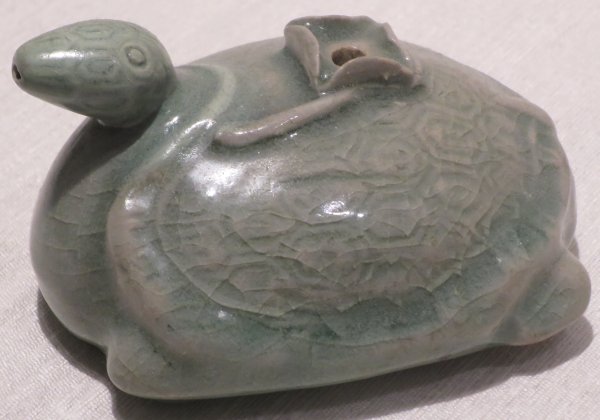
Above: Korean water dropper in shape of a turtle, Koryo dynasty, 12th-13th century, porcelain with molded and incised design under celadon glaze, Dayton Art Institute.

The Archetypes of Scripture: Jonah, Reluctant Hero

A General Introduction to the Series.

It’s cliché to say that the Bible is not so much a book as it is a library in a single volume. It contains works of history, law, poetry, prophecy, and even (if you have a Catholic Bible), works like Book of Tobit (Tobias) that has a structure similar to that of a novel. Genre, of course, is a modern invention; the Ancient Hebrews and the original Christians would not have “split” works into neat little categories. And truth be told, the books don’t always fit, like the aforementioned Tobit.

But genre is neither here nor there. My concerns here is the story. And, paradoxically, I lied above. The Bible is a single book in the same way it’s a library. Okay, so perhaps “I lied” isn’t entirely correct either. A better way, I think, to categorize the Bible is with the word Epic. It’s an epic in the same way the Lord of the Rings is epic. Threads from the books before are woven through the entire story, leading up to the epic conclusion of Christ Jesus’ passion, death, and resurrection.

In other words, it’s a Grand Narrative. The stories within the Story are themselves part of the Story. The Story ceases to make sense without these smaller stories. The Grand Narrative is the Word and the Word is the Grand Narrative.     

There are many who would disagree with me. Some because I’m thinking to much about it instead of living it. Others because they don’t believe in the Grand Narrative at all. Some will take issue with my choice of Bible, others will discount me entirely because I’m Catholic. Others, because I’m a woman.

All of that is irrelevant. When I peel apart an archetype in Scripture, it isn’t my intention to convert or to undermine or blaspheme. It’s my intention to understand the Story. I want to explore the Library that makes up the bedrock of the Western literary tradition. I want to find the archetypes that prototyped our modern archetypes.

Knowing these archetypes will help us become better writers. Understanding the foundation of Western literature will make us better readers, which in turn, makes us better writers. For those of us who believe, I hope it makes us better believers. For those who don’t believe, I hope it helps you understand why some of us do. Ultimately, this line of thought states that believing in the power of story improves our abilities to read and write.

For my Archetypes of Scripture Series, I will be using multiple Bible translations, mainly the Revised Standard Version: Second Catholic Edition (RSV-2ce); the Revised Standard Version: Catholic Edition (RSV-c); and the Douay-Rheims Version (DRV). I will use them interchangeably, depending on how I feel about the specific translation. Some are prettier than others or use more accurate language or better express what I’m getting at. I will always try to cite my translation. 

Jonah, Reluctant Hero

As stated above, the Bible is an epic, meaning that the books make reference to each other, or characters may appear in more than one book. Jonah is first referenced in 2 Kings 14:25. But let’s leave that aside for the moment and focus on the text of the Book of Jonah.

Jonah begins with the Call to Adventure.

Now the word of the Lord came to Jonah the son of Amit′tai, saying, “Arise, go to Nin′eveh, that great city, and cry against it; for their wickedness has come up before me.” 

[RSV-c Jonah 1:1-2]

Hearing this, Jonah immediately flees.

But Jonah rose to flee to Tarshish from the presence of the Lord. He went down to Joppa and found a ship going to Tarshish; so he paid the fare, and went on board, to go with them to Tarshish, away from the presence of the Lord.

[RSV-c Jonah 1:3]

There’s an economy of language common to Scripture and other ancient texts. The action is immediate, there is no time to breath between the Call to Adventure and the Refusal of the Call. The story begins it’s climb and it only has a few stops before it comes to the climax. Likewise, the denouement is as equally swift and in the case of the Book of Jonah, painfully brief.

Let’s take a quick detour to explain what I mean when I use these terms.

The Call to Adventure was coined by Joseph Campbell, likewise was the Refusal to the Call. These phrases are the first and second parts of the Hero’s Journey as outlined in his work The Hero with a Thousand Faces.

The Chosen One is the hero, the protagonist, the one called to the adventure, the one who will complete the quest. The Hero’s Journey can take on multiple forms, usually called Masculine and Feminine. Masculine/Feminine in this context has nothing to do with sex and everything to do with the type of journey; the Masculine is outer, usually marked by self-sacrifice, while the feminine is inner, marked by self-discovery. All good stories incorporate elements of both archetypal journeys.

In the Book of Jonah, Jonah is the Chosen One, he hears the call and he refuses it, choosing to flee to Tarshish instead of going to Nineveh. But why—the reader may ask—does Jonah choose the flee?

The Book of Jonah doesn’t really provide any detail. Like all ancient texts, we must do a little assuming. Often, ancient writers left out details because they assumed their audiences already knew why something was the way it was. Without reading the rest of the Bible, we may be a little confused.

Nineveh was an ancient Assyrian city now located in Mosul of modern-day Iraq. The Book of Jonah takes place in the Eighth Century BC but it was probably written after the Babylonian Captivity (or Exilic Period). This tells us that it probably isn’t meant to be taken historically, although Jonah is a historic figure. The point of this story is to tell a story. It tells the truth in the way all good stories tell the truth.

All this is to say that the Assyrians were more than just Gentiles to the ancient Hebrews, they were their captors and oppressors. Jonah, an Israelite, rightly sees them as the enemies of the Lord. Why would he go to Nineveh to preach repentance? They might actually repent and then Jonah’s enemies will be spared destruction.

So, returning to the narrative, Jonah is on a ship for Tarshish.

But the Lord hurled a great wind upon the sea, and there was a mighty tempest on the sea, so that the ship threatened to break up.

[RSV-c Jonah 1:4]

The sailors begin to panic and pray to their various gods. But Jonah, who knows why the storm is happening, doesn’t panic at all. In fact, he’s asleep in the hold, utterly unbothered by the danger. Jonah is exhibiting the main theme of the Book of Jonah, trust in the Lord. The Captain, angrily, says to Jonah: “What do you mean, you sleeper? Arise, call upon your god! Perhaps the god will give a thought to us, that we do not perish.” [RSV-2ce Jonah 1:6]

Lots are cast in order to figure out who’s to blame for the storm. Cleromancy, or the casting of lots has the Greek origin of klêros meaning “lot,” “inheritance,” or even “that which is assigned.” Cleromancy is used 47 times in the Bible, especially as a way to discern the Will of God.

The lot falls upon Jonah and the sailors interrogate him, demanding to know where he’s from and what god he worships. Jonah tells them that he is a Hebrew and that the Lord is his god. He then gives them some advice: “Take me up and throw me into the sea.” [RSV-2ce Jonah 1:12] The sailors hesitate. They don’t want Jonah’s blood on their hands. They try to bring the ship back to land but the storm just gets stronger, ultimately indicating that the Lord wants Jonah as a sacrifice.  

14 Therefore they cried to the Lord, “We beseech thee, O Lord, let us not perish for this man’s life, and lay not on us innocent blood; for thou, O Lord, hast done as it pleased thee.” 15 So they took up Jonah and threw him into the sea; and the sea ceased from its raging. 16 Then the men feared the Lord exceedingly, and they offered a sacrifice to the Lord and made vows.

[RSV-c Jonah 1:14-16]

Thus is the inheritance of the Chosen One. For the hero, destiny can be ridiculed, it can be ignored, even fled for a time. But in the end, it will swallow you whole.

In Jonah’s case, he is literally swallowed up by his destiny.

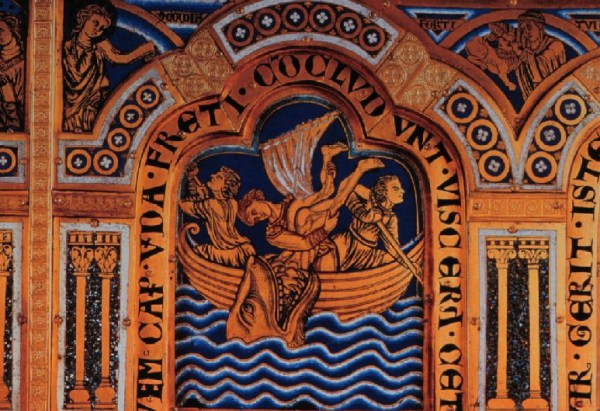
The Lord appoints a fish to swallow Jonah. Famously, Jonah remains in the belly of the fish for three days and three nights, foreshadowing the perfected hero archetype of Jesus Christ.

While in the belly of the fish, Jonah prays to the Lord in a beautiful piece of poetry sometimes called the Psalm of Thanksgiving or Jonah’s Prayer of Deliverance. “But I with the voice of thanksgiving will sacrifice to you; what I have vowed I will pay. Deliverance belongs to the Lord!” [RSV-2ce Jonah 2:9]  

Jonah, now having vowed to do as he’s been called to do, is unceremoniously vomited up onto dry land.

This is the lynchpin of the Reluctant Hero’s arc. After fleeing the adventure, the hero is always caught up by it. The way the snare is set is how great stories differentiate and become varied. Perhaps a loved one is killed? or an unrefusable offer is made? or the character simply makes the choice to stop ignoring the call? Regardless of method, the Reluctant Hero is made to finally embrace their destiny and, most importantly, they embrace the consequences of that destiny.   

This archetype, I believe, is most easily seen in the Lord of the Rings. Hobbits are not the adventurous type, but when fate comes asking questions in the Shire, Frodo is forced to flee where he is quickly caught up in events much larger than himself. He eventually accepts his fate, and to contrast with Jonah, he makes the choice to take the Ring, not to please anyone, but because it is the right thing to do. He knows the journey will be fraught with difficultly and that he may lose a part of himself, or even loose his life. But Frodo is the Ringbearer. In a series about reluctant Chosen Ones, Frodo is preeminent.

Now back on dry land, the Lord tells Jonah a second time, “go to Nineveh.” This time, Jonah goes. Nineveh is a great city, according to the Book of Jonah, it’s “three day’s journey in breadth.” Jonah walks one day’s journey into the city and cries, saying, in forty days’ time, Nineveh will be overthrown.

Miraculously, the people of Nineveh believe him. They proclaim a fast and put on sackcloth. The message makes its way to the king of the city, who rises from his throne, puts on sackcloth and sits in ashes. He decrees that all men and their animals will fast, taking neither food or water. He orders them to wear sackcloth and to cry out to God and turn from their evil ways.

Take a moment to imagine how funny sheep, cows, chickens, and other animal would look in sackcloth. This image, I believe, is purposefully amusing and marks a deliberate choice of the author to plant his tongue in is cheek.

The Lord sees that people of Nineveh (and their animals) repent, and “God repented of the evil which he had said he would do to them; and he did not do it.” [RSV-2ce Jonah 3:10]

The fourth and final chapter of Jonah speeds towards the end just as swiftly as the first sped to the action. Jonah, angry because the Ninevites repented and were spared destruction, prays to the Lord: “I pray thee, Lord, is not this what I said when I was yet in my country? That is why I made haste to flee to Tarshish; for I knew that thou art a gracious God and merciful, slow to anger, and abounding in steadfast love, and repentest of evil. Therefore now, O Lord, take my life from me, I beseech thee, for it is better for me to die than to live.” [RVS-c Jonah 4:2-3]

Jonah is quite the stubborn fool and, in a sense, like a teenager. Angry that his enemies have been spared, he declares that he’d rather be dead. “I’d rather be dead than have a father like you!” the Lord answers in trademark laconicism; “Do you do well to be angry?” [RSV-2ce 4:4]

Still mad, Jonah leaves Nineveh and pitches a tent east of the city in order to watch Nineveh. There is nothing that betrays Jonah’s thoughts, but perhaps he hopes that the Ninevites were just putting it on for his benefit and they’ll be destroyed not just for being idolatrous oppressors, but because they’re liars too.

Instead, the Lord makes a plant grow over Jonah so that he has some shade from the heat of the sun. This makes Jonah happy, despite his attitude, despite his unwillingness to attend properly to the call, the Lord still cares for Jonah. But, like any good parent, this is a teaching moment. The next day, the Lord sends a worm to wither the plant. The Lord then makes a hot wind and makes the sun beat upon Jonah.

Disappointed, and now, hot and tired, Jonah again declares that it would better to be dead.

But God said to Jonah, “Do you do well to be angry for the plant?”[d] And he said, “I do well to be angry, angry enough to die.” 10 And the Lord said, “You pity the plant,[e] for which you did not labor, nor did you make it grow, which came into being in a night, and perished in a night. 11 And should not I pity Nin′eveh, that great city, in which there are more than a hundred and twenty thousand persons who do not know their right hand from their left, and also much cattle?”

[RSV-c Jonah 4:9-11]

And that’s how the Book of Jonah ends. Of course, there’s still plenty to break down here. For one, the journey almost doesn’t seem complete. Is Jonah a better person? Does he understand what the Lord was trying to do?

I think the best way to examine this ending is to see it as an imperfect blend of both the masculine and feminine journey. We aren’t told that a profound inner change came upon Jonah, its barely even implied. But, assuming that he was changed, Jonah has undergone the feminine journey which is characterized by a deep, inner expansion of the self. Jonah has learned something about his god. A facete of the Lord is revealed to Jonah, a piece, that frankly, isn’t always easy to find in the Old Testament.

“Should I not pity Nineveh?” God asks and for the Christian this is clearly the voice of God the Son.

Knowing this, we can see how Jonah is also participating in the masculine journey. He has learned something new that will aide his people in the future. More so, he has confirmed a piece of ancient knowledge already known but forgotten in the turmoil of the Exilic Period.

As I said above, the Book of Jonah was probably written after the Babylonian Captivity. The Hebrews needed to relearn the mercy of the Lord. Yes, that’s right. I’m arguing that the text itself is the secret knowledge found at the center of the masculine journey. That means that every reader (at every time, anywhere, etc) is participating in the Hero’s Journey.

Writing and reading are participatory. You should read like you’ve heard the call to adventure and you should write like you’re calling the reader to adventure.

Never underestimate the power of these tropes. That word has been getting a lot of bad press lately, but there’s a reason why these foundational stories are so powerful. Breaking them down or imploding them can be useful for a time, but ultimately, when embraced, these tropes underline the journey of the human soul, from life to death and maybe even beyond.   

Above: Jonah and the Whale, a fraction of the Verdun Altar at the Klosterneuburg Monastery in Austria. Nicholas of Verdun (1130 – 1205). Enamel on metalwork (Champlevé). Housed in the Chapel of St. Leopold, Klosterneuburg Monastery, Austria.  
Writer’s Must Read…the Art of War

Sun Tzu’s Art of War

Sometimes research can be overwhelming. If you’re a writer who finds themselves intimidated by ancient texts, made easily bored by history, or just simply aren’t interested in a specific research topic, you’re not alone. But the simple fact is, as writers, we have a responsibility to relay interesting worlds, ideas, and characters. While a diet of pure fiction is enough to spark imagination, non-fiction helps us to better understand our topic.

Writer’s Must Read is my attempt to offer a map of non-fiction works that I believe have helped me become a well-rounded writer. The range in topic from history (okay, mostly history), to philosophy, to psychology, and even advice manuals.

The Art of War by Master Sun Tzu is something like all-of-the-above. It’s a fantastic piece of written history as well as a treatise on the philosophy of warfare. It covers a very early concept of war psychology, and of course, its main premise is that by following Master Sun, the reader will claim victory in war.

Chinese history is vast and filled to the brim with bloody conflict. Sun Tzu was probably born in the Easter Zhou Period of China; sometime before the Warring States Period. He served as a general and strategist for King Hëlu in the 6th Century BC. He would write The Art of War during this time.

“Warfare is the greatest affair of state, the basis of life and death, the Way (Tao) to survival or extinction. It must therefore be thoroughly pondered and analyzed.”

[Sun Tzu The Art of War Ch. 1 Initial Estimations, Sawyer translation]

From it’s first sentence, Master Sun makes it abundantly clear what his treatise is about. In the violent turbulence of the Zhou Period, victory is war is the knife’s edge between life and death.

“Warfare is the Way (Tao) of deception. Thus although [you are] capable, display incapability to them. When committed to employing your forces, feign inactivity. When [your objective] is nearby, make it appear as if distance; when far away, create the illusion of being nearby.”

[Sun Tzu The Art of War Ch. 1 Initial Estimations, Sawyer translation]

Master Sun lays out his goal and his main premise within the first chapter of his treatise. The Art of War is not a long book by any means, but it’s dense in content. It’s chock full of advice and observations that are stilled studied and relied upon today by modern armies the world over.

But why is any of this relevant to a writer of fiction?

War is a human experience; no culture has ever escaped war and no culture ever will. It is fertile writing ground. Blood is a terrible ink, yet war remains one of the most useful and popular plot devices.

War is hell, this is true, but the men who fight it are far from devils. All men fight for their own reasons and in their own ways and while it’s easy for a writer to explain why a character is fighting, but I’ve seen some writers struggle with the ways men fight. Sometimes making ridiculous blunders that rip readers out of their suspension of belief. I believe many of these misbegotten ideas come from the way war is portrayed on TV.

Now, there’s plenty of wiggle room in fiction, and there should be. If a story is good, no one will notice small tactical blunders (supply lines, trenches, reinforcement). However, when a writer sets out to write a large set-piece battle, it’s easy to fall into the belief that two opposing sides will simply line up and crash their armies together like children with dolls. While that has certainly happened in the annals of history, the vast majority of warfare is fought in much the way Sun Tzu outlines in his treatise.

For example, in Chapter 3 Planning Offensives, Master Sun says:

“Thus the highest realization of warfare is to attack the enemy’s plans; the next is to attack their alliances; next to attack their army; and the lowest is to attack their fortified cities.”

[Sun Tzu The Art of War Ch. 3 Planning Offensives, Sawyer translation]

What Master Sun is saying here is simple. In warfare, the optimal way to defeat an enemy is to attack his plans or his allies. That is, politics, espionage, sabotage—trickery. The next best way to fight your enemy army to army; ambushes, hit-and-runs, plundering villages/towns. The worst way, Master Sun says, is siege warfare. In fact, he goes on to say the “tactic of attacking fortified cities is adopted only when unavoidable.” [Sun Tzu The Art of War Ch. 3 Planning Offensives, Sawyer translation]

History shows that siege warfare is the worst kind of warfare. At the height of the Middle Ages, fortified stone castles were extremely common. Siege warfare—long, grinding, battles of attrition set before stone walls was the order of the day. Those inside the castle may be safe from the swords and spears of the besiegers, but supplies will be limited. You might be able to wait them out, or you can hope to break the siege and launch a successful sortie or pray your allies (if you have any) arrive in time to crush the besiegers against the castle walls and drive the enemy off. Your soldiers will have to work in constant shifts in order to keep watch for the dangers of siege weapons, wall climbers, sappers, and spies.    

But the besiegers will also have their own supply issues and a general must always keep in mind that his non-professional soldiers will be looking to go home ASAP in order to plant/harvest crops. Lack of water and sickness become serious problems for both sides; food goes bad, men die of dysentery and fever, or are mangled in engineering accidents and useless attacks against the walls. Morale sags. There are defectors and deserters on each side.     

With all this in mind, any writer can see how this is fertile ground for storytelling. But they should know that it’s the worst way to fight war. Seeing characters ply each of Sun Tzu’s strategies only to wind up fighting a crushing siege is far more interesting than reading about them blundering onto a 100-yard field to clash swords and spears.

Don’t get me wrong, that can be interesting but battles were hardly fought that way and they typically devolve into high casualties for little reward. Sun Tzu says: “attaining one hundred victories in one hundred battles is not the pinnacle of excellence. Subjugating the enemy’s army without fighting is the true pinnacle of excellence.” [Sun Tzu The Art of War Ch. 3 Planning Offensives, Sawyer translation]

Master Sun goes on to give advice on things like morale, espionage, and terrain. He warns of leaders who interfere too much with the actions of generals. In one potent elucidation he notes the five dangerous character flaws in generals:

“One committed to dying can be slain. One committed to living can be captured. One [easily] angered and hasty [to act] can be insulted. One obsessed with being scrupulous and untainted can be shamed. One who loves the people can be troubled.”

[Sun Tzu The Art of War Ch. 8 Nine Changes, Sawyer translation]

The martyr will seek out his martyrdom; the coward will turncoat; the prideful fool will blunder; the glory hound will be too timid. The overly compassionate will commit to lost causes. These are interesting ideas to play with. Not every general character will make mistakes because he’s a prideful idiot. Maybe your protagonist is overly concerned with the lives of villagers? While wanting to protect the weak and save the innocent is commendable, victory demands meat for the grinder, and sometimes a terrible calculation needs to be made. There’s a great story in that tension.

If you want an example from fiction, look no further than Ned Stark of A Song of Ice and Fire. Stark was blinded by his obsession with honor and right-doing. Concerned with the possibility of shame and dishonor, he is neatly dealt with by the less scrupulous. What a boring character Ned would have been had he decided to be a hot-head and died charging into the Red Keep?

Sun Tzu’s Art of War is not the place to stop when it comes to studying warfare, but it is the place to start. If you’re looking to level up your writing, especially when it comes to war and tactics, the Art of War is an accessible and enjoyable read. There are dozens of translations, even a graphic novel if you feel that pictures would help you understand the concepts laid out. No prior knowledge is needed to understand it and it will improve your writing, from your generals, to your kings, to your CEOs, and politicians.

I believe that Sun Tzu’s Art of War is a must read for all writers.

Above: statue of Sun Tzu, Chinese style gardens in Japan. Enchō-en (燕趙園) are located in Yurihama, Tottori Prefecture, Japan.

The First of Many, God Willing

It’s been little over a week now since the release of Cirsova Issue #14 Spring 2023. It contains thrilling adventure stories, including my own SciFi short, Egg. If you haven’t had a chance to check it out, may I suggest you do?

Egg is my first published work, and while I still despise the title, I can’t help but feel there’s some symbolism in it. It’s a small thing, but this short little pulp is the culmination of years of practice and patience. I’ve wanted to be a writer since I can remember and that dream has always been in the abstract. As small as this little fleck of concrete is, it’s still concrete. That’s good enough for me, for now.

Friends and family have been asking me how I feel about finally being published and I’ve had a really hard time explaining it. I’m proud because any small triumph is worthy of some admiration, but at the same time I feel driven. Its like a fire was lit. I have more to say, more to write, more joy to bring. I tell stories because I love telling stories, publication is just the physical proof of that passion.

I’ve been turned down before, rejected, forgotten, ridiculed even. It took a lot of time to gain back the courage to send anything out for consideration. Then, one day, it struck me: “what’s the worse that can happen, they say no?”

As terrible and heartbreaking as “no” can be, it should never be taken personal. It’s a challenge, a call to the writer’s adventure.

I’d like to extend a hearty thank you to Cirsova and all those who keep the wonderful world of pulps alive. I’ve been supported by family and friends, all of whom were more excited about my story than me. Finally, I give praise and glory to God, who let me know I was on the right track with a stupid title like Egg.

Buy Cirsova #14!

Lulu Hardcopy

Lulu Softcover

Amazon

Blog at WordPress.com.

Up ↑