Anvil Issue #2 is Funding Now

Anvil: Iron Age Magazine is no longer funding, but can be purchased “in demand” on Indiegogo. My short story, Afflicted: Nourritures les Ver, will be included in this issue along with a number of comics and shorts by other independent authors like me.

I can only speak for myself, but I am extremely excited about this magazine and my small place in it. I believe Nourritures les Ver will fit comfortably on the shelves of fantasy, sci-fi, and horror fans alike. I hope the blurb below whets you appetite for more.

Afflicted: Nourritures les Ver by Jaime Faye Torkelson

Amélia Mitre is Afflicted. Cursed by a pact of her own making, she is made to follow the Weird Way of Scealfe, God of Death of Decay. Summoned to the industrializing city of Beauanne, the Cursed Doctor finds herself investigating a disturbing disease that defies the laws of nature and therefore, the laws of her dark patron. She must discover the origins of the plague and punish anyone foolish enough to pretend rivalry with the God of Death.

If you choose to support Anvil, let them know I sent you. Your support, no matter how small, helps keep the flame of independent IPs alive and I cannot thank you enough!

My thanks, first and foremost, to God, who likes stories more than I do.

Secondly, the team at Iron Age Media has been great to work with. I highly recommend you check out their website.

And, finally, to the readers, who deserve good stories I hope my small offering fits the bill.

Above: a handful of worms in coffee ground compost, which makes excellent worm food.

Hail, Iron Age!

I’ll be featured in the 2nd issue of Anvil: Iron Age Magazine. Updates are to come, but I expect publication in Fall 2023.

For now, I would direct you to their 1st issue. It’s been fully funded, but you can still use the Indiegogo page to purchase the 1st issue or reach out to campaign directly. Publication for issues one is expected in July 2023.

Anvil promises to be an aggregator of indie IPs, especially drawing from the tradition of pulp fiction and comics. If this is the kind of writing you’re interested in, check out their website for more info.

I haven’t written much about my love of pulp, but when it comes to short stories, I draw much of my inspiration from the greats: Robert Howard, H.P Lovecraft, C.L Moore.

For this latest piece, I tapped into my inner C. L. Moore and wrote a female fantasy hero. But unlike Moore’s Jirel, I lean into the gross-out horror of 18th Century medicine. I want to see Amélia Mitre become a modern pulp hero worthy of my heroes.

Some exciting things are happening for me this year and I’m proud to share it with you. Further details are to come.

Update 07/24/2023: You can preorder Anvil: Iron Age Magazine Issue 2 here.

And, if you don’t already know, my short story, Egg, can be read in Cirsova 14, Spring 2023.

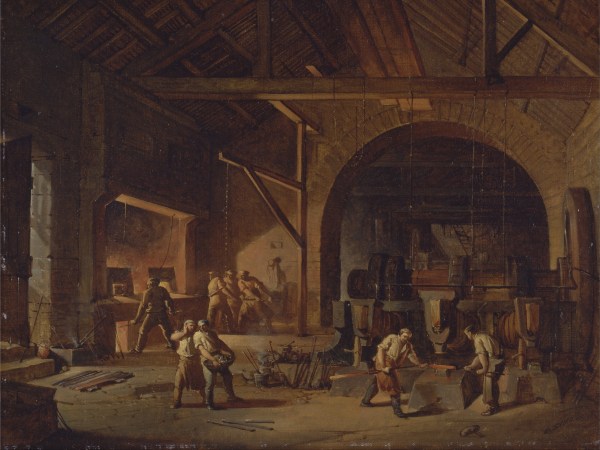
Above: Interior of an Ironworks. Godfrey Sykes (1825 – 1866) British Painter. Oil on Canvas. Housed at the Yale Center for British Art.

Adventures in Storytelling 3

Entry 3, Carpe editorem, occide. 

As I stated in the last entry, I learned it was okay to trust my instincts. But when it came to editing, I didn’t really know where to start. I read a couple books on editing, some more useful than others, and sort of just decided to start from the beginning. {read Storytelling 2, here}

I wrote Project Paisley’s P1 into three parts. As a finished draft, P1 was massive, as in, this-is-never-getting-published massive. It was a problem I was aware of while writing it. The seed had grown into a wild forest and was in need of serious cultivation if I was going to make anything of it.

While writing P1 I made heavy use of a tactic I call pre-editing (some call it backtracking). Pre-editing is when I go back to former chapters/sections in order to reread them. Sometimes this is done in order to refresh my memory, double check lore, or simply because I can’t do anything else. Often, if I see a mistake or I decided to rewrite something, I fix it. There are people who believe this is terrible for your writing, but I find helpful. Sometimes, I’ve gone back and read something really good and it’s inspired me or reminded me that I’m not utterly useless as a writer.

While working on part three I had some difficulty getting to my end. I took some time at the local library to print out the first part of P1. I learned from one of the aforementioned editing books that seeing your work in print instead of on a screen can help you distance yourself from it. I also learned that changing the font from your standard use font (like Times New Roman) to something less familiar (like Bahnschrift) provides further alienation.        

This technique, which I call alienation, works for me and I still use it. Placing distance between yourself and your work is like taking a break in a very torrid relationship. It can be incredibly difficult. You’ve spent hours, days, months, years with a particular project. Cutting yourself off from the creative process that held you in thrall for so long is like clipping off pieces of your own soul.

But you must cool that fire before you can really edit. Pre-editing, for all the use I got out of it, wasn’t helping me edit. It was creating a longer and more unwieldy draft. I spent so much time with part one that I had difficulty pulling away from it in order to finish part three. I ended up adding an entirely new section to part two, while I believe this worked out for the best, when I finally got around to finishing part three, I was dealing with a draft so large I knew that no company would publish it as a first novel.

Still, I persevered. I sent the draft to a printer in order to have the monstrosity printed and mailed to me. Note: don’t ever do this. It is cheaper to buy your own ink and paper, print from home in batches and store in a three-ring binder.

In 2019, I started a new fulltime job. Circumstances required me to shelve P1 for months.

Then, Covid happened, and I dusted P1 off. 2020 was a hard year for most of us, but opportunity lies in even the worst elements of chaos and hardship. Never pass up an opportunity to exercise your passion.  

Distance granted me clarity. But not crystal-clear clarity. More like, cold light of day, icy shower clarity.

That’s a little harsh, but you catch my meaning. There were things about my writing that shocked me. The overuse of -ly words, the abundance of had and so, the rambling sentences, the ones that ended randomly unfinished.

And that was just the technical stuff. There were lore errors, inconsistent naming, naming conventions I suddenly found that I hated…

But, as I went further and further into my first draft edit, I came to realize something. For all my mistakes, I enjoyed reading it. Sure, it was messy and unfinished, I had a hundred little things that needed fixing, plot threads that needed tying up (or cutting entirely), but it was good. Or, at least, it was good to me. It hit me as something I would like to read.             

Writing is an organic endeavor. Where you start shouldn’t be where you finish. This became abundantly clear when I took P1 off the shelf and began my first few rounds of editing. My ending was better than my beginning.

My skills as a writer improved dramatically from the first sentence to the last sentence. Both still needed work but the last sentence was in a much better state than the first.

I came away from my first draft feeling better than I expected. I wrote an end-of-edit letter to myself and stuck it in my binder to act as a rubric for my next move. In it, I outlined several things I needed to work on:

  1. My voice is passive, I need to own my words.
  2. If you see had or so, delete immediately/rewrite the sentence.
  3. Various lore and worldbuilding mistakes and inconsistencies.
  4. There are somethings here that I simply don’t like.  

By itemizing the issues in P1, I felt more confident and put it back on the shelf for another month.

I needed a break, editing is hard work, in many ways harder than writing. Editing engages our creative drive, but it also demands our reason. There were times where I found myself arguing over if I should delete a certain word or rework a sentence. More than once I crossed out a word only to mark it with a simple “ok” only to cross that out.   I started the next month, rested and ready. I used my end-of-edit letter to focus my second pass on the nuts and bolts of my writing. My voice was there, but it was buried under mountains of passive verbs and extraneous adverbs. Not to mention that I used the words had and so like crutches.

99% of the time, had and so are unnecessary and they take away from the active action of the characters turning them into passive meat puppets and robbing your voice of it’s confidence. “She had become tired” should be “she was tired.” “So she changed her plans” needs to be “she changed her plans.”

This paragraph: “She ran quickly, speeding down the hall and roughly turning the corner. She threw herself into the next room. Slammed the door and waited silently for the danger to pass.”

Became: “She ran. Her pace picked up speed, slowing as she rounded the corner. There! She spotted the first open door and threw herself into the room. She pressed against the door. Waited. Sweat slipped down her temple. She heard steps—stilled.”     

You’ll note that the second paragraph became longer and the sentence length became more varied. By removing the crutch of adverbs, I was forced to think more about the scene. How do you add tension without an -ly guiding the reader?

Variation is the spice of writing. Vary your sentence length. Vary your grammatical structure. Vary your verbs, nouns, etc. There is no reason sentences in fiction can’t be one word. Or twelve. I also vary my punctuation and my diction.

Note: I don’t want to make it seem as if this all happened between my first and second draft. Writing doesn’t work that way. One day I simply began to notice these changes in my writing. That being said, I’ve gone through four drafts of P1 and I’m currently rewriting most of it. I’ll address the last two issues in the next entry.    

These are my tools, pre-editing, alienation, end-of-edit letter, and variation. They go by different names, some people don’t like them, some don’t find them useful. And that’s okay. Writing is not carpentry. We craft our own tools and use them as we intend them; if it doesn’t work, we toss it out even if it works for someone else.   

Own the tools of your craft. Use them to help you identify your crutches and build the confidence to yank them out.  

A Simple Meal of Bread and Cheese

Some time ago, an old friend and I had a discussion set off by a fan fiction she was reading. She sent me a screen shot of something she thought was funny, or horrendous, I can’t remember. What I do remember was seeing the phrase “they stopped near midday and ate a simple meal of bread and cheese.” Immediately, without much context, I knew it was either an alternate history or a fantasy alternative universe (AU) because I’ve seen this deliciously terrible phrase in nearly every fantasy I’ve ever read.

A simple meal of bread and cheese evokes a strange, nostalgic feeling. It has the quality of a really good but utterly normal Christmas dinner. Or better yet, Holiday leftovers. When it’s the middle of the night and you make a cheese sandwich with a dinner roll and some slightly dried cheddar that was left on the appetizer tray.   

The phrase itself is unassuming but I can glean some information from it. If your meal is simple, its probably because you come from a high-class background because for a peasant this is just a meal. Simple connotate rustic. Rustic is a polite word for coarse, country, rural, roughing-it. And while its utilitarian enough to evoke these vagaries, the quaint charm leaves me unsatisfied. Like there was a missed opportunity for a slight taste of a wider world.

I find myself asking the writer, what kind of cheese? What kind of bread? Are there nuts in the cheese? What kind of grain is the bread made from? Would it go well with apples?

As Chesterton so elegantly put, the poets have been silent on the subject of cheese and we ought to rectify that.

Personally, I’d rather smear a soft green cheese over a slab of oat-laden bread than place a slice of Kraft on a piece of Wonder Bread. But my tastes aside, a simple meal of bread and cheese is prime real-estate for worldbuilding, whether that world is modern, archaic, or fairytale.

“…hot soup, cold meats, a blackberry tart, new loaves, slabs of butter, and half a ripe cheese: good plain food, as good as the Shire could show…”

The Fellowship of the Ring

While the meal Frodo and his friend have at the Prancing Pony is more than just bread and cheese, the words to describe this simple meal of bread and cheese is marked with Tolkien’s usual narrative color. “Good plain food” he wrote. Because it is. It’s simple fare. Half of a ripe cheese, new loaves. That is, a slightly tangy, older cheese and fresh bread still hot from the oven.

It paints a picture that expands the world a bit. The men of Bree aren’t so different from the hobbits of Hobbiton. It’s this meal that calms Sam who is unused to being around so many tall-folk. For an instant, as readers, we get to enjoy the hobbit’s momentary comfort. We taste a world that is familiar, and yet achingly far away.   

Food culture flavors a setting. There is something otherworldly about drinking spice coffee over coffee [Dune]. Something familiar and real about wheels of white cheese and chunks of hardbread [A Song of Ice and Fire]. There are warm comforts in a serving of deeper-than-ever-turnip-and-tater-and beetroot pie next to hotroot soup and nutty soft cheese [Redwall].

A simple meal of bread and cheese tells us much, but a meal of green white cheese and sesame crackers tells the reader a bit more.

It’s these tiny details that give readers a place to latch on. Never pass up a chance to deepen a reader’s journey. Writers don’t need to fill in every blank, that’s tiresome, but take into account the flavor of the universe you’re trying to convey.

If a story takes place in ancient China, no one is eating cheese or bread (as in, typical wheat bread). If your story takes place in medieval England, everyone eats bread and cheese, but class differences dictate the type and quality. A word a caution, never fall into the trap of cultural stereotypes especially when it comes to food. Anyone calling “British food” boring has never had the experience of a blisteringly hot bite of shepherd’s pie. Calling every Indian dish spicy does a disservice to the creamy, sweet, and even sour dishes of India. Making pasta a completely foreign and exotic meal to your adventuring party ignores the fact that some of the first written references to pasta in the West come from the 1st century AD.

When it comes to food and the worldbuilding you do around food, research is your friend. Watch any number of historical cooking shows on YouTube; look up recipes for dishes you’re unfamiliar with and then make it. If a local restaurant serves a specific kind of cuisine, go try it. The best teacher is experience. Take note of the similarities between cultures, appreciate how those similarities are expressed differently.

This small concept—a simple meal of bread and cheese—is the vehicle for a richer experience. We become more potent writers when we make an effort to expand a universe through food. Food is a way for us to come together.

As a writer, bring yourself and your readers to the dinner table. Make them hungry, make them want to come to your works just to taste a fine meal, make them want to come back for more.  

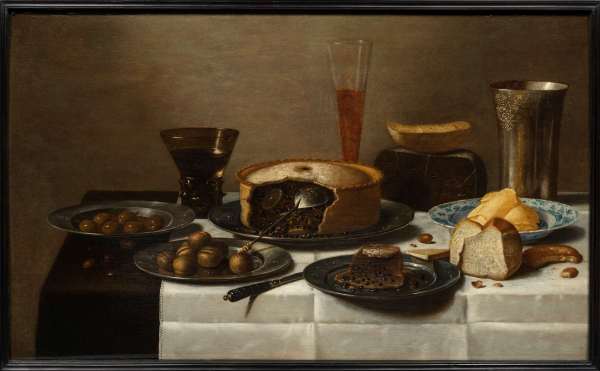
Above: A Still-life with Bread, Cheese and a cut Pie. Floris van Schooten, (between 1585 and 1588 – buried 14 November 1656), Dutch Painter. Oil on panel. Housed at Koetser Gallery.

Currently Reading…An Introduction to Medieval Philosophy

Joseph W. Koterski’s An Introduction to Medieval Philosophy: Basic Concepts

Father Joseph Koterski, a Jesuit Priest and educator at Fordham University entered into his Eternal Reward in 2021, but he left a legacy of education behind on earth. I was first introduced to him via The Great Courses. First listening to his course on the Ethics of Aristotle and then his course on Natural Law and Human Nature.

It was in one of the introductions to these lectures that I first learned of his only book: An Introduction to Medieval Philosophy. While I grew a little bored with his lecture on Natural Law, I still go back to his lectures on Aristotle as a refreshment course, especially before I read a work on philosophy. The lectures are a great introduction if you’re intimidated by works like the Nichomachean Ethics.    

Intro to Medieval Philosophy is just that, an introduction. It’s a good place to start for those interested in a deeper understanding of the thought patterns of medieval peoples. When I say the “thought patterns of medieval people” I am very strictly speaking about the thought of the educated, religious elite. That is, the great founders of the University System, the theologists who’s thoughts form the rudimentary thought of Modernity.

Koterski sticks closely to the philosophy of Western Christianity, stating openly in his introduction that enlarging the scope to include Western Jewish philosophy or Eastern Christianity would do a deep disservice to those philosophical traditions. It makes me wonder if he intended other books to explore those topics? It’s a shame that he never got to them, as his Great Course works suggest he was familiar with them and his writing shows him to be excellent teacher. He is clear and concise, the divisions of the book make sense, and appear to layer concepts on top of each other—which is really the only way to teach philosophy.

Medieval philosophy can truly be summed up in the words of Saint Augustine: credo ut intellegam and intelligo ut credam. “I believe so that I may understand,” and “I understand so that I may believe.” Saint Anselm would tidy these two sentiments into a neat creed: fides quaerens intellectum, “faith seeking understanding.”  

A reader looking for skepticism will not find it here; he will find an honest introduction to the philosophical thinking of the medieval mind with all its complex variety and petty hobgoblins. Like most medieval studies, whether history or philosophy or literature, this book will bust the myths modern man (and especially Victorian man) have constructed around the so called “Dark Ages.”            

Once you know what to look for, you’ll see it everywhere. Modern Man does not move without slamming into Thomas Aquinas, or Augustine, or Anselm. I’m enjoying the study, especially because no one is ever above reviewing the basics. It’s not for everyone, no book ever is.   

Blog at WordPress.com.

Up ↑