Petals from my Florilegium: C.S. Lewis, letter to Jane Gaskill 09/02/1957

I keep a commonplace book where I collect phrases, proverbs, sentences, or ideas like a haphazard bouquet of wildflowers. I pick them as they come to me, with no curation save what I share on this blog.

In this series, I’ll offer a quote and meditate on why it deserved to be preserved in my Florilegium.


“Aren’t all these economic problems and religious differences too like the politics of our own world? Why go to faeries for what we already have? Surely the wars of faeries should be high, reckless, heroical, and romantic wars—concerned with the possession of a beautiful queen or an enchanted treasure?”

C.S. Lewis, letter to Jane Gaskill 09/02/1957

Modern fiction, particularly fantasy, doesn’t do it for me anymore. There was a time in my life were going to a major bookstore chain—an onerous thirty-minute drive with terrible parking—was an event. I looked forward to visiting the bookstore and would spend hours perusing the shelves, on the hunt for that one perfect volume.

The last time I went to a major bookstore chain, I spent thirty minutes wandering the morass of confusing shelves, games, toys, anime, and Marvel ephemera. It was a dreadful experience punctuated by the reek of unwashed teenagers, bad coffee, and the bumping of Billboard Chart pop.

Worse still was the book selection. It was atrophied; tables awash with the same five writers, all with similar titles: A Blank of Blank and Blank. An entire section was carved out for “cozy” fantasy and the comic book section was expanded into a malignant tumor of plastic toys and uber-expensive special editions. I could barely find the historical section, which of course, had been trimmed down to make room for the toys.   

It was a veritable swamp of similar plots, similar heroines, glossy, minimalist photo-shopped covers, and all stinking of plastic-wrapped corporate greed.

This is starting to sound more like a complaint than an invitation.

Why go to faeries for what we already have?

Growing up, my family was not the kind of family that could afford lavish vacations. Instead, we spent three to four days every summer camping in the California Wilderness punctuated with a day-long trip to the lake.

It was in those woods that I would imagine tales of heroic wolves and foxes as questing knights. Only as an adult do I really appreciate how truly formative the dense, quiet woods of the Sierra-Nevada were for my identity and style as a writer.

Those knightly wolves and foxes were out to rescue a headstrong, tom-boyish queen—the character I most often pretended to be.

For three days, with a new school year looming on the horizon, I got to pretend that the world of fantastical forest animals was in deep, dark peril from a wicked and unnamed evil that stalked the woods at night and ate little girls who wandered too far from the fire.

Fiction, was then, as it is now, my escape from the daily grind.

So, why the hell would I want to read a book about an elf opening a Starbucks? Or about your thinly veiled political hang-ups? Or your trite condemnation of “religion?” Or your edgeless handwringing love-triangle?     

 I want the “high, reckless, heroical, and romantic.” I want the bright banner and the crimson sword, the passionate romance of destined lovers, the tricks of faeries, and the triumphs of brave knights.

Give me edge, give me flesh and blood—take me somewhere else, somewhere that isn’t here.

I wrote this quote down, not to smugly lecture writers on what they should and shouldn’t write, but as a reminder to myself.

I owe myself a good story.

While I’ll never be able to escape my biases, reminding myself that they exist makes it easier to avoid them. I want to be the kind of writer people read because they enjoy what I write, but I can only do that if I try to make myself the kind of writer I want to read.

That means high adventure and even higher truths.    

Above: Fairy Rings and Toadstools. Dated 1875. Richard “Dickie” Doyle (18 September 1824 – 10 December 1883). British Illustrator. Watercolor on paper. Private collection.

Like weird tales? I write my own, you can find them here! You can also follow me on Twitter/X!

Petals from my Florilegium: William Gibson, Virtual Light

I keep a commonplace book where I collect phrases, proverbs, sentences, or ideas like a haphazard bouquet of wildflowers. I pick them as they come to me, with no curation save what I share on this blog.

In this series, I’ll offer a quote and meditate on why it deserved to be preserved in my Florilegium.


Its steel bones, its stranded tendons, were lost within an accretion of dreams; tattoo parlors, gaming arcades, dimly lit stalls stacked with decaying magazines, sellers of fireworks, of cut bait, betting shops, sushi bars, unlicensed pawnbrokers, herbalists, barbers, bars. Dreams of commerce with their locations generally corresponding with the decks that had once carried vehicular traffic; while above them, rising to the very peaks of the cable towers, lifted the intricately suspended barrio, with its unnumbered population and its zones of more private fantasy.    

William Gibson, Virtual Light

William Gibson of Neuromancer fame is one of my favorite writers. His work, Virtual Light, falls into the cyberpunk genre, but in a far more subtle way than the Sprawl Trilogy. There are evil mega-corporations, corrupt governments, mysterious climate disasters, and all the other accoutrements that accompany the genre, but the story revolves around a pair of high-tech glasses and the powerful entities hunting the glasses down.

Sounds bizarre, I know, but the fun of Virtual Light is the unsettling implications behind the high-tech, low-life world that the characters live in.

That said, if you looking for neon-soaked streets, desperate drug addicts, and cyberspace raids, Virtual Light ain’t it. Cyberspace isn’t mentioned once.

Unlike the Sprawl Trilogy where Console Cowboys melt ICE and chat with mystical AI pseudo-gods, Virtual Light revolves around the Bridge.

The Bridge, what we would know as the Golden State Bridge, has in the seedy near-future, become a ghetto. It’s a holdout for the disenfranchised lowlifes of San Francisco. The passage above is the first glimpse the reader gets of the Bridge.

“Its steel bones, its stranded tendons, were lost within an accretion of dreams.” The Bridge is a massive, haphazardly pieced together architectural marvel of busted beams, splintery planks, and rusted platforms. The shops and bars and stalls are all located on the two lower decks where once cars buzzed from San Fran to Oakland. Above, people have built their homes from whatever scrap they can find.

What draws me to this paragraph is not the strange prescience with which it describes the San Francisco of 2024, but the poetry of it.

Gibson is a poet when the mood strikes him, especially when he’s describing places.

This passage begs to be read aloud with emphasis set on the repeated sounds like an alliterative poem.

steel bones, its stranded tendons”

“dimly lit stalls stacked with decaying magazines

“cut bait, betting shops, sushi bars, unlicensed pawnbrokers, herbalists, barbers, bars.”

This passage is awash in sounds and scents, a description that gives you what you need to paint a clear picture without robbing you of the joy of letting your imagination hold the brush. I can hear city traffic humming just below the harsh cries of the vendors. I can smell salt and rust and ramen and rotten fish.

This is the kind of paragraph I long to write—words that stick with a reader, that demand to be read again, and then, read aloud. It’s the perfect balance of rhythm and flavor, sweeping you into something at once familiar and utterly alien.

Gibson is a visionary—not just of the future, but a man who really seems to know his craft. As much as his works tend to horrify me, they enchant me too. Virtual Light doesn’t haunt me the way Neuromancer and Mona Lisa Overdrive still do, but I wrote down this passage because I couldn’t get it out of my head.

I hope it haunts you too, and it convinces you to give Virtual Light a read, if only for gems like this.   

Above: Close up of a Flower. Susanne Nilsson.    

Like weird tales? I write my own, you can find them here! You can also follow me on Twitter/X!
A Gentle Introduction to Conan the Cimmerian

Conan casts a mighty shadow over the swords and sorcery genre. You might even say, Conan is the genre. At the very least, he is the gold standard and all sword and sorcery fare is measured against the Cimmerian, regardless of the fairness of it.

The half-clad, sword-wielding barbarian is the trope de jour in all things swords and sorcery. From movies, to short story collections, to heavy metal music—if it’s swords and sorcery, it’s got buxom ladies, evil wizards, and loincloth bedecked barbarians.  

This isn’t a bad thing. I like tropes, I think they’re useful—good, even! And this trope is one of my favorites. I love a good sword-swinging savage man, bare-chested, blood covered, roaring insults against cowards and foes alike.

And if you like this trope too, Conan is your man. But, he’s also wily, cunning, quiet, pensive, chivalric, deceitful, womanizing, loyal, sneaky, brash—in other words, he’s complex.

Now, complex does not mean he completes a full “modern” character arc—in fact, he wouldn’t be Conan if he “changed” at the end of his tales.

“The Pulp Structure” as I call it, is about a character facing an obstacle or series of obstacles be they physical, mental, or both and overcoming those challenges. The story is found in the way they overcome the contest. Most importantly, they need to surmount the obstacle with their character or morality or ideology intact.

This resistance to change serves two purposes, it preserves the integrity of the kind of character that Conan is. It is also the mechanism that allowed Robert Howard to write Conan into all sorts of situations. The fun of a Conan story is in how Conan solves the problem before him.

“Hither came Conan, the Cimmerian, black-haired, sullen-eyed, sword in hand, a thief, a reaver, a slayer, with gigantic melancholies and gigantic mirth, to tread the jeweled thrones of the Earth under his sandalled feet.”

-The Phoenix on the Sword

This is Conan, a savage from the wastes of Cimmeria. A mercenary and robber. A man who has known great joy and even greater sadness. Impudent, knavish—he scoffs at kings and peasants alike. He lives, he burns with life, he loves and slays and is content. Plunder is seized and spent just as quickly—his philosophy, if a man like Conan has one, is this:

“I think of Life! The dead are dead, and what has passed is done! I have a ship and a fighting crew and a girl with lips like wine, and that’s all I ever asked. Lick your wounds bullies, and break out a cask of ale. You’re going to work ship as she never was worked before. Dance and sing while you buckle to it, damn you! To the devil with empty seas! We’re bound for waters where the seaports are fat and the merchant ships are crammed with plunder!” 

-The Pool of the Black One

Conan is not a man who goes out of his way to protect the weak. In fact, he doesn’t have a lot of respect or understanding for the weak and the poor.

By his estimation, the poor ought to get strong and rob the rich. The life of man is warfare, so men ought to take up sword and war. The strong will grow stronger because they are strong and the weak will die, because they are weak.

In this way, Conan is pure pagan. He would hear the words of Jesus “blessed are the poor” and sneer and ask how man is meant to eat a blessing.

This is best exemplified by the shadowy, utterly absent, cold and grim, god of the Cimmerians—Crom.

“Their chief is Crom. He dwells on a great mountain. What use to call on him? Little he cares if men live or die. Better to be silent than to call his attention to you; he will send you dooms, not fortune! He is grim and loveless, but at birth he breathes power to strive and slay into a man’s soul. What else shall men ask of the gods?”

-The Queen of the Black Coast

Conan’s fatalism is more Norse than it is Roman. His grim god’s attention promises doom, but despite that he seems to call out Crom’s name as if tempting fate, daring, maybe even demanding that promised doom so he might conquer it.

The Hyborian Age, the fictional pre-history setting of Howard’s Conan stories is awash in pagan fatalism. There is Bel, the god of Thieves; Mitra, the most widely worshiped and beloved of the gods; Set, the snake god of the Stygians who demands human sacrifice; the mysterious Asura. The good ones, if there are good ones, are Bel, Mitra, and Asura.

Conan does not call on any of them. Nor does he seem to care for their cults and practices. He has little regard for “blasphemy” and would do battle with a god if it suited him. The Priests of Asura have aided Conan in his journey, and Mitra has aided others in finding Conan’s help. He has spurned Set in a more physical way—slaying his children and confounding his priests.

For the average people of this mythical age, there appears to be little hope. This fatalistic caste system, where the strong prey on the weak, makes slavery, wanton cruelty, and human sacrifice the order of the day.

Power is all that matters, and those who don’t have it, live and serve at the pleasure of those who do.

Women are the particular victims of this system. Although Howard never spells out exactly what occurs in the flesh markets, harems, and pleasure palaces of the civilized nations, it is easily discernable to any but the most naïve of readers.

“…her worst oppressor had been a man the world called civilized.”

-Iron Shadows in the Moon

The tension between civilization and savagery is the red-hot pulse of the Conan stories. Howard does not hide what side he comes down on—barbarism is the superior. What Howard really appears to be doing is showing the ultimate end of degenerated civilizations. Rome degenerated and fell to “barbarian” incursions. The same fate befalls Aquilonia.

The difference, of course, is Conan.

He bucks against the spirit of fatalism. He forges his own path, mocks the gods. He has no need for the rules of civilization or savagery. If he is a barbarian, then I suspect we’d all wish to be barbarians.

“We do not sell our children.”

-Iron Shadows in the Moon

Conan says to a woman sold into sexual slavery by her own father. He’s never forced a woman against her consent, bought a human being, or forced a heavy tax burden on his people. He is a thing apart. Perhaps the only true example of rugged individualism that has and even will be.  

Conan is a renewing force; an infusion of fresh blood into a sickly man. He does not change, but all who meet him are changed. Slaves are freed, spines are steeled, villains are slain. In a bizarre, round-about way Conan is a liberator. Whether physically, or spiritually, Conan slaps sense into those around him, especially those who read him.

If you’re tired of tepid modern fantasy with it’s warmed-over Tolkienian platitudes, or handwringing, “grimdark” antiheroes; Conan might be the barbarian for you. Think of life! Think of rich red meat and stinging wine, think of passion and the flash of crimson blades, and be contented!

“Oh, soul of mine, born out of shadowed hills,

To clouds and winds and ghosts that shun the sun,

How many deaths shall serve to break at last

This heritage which wraps me in the grey

Apparel of ghosts? I search my heart and find

Cimmeria, land of Darkness and the Night.”

-Cimmeria

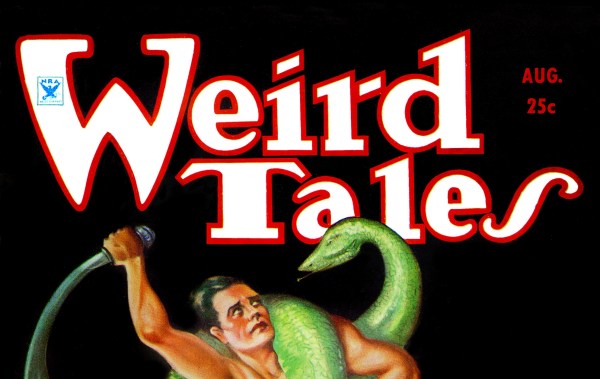
Above: A section from the August 1934 cover of Weird Tales featuring Robert E. Howard’s Conan the Cimmerian in The Devil in Iron.

I write my own weird tales, check them out here and follow me on X/Twitter.

Anvil Magazine #4 Pre-Orders live on Indiegogo!

Anvil Iron Age Magazine Issue #4 is now funding on Indiegogo or can be pre-ordered on the IronAge Media website. My short story, Homefront, will be featured in this issue alongside other fantastic pulp offerings, including a story by Blaine Pardoe!

Here’s the blurb for Homefront!

A housewife’s work is never done. She must get the kids ready for school, tend the garden, clean the house, buy groceries, do the laundry, greet the new neighbors, and suss out any extraterrestrial activity and neutralize it all before her husband gets home!

If you choose to support Anvil, let them know I sent you. Your support, no matter how small, helps keep the flame of independent IPs alive and I cannot thank you enough!

Don’t forget to follow me on Twitter/X and if you haven’t already, you can find my short story, Afflicted: Nourritures les Ver in Anvil #2. You can find links to my other written works, here!

Album Review: First Strike

Am I qualified to talk about music? Probably not, I haven’t read a lick of sheet music since I was in High School; the last instrument I played was for my Junior High String’s band.

That said, I know what I like and I have a deep appreciation for music. It has always been a part of my life, from blasting Alan Jackson and Toby Kieth from the speakers of my Dad’s truck while camping, to sifting through my mom’s collection of rock albums, to my adulthood obsession with collecting every David Bowie CD—my tastes are wide and discerning and I am always hungry to discover new bands.

Last year I decided I wanted to get into heavy metal. That means I sat down and listened to band after band, pushing the YouTube algorithm to its limit in a desperate search for something I could really fall in love with.

Heavy metal is a vast genre, composing so many different quirks and subgenres. I found that I like melody and vastness of sound, epic topics, harmonic singing—what I believe is sometimes called power metal.   

Naturally, I was intrigued when IronAge Media announced an album.

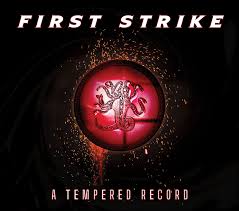
First Strike is probably best described as a compilation album with the talents of Jacob Calta (YouTube/Twitter), Evaleigh (YouTube/Bandcamp), Chillkid (YouTube/Soundcloud), J.V.P. (YouTube/Twitter), and A.C. Pritchard (YouTube/Substack) with Jacob Calta as Producer, Mastering completed by Calta and J.V.P., with Executive Producer, Richard Wilson.

(Disclaimer: I’ve worked with IronAge Media in the past. Whether that makes me biased or not is up to you.)

First things first

I prefer physical media so I tend to buy CDs instead of downloading them as a rule. It may seem silly to discuss a jewel case, but I collect music albums. It’s important to me that the case work as intended and look cool.  

The CD case is smooth cardboard with plastic insert, it includes a song booklet. It’s quality, especially considering the downward spiral most jewel cases have had in the past few years. Is it going to get beat up in the console of my car, are the edges going to get frayed? Yes. But it will hold the CD and the booklet

The album art is pretty slick. I like simplicity in an album cover, especially in something that suggests a wide variety of styles. Also, the symbol of a hydra can’t be overstated—I’m pretty positive that Jacob Calta, the art designer, chose that symbol on purpose. A good choice considering the stated goals of IronAge Media and the Iron Age at large.  

The music

Is First Strike a metal album? Yes. But like I said above, it’s a compilation of talents. There is heavy, pulsing guitar, melodic synth, scream vocals, and most importantly sick guitar solos. Everyone involved has brought their A game.

There are only six songs on the album, so let’s go through them one by one.  

Track 1 – First Strike – Jacob Calta

Track 1 is an instrumental. I found it surprisingly jazzy, with shades of the classic Sonic soundtrack—sort of etheral late 80s, early 90s synth—if that makes sense. There’s a head bobbing urgency to it and a warmth of tone that feels like a classic cape-crusader training montage.

I’ve been getting into synth lately and one of the problems with synth is that, after a while, some of it really starts to sound the same. Juxtaposing a heavy synth instrumental next to a more guitar-heavy rock song is a good call.

This is a great track to start the album off with.  

Track 2 – Power – Evaleigh

Does the Iron Age have an anthem? If not, I nominate Power.

If this song is supposed to be about the little guy, the small-time indie artist, taking on the big corporate music industry, then he’s nailed it. David v. Goliath is a universal tale that is applicable to all kinds of situations, not just the Iron Age.  

“God only knows what I’m doing here tonight” is the kind of lyric I can appreciate. I know that feeling. I still feel it, especially when I burn midnight oil on a Sunday night, hammering out a crappy first draft wondering if anyone will even read what I’ve written or if I’m just wasting time.

The song goes on to suggest that I am not wasting my time, and neither is Evaleigh.

Fantastic little anthem. I love it.  

Tack 3 – the Anvil – Chillkid

I’ve really come to appreciate chillwave synth. Track 3 is very chill, but not a calm chill, an intense chill.

The lyrics are about being “born in fire” and “shaped on the anvil.” I find the irony of a chillwave song about forging by fire and anvil to be deliciously clever. It also has this really cool call-and-response to the lyrics that makes it feel more like a war chant than a typical song.

I think this is a song that grows on you.  

Track 4 – the Wraithsayer – J.V.P.

This instrumental is probably my favorite track. It features a wide variety of synthetic instruments: strings, horns, even an organ, ghost-like chanting. It makes the song feel expansive, like a guitar player with the backing of an orchestra.

The use of organ and bells lends a Victorian eeriness that builds into something epic and heroic. This is the song of a English gentlemen plucking up his courage and taking on the thing that haunts the graveyard.

Weird horror in song. Absolutely love it.

Track 5 – Villainous Wake – A.C. Pritchard

There is not accounting for taste. Unfortunately, I’m not a fan of screaming, gruff, vocals a la Slipknot. That doesn’t mean there aren’t things to like in this song—there are.

The discordant sounding chorus is a very cool effect that matches the lyrics. “I’d rather fly free, than die as a slave. I’ll break from my cage, I’ll rise from the flames. My words are my wings, my shield, my blade, my pleasure, your pain, my villainous wake.” Pritchard casts himself as the villain, and maybe he is? But doesn’t the POV matter?

Not a fan of screamo, but the lyrics are fantastic and J.V.P.’s guitar work is excellent.  

Track 6 – Blow by Blow – Chillkid, A.C. Pritchard, Evaleigh, J.V.P., Jacob Calta

If this album has a B side, then track 6 is it. The weakest of the six tracks, I’m not sure if the problem stems from too many cooks, or if its just the principal that every album must have that one song you can’t vibe with?

Evaleigh and J.V.P.’s guitar work stands out, especially with that plucky guitar work at the 1:40 mark and the solo at the 2:30.

Final thoughts

I honestly had my concerns when I bought this album. I feared that it was going to be like those CDs you buy from the bands who play the bars in Nashville or L.A. But this is a solid album with excellent production and high-quality music.

Even in the song’s I don’t like, I can feel the passion and the care. I believe that these artist like making music and that they want me to like their music too; mutual respect is a part of the titular Iron Age. I feel like I got my money’s worth and that my time wasn’t wasted.

An excellent showing, I recommend it and leave you, appropriately, with lyrics from Track 6:

Flying free into horizons

The moon and stars all fall away

Determination, out instincts guide us

Into a whole new age.   

-Blow by Blow

Don’t forget to check out Anvil Magazine #4, currently available for pre-order!

I write my own weird tales, check them out here and don’t forget to follow me on Twitter/X!

Blog at WordPress.com.

Up ↑