I love the Dragon Age games—I own all the novels, comics, and the cookbook. I am a sucker for this series. I will defend DA2 out of loyalty. I’ve gotten thousands of hours of enjoyment out of the Dragon Age games and I will get thousands more in the future.
In preparation for Veilgaurd, I replayed Origins and 2. I listened to the audiobooks. I reread the comics. I also imposed a content embargo, meaning I didn’t watch or read anything about Veilgaurd and made the decision to go in blind.
Milquetoast, Dull, Tedious, and other Adjectives
Dragon Age 2 catches a lot of flak for “not being an RPG.”
Well, Dragon Age: The Veilguard, saw that and said “hold my lyrium potion.” Or at least it would, if Veilguard had any lyrium potions.
Much like the aforementioned lyrium potions, Veilguard is missing something. The game is polished, pretty to look at, but every time I boot up the game, I leave it feeling intensely unsatisfied, like I’m playing a spin-off and not the actual sequel to Dragon Age Inquisition.
Trying to put words to what’s missing is a staggering challenge, mostly because there are just so many words that qualify.
To put it bluntly, Veilguard commits the greatest gaming sin: it’s really fucking boring.
The game feels cold. Its charmless. Its tedious. The combat is terrible. Thedas feels empty. The environments are pretty, but there’s nothing interesting in them. The characters have vague, almost non-existent motivations. There’s not a single memorable score. Not a single memorable character interaction, villain, or NPC. The companions are uninteresting. There is a general, intense, noticeable lack of tension. Edgeless, clinical, sanitized, Disney-esqe.
Veilgaurd left me asking, with great disappointment: I waited ten years for this?
Would you like to gather your party and venture forth?
For some unidentifiable reason, BioWare made the choice to overhaul Dragon Age’s combat system, turning it into something more akin to “baby’s first souls-like.” It’s toothless and dull, requiring little beyond button mashing. The game helpfully [read: hand-holdy] reminds you whenever your team can complete a combo.
Part of the combat issue, I believe, stems from the collapse of the class system. Picking a class in Veilguard seems to be wildly irrelevant.
Mage class is favorite class in DA. I enjoy controlling the battlefield from a safe distance, setting up elemental based traps, containing the fight, while using my warrior companions to tank, and my rogue to lay on damage—this is the typical set up for most companion-based RPGs.
Veilguard has done away with that. You can only select two companions for your party, which doesn’t seem like an issue in and of itself until you realize that your companions’ abilities are locked behind cooldowns (think Mass Effect).
This means, if you play a mage and you want to draw enemy damage away from you, you must bring Davrin. He is the only companion who can taunt. If you use taunt, you can’t use any of Davrin’s other abilities until taunt completes its cooldown, effectively locking him out of the fight.
Oh, and taunt stops working the moment you strike a target.
When playing as a mage, you spend most of each combat encounter running away because the enemies are always aggroed to you.
The enemies don’t really target your companions, begging the question: why even have companions?
The companions don’t have health bars, they never go down, they teleport to targets only on command, and the player can clip right through them.
Sometimes, I forget the companions are even there, helpfully, the game has them shout out “I’m ready!” “Snipers!” “They have us at range!” to remind me that I’m being haunted by the ghosts of BioWare Past.
As far as I can tell, the companions basic attacks do very little—if any—damage. Rarely do the companions finish off a fight. As the player, I always strike the first blow, and the final, on each and every enemy.
Although simple to understand and even master, the combat system is tedious. You bring two companions who can set up triggers and detonations for high-damage combos—bonus if you also have abilities that trigger and detonate.
The game grinds to a halt while I slog my way through another combat encounter filled with copy-paste enemies that all feel and fight the same. Fighting Qunari feels like fighting darkspawn feels like fighting Ventori feels like fighting demons.
Because the enemies are all the same, there’s no need to change your strategy. Bring the two companions that earns you the “Triple Threat” bonus and then spam those abilities whenever available one enemy at a time. There’s no reason to try and attack multiple enemies at once, each is a sponge. You’re better off focusing on a single target and trying to subtract, one by one, the enemies attacking you.
Just to reiterate—attacking you. The enemies don’t really attack your companions. They’re ghosts. Insubstantial. They don’t even stand in the background of cut scenes.
BioWare has created some of the best companion characters that I know of. Many of them have extremely well-written character arcs, backgrounds, and compelling romances. Garrus from Mass Effect and Alistair from Dragon Age Origins come to mind.
Romance has become a big part of what sets BioWare games apart, although, I think it can be argued that romance has become too much a part of BioWare games. But there is something fun and rewarding about connecting with an interesting character on deeper level, role-playing as their lover, having quiet moments of tenderness with them.
Unfortunately, Veilguard suffers from the same problem that plagued Dragon Age 2. Because your companions are all “pansexual” the friendship feels like romance and romance feels like friendship.
There’s no romantic tension, or there’s an inappropriate underlying romantic tension. Its off-putting and awkward.
It’s the worst of Dragon Age 2’s companions mixed with the worst of Mass Effect Andromeda’s companions. Its lazy writing, it’s unrealistic, its uninteresting.
Never have I played a game with such a roster of milquetoast characters. They are unsubstantial, analogous, hardly even characters. More like an arbitrary addition, grudgingly there because the fandom simply expects them to be.
Not a single companion says anything interesting. Not a one challenges me in a meaningful way or allows me to challenge them. We are like the imaginary characters in a HR Sexual Harassment training course. Mind-numbingly agreeable, belonging only to the dull imaginations of a Human Resource Manager.
Not one character has a defining moment—and why would they? I do all the work, even in their own personal quests.
“I don’t work for the Inquisition.”
For the life of me, I cannot figure out why Rook is involved in the hunt for Solas.
Varric hired me, or I’m on loan from the Lords of Fortune—I genuinely do not know my character’s personal motivations.
There are no personal stakes for Rook, outside of a vague “the world is ending” feeling. You even tell the Inquisitor, the person sworn to stop Solas, that you “don’t work for the Inquisition.”
So why is Rook here? What is the inciting incident that brought Rook to work with Varric in the first place, especially if it’s not because they’re an Agent of the Inquisition?
The Hero of Ferelden was conscripted. Hawke was self-made. The Inquisitor was a victim of fate. Rook is… here?
To illustrate my point, one of your companions, Bellara, asks Rook why they’re “doing all this.” I had three response options: “Someone has too;” “Redemption, I guess;” and, “I don’t know.”
And that just really sums up Veilguard in its entirety. Rook doesn’t know why they’re here, and neither do I.
Veilgaurd doesn’t allow you to craft Rook beyond cosmetics, you can pick their sex, their pronouns, their scars, even add cataracts. But if you’re looking to create an interesting role playing experience, you’re out of luck.
Every response Rook has in every interaction is a slightly different shade of agreeable. There is no room for conflict between you and your companions, no place to disagree, even slightly, when a companion is out of line.
Rook is edgeless, an ineffective middle manager trying desperately to avoid an employee complaint.
Part of my defense of Dragon Age 2 is that you can read the ambition between the lines. Everything about DA2 falls short, but none of it feels shallow, none of it reads like a mass-appeal Pixar flick.
DA2’s serial killer arc doesn’t cinch it, but its implication are brutal; the blood magic that infects Kirkwall is clearly influencing the city, but you’re suspicions are never quite satisfied; Mages are suffering, but so are the Templars, and the game doesn’t do enough to show the player how mutual suffering builds mutual suspicion and mutual hatred.
But at least DA2 felt like a rowdy band of miscreants hunting up trouble, causing problems for themselves and others, sometimes, even without remorse.
Veilguard’s quests are fairly cut and dry. They are complete, they provide further explanations of the lore, they confirm suspicions I’ve had since DA2, some of them are even interesting in the moment, yet I can barely remember them.
The whole game feels shallow, cold, unserious.
It gets worse.
As I completed the game and marinated on my thoughts, one thing became shockingly clear to me.
Everything about Veilguard feels envious and resentful.
At the beginning of the game, you are able to design you Inquisitor and it asks a couple questions about your previous game state. My favorite Inquisitor is a female, human mage, who romanced Blackwall. The background questions don’t even differentiate between the classes of your Inquisitor, despite the fact that being a Mage Inquisitor should have deep implications for the end of the Mage-Templar War.
But that war never gets mentioned.
It gets worse—eventually, you get a letter from the Inquisitor that tells you how Southern Thedas is faring amidst the blight and you learn that Denerim and Redcliffe have been destroyed, Kirkwall has evacuated and ruined. Skyhold is barely holding on. Orlais is fighting Venitori and not answering any of the Inquisitor’s letters.
My heart sunk when I read that Denerim and Redcliffe were destroyed because those are places I care about.
As the Warden, I fought to put Alistair on the throne, to save Redcliffe from the Undead. As Hawke, I put time into cleaning up Kirkwall’s crime-riddled streets. As the Inquisitor, I traveled from Ferelden to Orlais closing rifts, stopping demons, and Red Templars.
Veilguard does not mention any events from the previous games.
Hawke’s name is never stated, despite that Hawke is Varric’s best friend. The last thing we heard of the Warden is that they were at Weisshaupt, yet, the Hero of Ferelden is never mentioned. The Divine is never mentioned. No one discusses the Circles or Templars or the fallout from their war. The Inquisitor, who, at the end of the Trespasser DLC, swore to save or stop Solas has the force of presence of a potato.
The continuity of Dragon Age is gone, destroyed. Shoved aside.
It gets worse—the “secret” ending offers us a glimpse of what BioWare has “planned” for the next entry.
A shadowy organization Inquisition players will immediately recognize as the Executors, have been the dark puppet masters all along. They convinced the Magisters to enter the Fade, they guided Loghain into betraying Ferelden, they whispered to Bartrand about the Idol, they aided Corypheus.
Loghain didn’t come to the conclusion that he must kill Calian in order to save Ferelden from the Orlesian’s. He was manipulated into his actions.
The red lyrium didn’t corrupt and amplify Bartrand’s innate greed—the Executor’s did!
The Inquisitor wasn’t at the wrong place at the wrong time, they, the Divine, and Corypheus were all victims of shadowy machinations!
A lot is said about the hunt for the “modern” audience and the plundering of beloved franchises. I said above that Veilguard feels shallow, but perhaps it’s better to say that its hollow. Like something emptied out of its soul.
Veilguard doesn’t feel so much like soft reboot as it does a message of resentment and envy.
There are two explanations for this: the writers at BioWare are too cowardly to take a shot at creating a different franchise, or the writers at BioWare resoundingly resent their predecessors.
Neither explanation is nice, neither is how I want to feel; but cowardice can be forgiven. Resenting the story, resenting the choices, resenting the players—that’s not something that’ll induce me to give them another shot.
Conclusion
Enough digital ink has been spilled regarding wokeness and Dragon Age and I have no intention to add to it, other than to note that “wokeness” is an excuse. It’s a crutch used by both sides to obfuscate legitimate criticism.
Veilguard has more problems than an uncomfortable discourse about identity.
Veilguard is poorly written, the combat is unfun, and the story is disjointed and hollow, its characters are limp and insubstantial, it had none of the charm I associate with Thedas, it utterly disregards the former entries and hopes you don’t notice—trust me, you’ll notice.
To paraphrase G.K. Chesterton: a good story tells us the truth about its hero. A bad story tells us the truth about its writer.
The truth that Veilguard tells me about its writers is unbelievably disheartening.
I don’t recommend Veilguard, not even for hardcore Dragon Age fans like me.
Things I liked
There’s actually a reason why dragons need to be hunted and slain.
Manfred.
Complaints I couldn’t include above
The HUD is terrible. The menus system is clunky.
The enemies are just copy-paste reskins of each other. They all fight the same, have the same abilities. There is no variety of peril.
Classic enemy types have been redesigned. Enemies are indistinct from each other. The darkspawn are cartoony and visually bland.
There’s a surprising lack of grim-dark in my grim-dark fantasy game. Tevinter has been hyped up as the evil empire and yet it has zero implications for the plot and you wouldn’t even know they practice slavery if an NPC didn’t tell you.
Lacks the small, charming elements I associate with Dragon Age: no Elfroot to pick, no lyrium potions, hardly a mention of the extremely poetical Chant of Light, “would you like to gather your party and venture fourth?”, bees.
Solas is wasted as a villain.
Varric’s death is cheap and leads me to believe that he was used as a lure to old fans.
I’ve gotten more enjoyment out of making fun of this game than actually playing it.
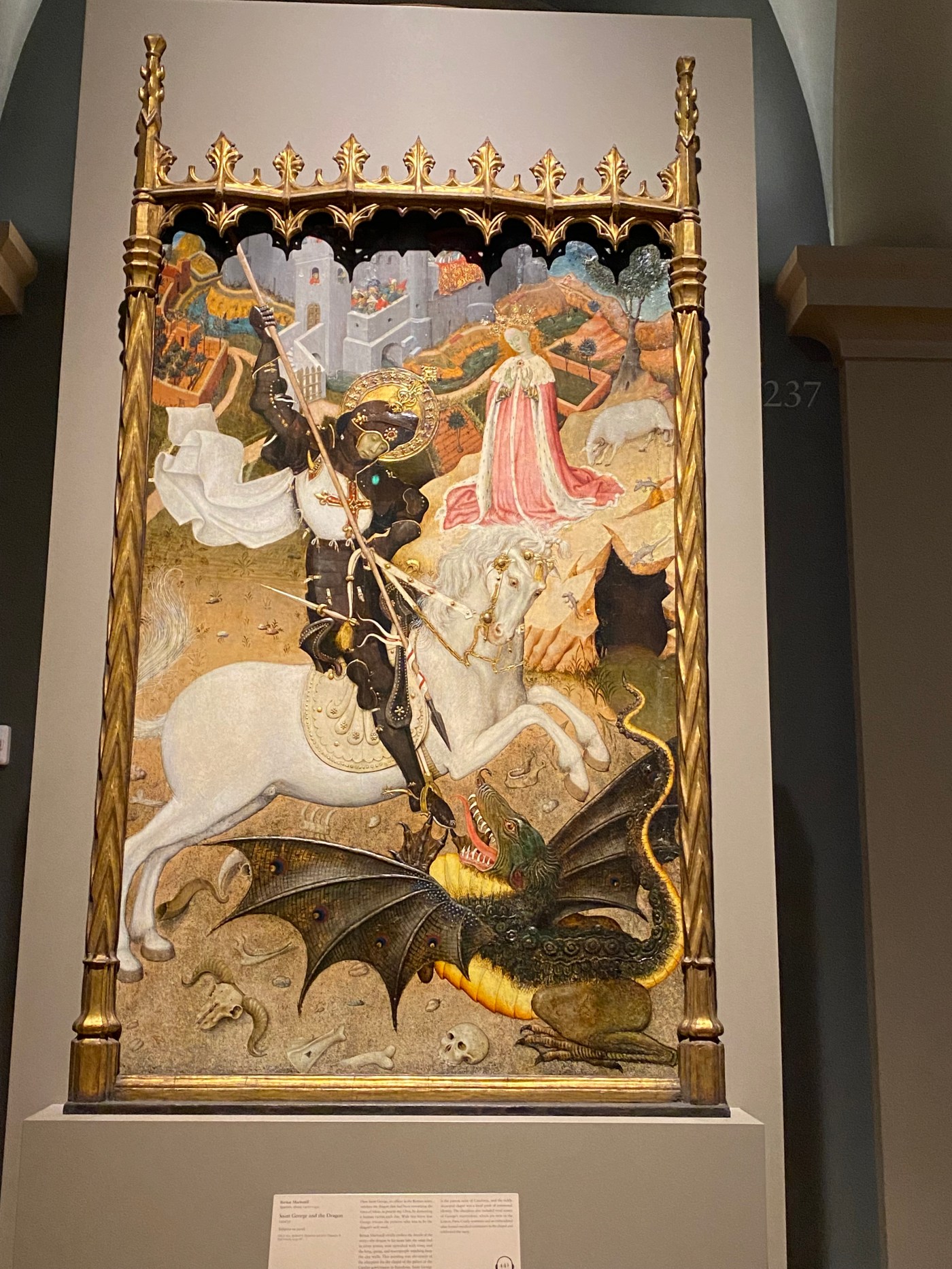
ABOVE: Saint George and the Dragon. Bernat Martorell, Catalan, d. 1452. Tempera on panel. A picture I took at the Art Institute of Chicago, it is most impressive in person.
 The Salon at Elfland
Leave a comment