I love notebooks—I think every writer loves notebooks. There’s something about a virgin piece of paper and the unbent binding that beckons the writer onto some adventure. It becomes a new companion. A friend, a lover. Someone to whom we pour out a best and silliest ideas. Some of it is useful, some of it is forgotten. The rest is chaff, the nonsense we jot down for kindling in the furnace of the imagination.
If you’re like me, you rarely—if ever—finish out that notebook. The paper yellows, the spirals bend, the corners crease, and it takes up space in a closet. Half-used, half-remembered. Sometimes I stumble upon an old notebook and thumb through it, grinning at the little spark that become that story or that poem or got reworked into a greater whole.
I collect those bits and add them into a binder or another notebook. The rest, like I said above. Is chaff. I don’t discard it because it was useful when I put it down, but I’ve outgrown the idea. I still respect it.
A few years ago, I came upon the Latin word “Florilegium.” Or, “a gathering of flowers.”
Medieval Scholars kept a kind of commonplace book, a literal notebook collection of Scripture, Patristic sayings, ideas, etc. for the purpose of writing Sermons. They called these books Florilegium.
This got me thinking.
First, what a wonderful concept—gathering flowers. And gathering flowers, not to destroy a lovely growing thing, but the kind of metaphysical flower we call Wisdom.
Secondly, there are so many kinds of flowers. Why stop at wisdom? Why not pick one because I think it’s pretty? Or because it means something to me? Or because the aesthetic is something so powerful I must collect it with the hope of planting something half that brilliant?
Thirdly, I began to wonder what would happen if I finished one of those notebooks? As in used up all the paper, front to back?
To make sure I actually accomplished this massive feat, I bought a nice notebook. Its leather bound with cream colored lined paper, and personalized with my name and the book’s title: Florilegium, “a gathering of flowers.” I then bought a fountain pen. If I was going to do this, I wanted to do it as ritualistically as possible. I wanted to make it a devotion.
My first entry tells you a little about where I was when I first began gathering flowers.
“…I believe; help my unbelief!”
Mark 9:24
There are parts of this volume (there are two at the time of writing this post) that I can read and feel a wash of memories. There are others that are there because I like them.
Some hold a rich degree of meaning to me:
I am in a sea of wonders. I doubt; I fear; I think strange things which I dare not confess to my own soul. God keep me, if only for the sake of those dear to me!
Bram Stoker, Dracula
Others are for pure aesthetics:
Paul-Muad’Dib remembered that there had been a meal heavy with spice essence.
Frank Herbert, Dune
The more I think on these flowers, the more I see a collage of the writer I want to be.
My handwriting grew sloppier the more I used the book, not because it became a burden, but because I had so much to write down. I dumped the fancy pens and went for whatever pen I had at hand.
This bouquet has become personal to me. The casual reader would find something deeply intimate, and yet come away knowing hardly anything about me. Some of the quotes connect to thoughts, others seem so jarringly out of place that the ideas may appear schizophrenic.
Only I know what Mona Lisa Overdrive has to do with Christ Jesus. Only I know why Chesterton’s work sits next to Frank Herbert’s or why the Spiritual Combat takes up a majority of pages, why I only quote my favorite novel once.
I don’t need anyone to see the pattern—if there even is one. I read what comes to me, what seems fun and profitable as I find it. I collect what I like or what makes me think or what I think sound cool.
And that is why I think a commonplace book is good practice. Not just for writers, but for people. As a purely human exercise.
You don’t even have to read to keep one. Movies, or TV, or friends, have just as much to say to us as anything else. Hell, you don’t even have to keep a book! A blog is just as useful, or just a text sheet on your computer.
The only thing I think you shouldn’t do it make any kind of order of it. Pick flowers as you come upon them. Try it for a year, I think you’ll find that what you thought was a bouquet of cut flowers, is actually a healthy, growing garden.
Here’s where you can read me!
Follow me on Twitter/X.
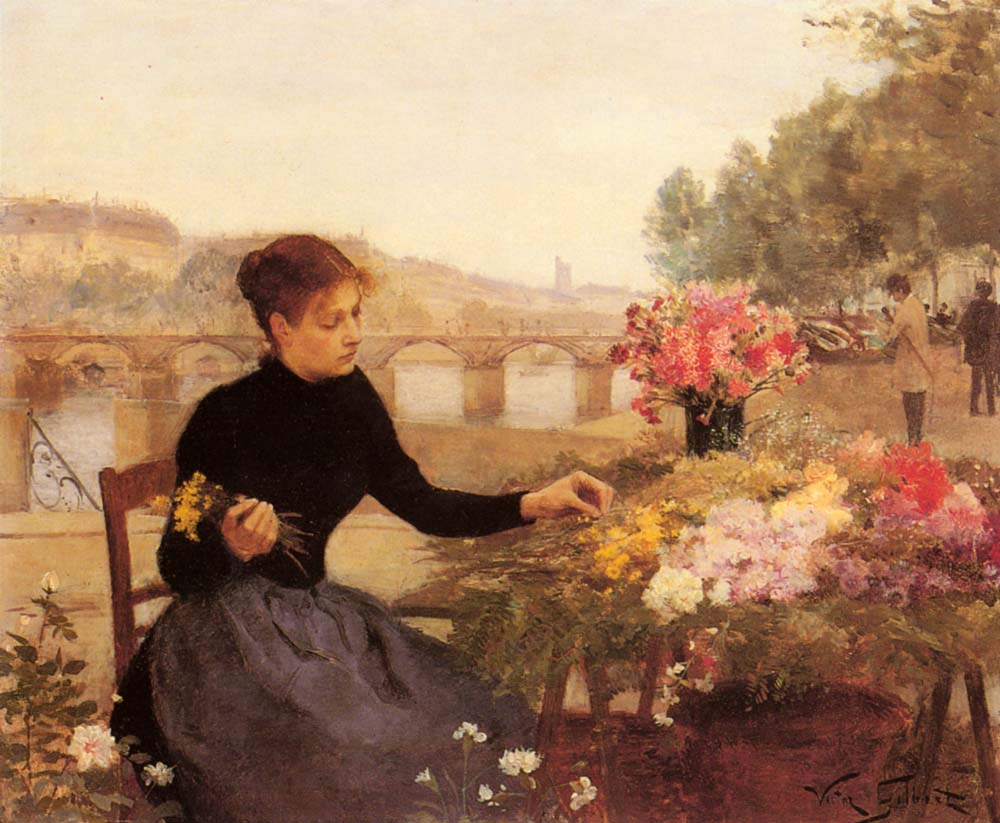
Above: A Parisian Flower Market. Oil on Canvas. Victor Gabriel Gilbert 1847-1933. French.
 The Salon at Elfland