Sun Tzu’s Art of War
Sometimes research can be overwhelming. If you’re a writer who finds themselves intimidated by ancient texts, made easily bored by history, or just simply aren’t interested in a specific research topic, you’re not alone. But the simple fact is, as writers, we have a responsibility to relay interesting worlds, ideas, and characters. While a diet of pure fiction is enough to spark imagination, non-fiction helps us to better understand our topic.
Writer’s Must Read is my attempt to offer a map of non-fiction works that I believe have helped me become a well-rounded writer. The range in topic from history (okay, mostly history), to philosophy, to psychology, and even advice manuals.
The Art of War by Master Sun Tzu is something like all-of-the-above. It’s a fantastic piece of written history as well as a treatise on the philosophy of warfare. It covers a very early concept of war psychology, and of course, its main premise is that by following Master Sun, the reader will claim victory in war.
Chinese history is vast and filled to the brim with bloody conflict. Sun Tzu was probably born in the Easter Zhou Period of China; sometime before the Warring States Period. He served as a general and strategist for King Hëlu in the 6th Century BC. He would write The Art of War during this time.
“Warfare is the greatest affair of state, the basis of life and death, the Way (Tao) to survival or extinction. It must therefore be thoroughly pondered and analyzed.”
[Sun Tzu The Art of War Ch. 1 Initial Estimations, Sawyer translation]
From it’s first sentence, Master Sun makes it abundantly clear what his treatise is about. In the violent turbulence of the Zhou Period, victory is war is the knife’s edge between life and death.
“Warfare is the Way (Tao) of deception. Thus although [you are] capable, display incapability to them. When committed to employing your forces, feign inactivity. When [your objective] is nearby, make it appear as if distance; when far away, create the illusion of being nearby.”
[Sun Tzu The Art of War Ch. 1 Initial Estimations, Sawyer translation]
Master Sun lays out his goal and his main premise within the first chapter of his treatise. The Art of War is not a long book by any means, but it’s dense in content. It’s chock full of advice and observations that are stilled studied and relied upon today by modern armies the world over.
But why is any of this relevant to a writer of fiction?
War is a human experience; no culture has ever escaped war and no culture ever will. It is fertile writing ground. Blood is a terrible ink, yet war remains one of the most useful and popular plot devices.
War is hell, this is true, but the men who fight it are far from devils. All men fight for their own reasons and in their own ways and while it’s easy for a writer to explain why a character is fighting, but I’ve seen some writers struggle with the ways men fight. Sometimes making ridiculous blunders that rip readers out of their suspension of belief. I believe many of these misbegotten ideas come from the way war is portrayed on TV.
Now, there’s plenty of wiggle room in fiction, and there should be. If a story is good, no one will notice small tactical blunders (supply lines, trenches, reinforcement). However, when a writer sets out to write a large set-piece battle, it’s easy to fall into the belief that two opposing sides will simply line up and crash their armies together like children with dolls. While that has certainly happened in the annals of history, the vast majority of warfare is fought in much the way Sun Tzu outlines in his treatise.
For example, in Chapter 3 Planning Offensives, Master Sun says:
“Thus the highest realization of warfare is to attack the enemy’s plans; the next is to attack their alliances; next to attack their army; and the lowest is to attack their fortified cities.”
[Sun Tzu The Art of War Ch. 3 Planning Offensives, Sawyer translation]
What Master Sun is saying here is simple. In warfare, the optimal way to defeat an enemy is to attack his plans or his allies. That is, politics, espionage, sabotage—trickery. The next best way to fight your enemy army to army; ambushes, hit-and-runs, plundering villages/towns. The worst way, Master Sun says, is siege warfare. In fact, he goes on to say the “tactic of attacking fortified cities is adopted only when unavoidable.” [Sun Tzu The Art of War Ch. 3 Planning Offensives, Sawyer translation]
History shows that siege warfare is the worst kind of warfare. At the height of the Middle Ages, fortified stone castles were extremely common. Siege warfare—long, grinding, battles of attrition set before stone walls was the order of the day. Those inside the castle may be safe from the swords and spears of the besiegers, but supplies will be limited. You might be able to wait them out, or you can hope to break the siege and launch a successful sortie or pray your allies (if you have any) arrive in time to crush the besiegers against the castle walls and drive the enemy off. Your soldiers will have to work in constant shifts in order to keep watch for the dangers of siege weapons, wall climbers, sappers, and spies.
But the besiegers will also have their own supply issues and a general must always keep in mind that his non-professional soldiers will be looking to go home ASAP in order to plant/harvest crops. Lack of water and sickness become serious problems for both sides; food goes bad, men die of dysentery and fever, or are mangled in engineering accidents and useless attacks against the walls. Morale sags. There are defectors and deserters on each side.
With all this in mind, any writer can see how this is fertile ground for storytelling. But they should know that it’s the worst way to fight war. Seeing characters ply each of Sun Tzu’s strategies only to wind up fighting a crushing siege is far more interesting than reading about them blundering onto a 100-yard field to clash swords and spears.
Don’t get me wrong, that can be interesting but battles were hardly fought that way and they typically devolve into high casualties for little reward. Sun Tzu says: “attaining one hundred victories in one hundred battles is not the pinnacle of excellence. Subjugating the enemy’s army without fighting is the true pinnacle of excellence.” [Sun Tzu The Art of War Ch. 3 Planning Offensives, Sawyer translation]
Master Sun goes on to give advice on things like morale, espionage, and terrain. He warns of leaders who interfere too much with the actions of generals. In one potent elucidation he notes the five dangerous character flaws in generals:
“One committed to dying can be slain. One committed to living can be captured. One [easily] angered and hasty [to act] can be insulted. One obsessed with being scrupulous and untainted can be shamed. One who loves the people can be troubled.”
[Sun Tzu The Art of War Ch. 8 Nine Changes, Sawyer translation]
The martyr will seek out his martyrdom; the coward will turncoat; the prideful fool will blunder; the glory hound will be too timid. The overly compassionate will commit to lost causes. These are interesting ideas to play with. Not every general character will make mistakes because he’s a prideful idiot. Maybe your protagonist is overly concerned with the lives of villagers? While wanting to protect the weak and save the innocent is commendable, victory demands meat for the grinder, and sometimes a terrible calculation needs to be made. There’s a great story in that tension.
If you want an example from fiction, look no further than Ned Stark of A Song of Ice and Fire. Stark was blinded by his obsession with honor and right-doing. Concerned with the possibility of shame and dishonor, he is neatly dealt with by the less scrupulous. What a boring character Ned would have been had he decided to be a hot-head and died charging into the Red Keep?
Sun Tzu’s Art of War is not the place to stop when it comes to studying warfare, but it is the place to start. If you’re looking to level up your writing, especially when it comes to war and tactics, the Art of War is an accessible and enjoyable read. There are dozens of translations, even a graphic novel if you feel that pictures would help you understand the concepts laid out. No prior knowledge is needed to understand it and it will improve your writing, from your generals, to your kings, to your CEOs, and politicians.
I believe that Sun Tzu’s Art of War is a must read for all writers.
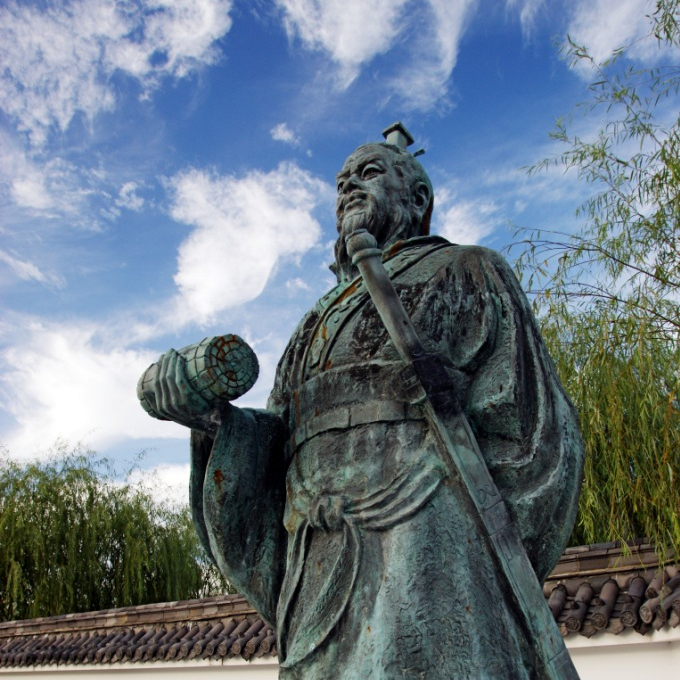
Above: statue of Sun Tzu, Chinese style gardens in Japan. Enchō-en (燕趙園) are located in Yurihama, Tottori Prefecture, Japan.
 The Salon at Elfland